Whitening Toothpaste for Coffee and Wine Stains in Japan

Reviewed by Dr. Ryosuke Murai, DDS, MSD — Prosthodontist, trained at Indiana University School of Dentistry (U.S.). Last updated November 2026.
Coffee, tea and red wine are part of life in Nagoya, and so is the question that follows them: can a whitening toothpaste lift the stain, or is something more planned needed? The short answer from recent laboratory research is that whitening toothpastes can remove surface stain from coffee, tea and wine, that the right type depends on how deep the stain sits, and that abrasive formulas can roughen enamel in some conditions. This guide sets out what the studies show and where toothpaste stops being the right tool, for English-speaking patients in Nagoya and elsewhere in Japan who prefer a considered, private approach to their smile.
What the laboratory studies found
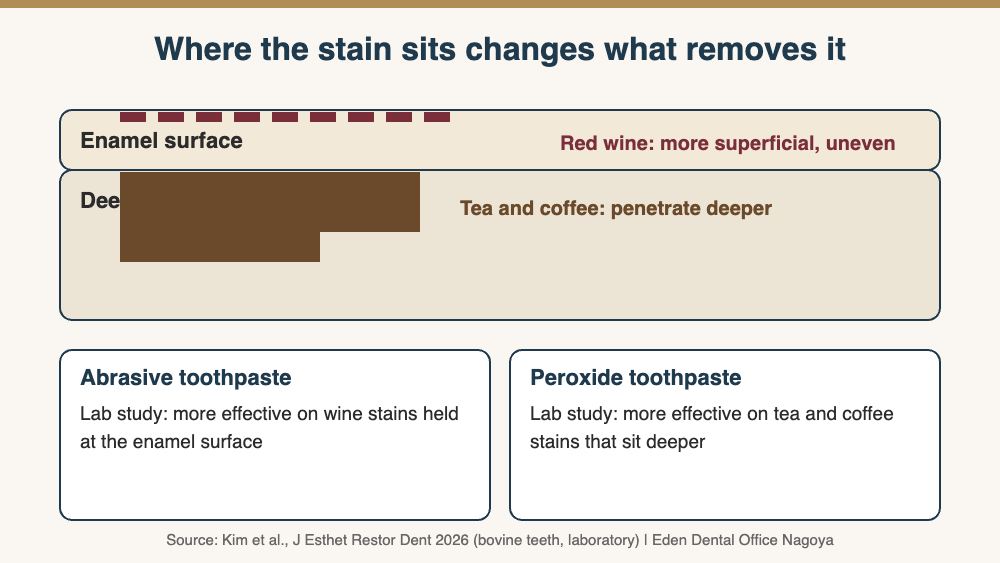
Three 2026 laboratory studies looked at whitening toothpastes on stained enamel. In a bovine-tooth study in the Journal of Esthetic and Restorative Dentistry (PubMed 41359870), ninety teeth were stained for seven days with black tea, coffee or red wine and then brushed for 10,000 cycles. Abrasive toothpastes were more effective on wine stains, which were superficial and uneven, while a hydrogen peroxide toothpaste was more effective on tea and coffee, which penetrated more deeply. Surface roughness rose most in the wine-stained specimens.
A second study in the American Journal of Dentistry (PubMed 41785027) used 130 bovine incisors and reported that two whitening toothpastes removed coffee and wine stains effectively, but that one of them increased enamel roughness on wine-stained samples. The authors concluded that clinicians should weigh whitening benefit against possible enamel damage. A third, on human incisors (PubMed 42013427), found that bromelain-containing toothpastes improved colour after coffee staining without a significant roughness increase.
These are laboratory studies, mostly on bovine teeth, using a small number of products and short brushing protocols. They show what can happen to a stained surface under controlled conditions. They do not show how a particular toothpaste will perform in your mouth over months, and they do not measure sensitivity or gum response.
Surface stain and deeper colour are different problems
The studies are useful mainly because they separate two ideas that are often mixed together. Extrinsic stain sits on or in the outer enamel and comes from what we drink, from smoking and from plaque. Intrinsic colour sits within the tooth and reflects its structure, its age and its history. A toothpaste, whichever kind, works on the first. It does not change the colour of dentin, and the findings above apply to stain, not to the underlying shade.
| Approach | What it addresses | Points to weigh |
|---|---|---|
| Abrasive whitening toothpaste | Superficial stain such as wine | Roughness increased in some lab conditions |
| Peroxide whitening toothpaste | Deeper tea and coffee stain in one study | Limited contact time; effect depends on the product |
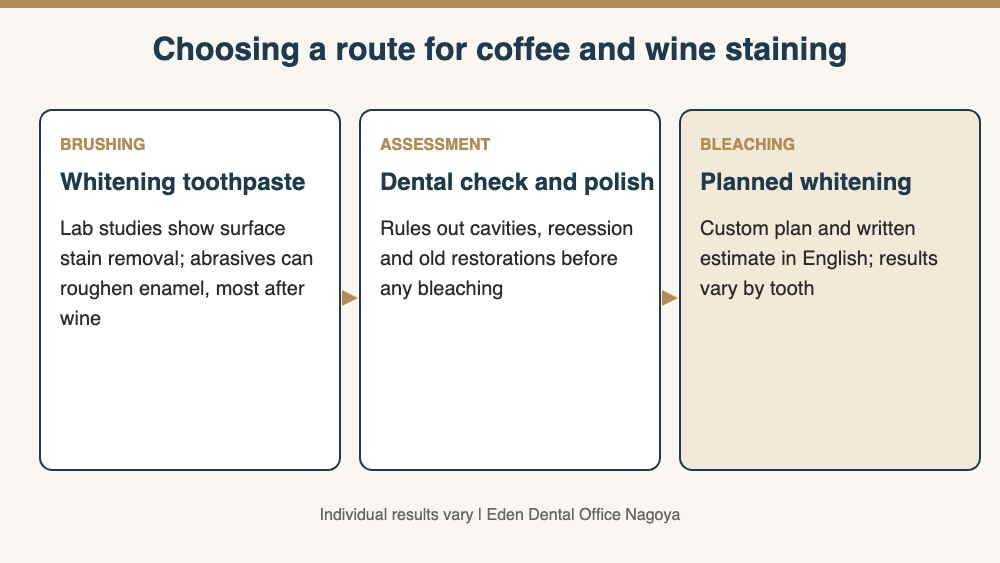
| Check-up and polish | Plaque, tartar and surface stain | Also screens for cavities and gum problems |
| Planned whitening | Shade of the tooth itself | Needs assessment; sensitivity is possible |
For the difference between a polish and a bleaching treatment, see our note on whitening versus cleaning.
Using toothpaste sensibly
If you choose a whitening toothpaste for everyday use, a few habits keep the risk low. Use a soft brush and light pressure, because the abrasive effect in the laboratory protocols came from repeated, mechanical brushing. Avoid brushing straight after acidic drinks such as wine, since enamel is briefly softer, and rinse with water first. Do not combine several abrasive products, and stop and ask us if your teeth become sensitive or the surface feels rough. These are practical habits and not findings of the studies above, which did not test them.
Why the drink matters
The depth finding explains something patients often notice for themselves. Red wine tends to leave a surface tint that responds to polishing and to abrasive brushing, while tea and coffee, which are consumed more often and in smaller sips throughout the day, can leave stain that sits further into the enamel and is harder to remove by brushing alone. That is also why stain from a daily habit tends to come back faster than stain from an occasional event. If you drink several cups a day, it is worth planning around the habit and not only around the stain, for example by rinsing with water afterwards and keeping regular professional cleans, so that surface colour does not build up between visits.
If you have just finished a whitening session, the question is slightly different: whether these drinks reduce the result while it develops. Clinical studies on the so-called white diet are summarised in our article on eating after whitening.
When toothpaste is not the right step
Stain that returns within days, colour that is grey or uneven, a single tooth that looks darker than the rest, or staining around crowns and fillings are all signs that the cause may not be a drink. Restorations do not change colour with bleaching, as we explain in our guide to whitening with crowns, veneers and fillings. Exposed roots and receding gums also stain differently and are more sensitive. A short examination can separate these cases from ordinary surface stain, and our overview of teeth whitening in Japan explains what a planned course involves.
How we approach staining at Eden
At Eden, Dr. Murai begins with an examination and a professional clean, so that surface stain is removed and the true shade of the teeth can be seen. If whitening is appropriate, we plan it in relation to your enamel, any restorations and your sensitivity, and we compare the options set out in at-home and in-office whitening. Appointments are by reservation and unhurried, the plan and estimate are given in writing in English, and one prosthodontist looks after you from the first visit. Questions about enamel are covered in whether whitening damages enamel, and about comfort in tooth sensitivity after whitening. You can read more about the clinic on the About page.
What it costs
The first visit is ¥15,000, the check-up package is ¥40,000 and the whitening package is ¥75,000. Anything beyond these is quoted after assessment as a written estimate in English before treatment begins.
Frequently asked questions
Do whitening toothpastes remove coffee and wine stains?
In laboratory studies on extracted or bovine teeth, whitening toothpastes removed extrinsic coffee, tea and wine stains. Results depended on the stain and the toothpaste, and these were not studies of patients over time.
Can whitening toothpaste damage enamel?
One laboratory study found that an abrasive whitening toothpaste increased surface roughness on wine-stained enamel. Others found no significant roughness difference, so the effect depends on the product.
Which works on tea and coffee, abrasive or peroxide toothpaste?
In a 2026 laboratory study, peroxide toothpaste worked better on tea and coffee stains, which penetrated deeper, while abrasive toothpaste worked better on superficial wine stains.
Will toothpaste change the natural colour of my teeth?
Toothpastes are mainly studied for removing surface stain. Changing the underlying shade is a different goal that is assessed and planned individually.
When should I see a dentist about stained teeth?
If staining returns quickly, is uneven, or you also notice sensitivity or gum changes, a check and polish is the sensible first step before any bleaching is planned.
Risks and limits
Whitening products and treatments can cause tooth sensitivity and gum irritation, and abrasive products can wear or roughen enamel with heavy or prolonged use. The studies cited are laboratory studies on bovine or extracted human teeth and do not predict individual outcomes. Whitening does not change the colour of crowns, veneers or fillings. Individual results vary.
To arrange a first visit, message the clinic on WhatsApp or call 052-265-8996.
More on this topic: Whitening Guides — every article we have published in this cluster, grouped by stage.