Does Teeth Whitening Damage Enamel? Evidence for Japan
Reviewed by Dr. Ryosuke Murai, DDS, MSD — Prosthodontist, trained at Indiana University School of Dentistry (U.S.). Last updated October 2026.
Does teeth whitening damage enamel? For professionally supervised peroxide whitening, the published reviews say the effect on enamel is small at most, and not clearly meaningful in practice, while temporary sensitivity and gum irritation are the effects people actually notice. This article sets out what the systematic reviews measured, where their limits are, why the answer depends on how whitening is done, and what a dentist checks before starting. It is written for patients in Japan or planning treatment here who want the evidence rather than a reassurance.
What the evidence actually measured
Three kinds of evidence are often blended together online, and separating them avoids most of the confusion. Clinical trials follow real patients and record shade change and side effects. Laboratory studies treat extracted teeth with bleaching gel and then measure surface hardness or roughness. Reviews pool both. Each answers a slightly different question.
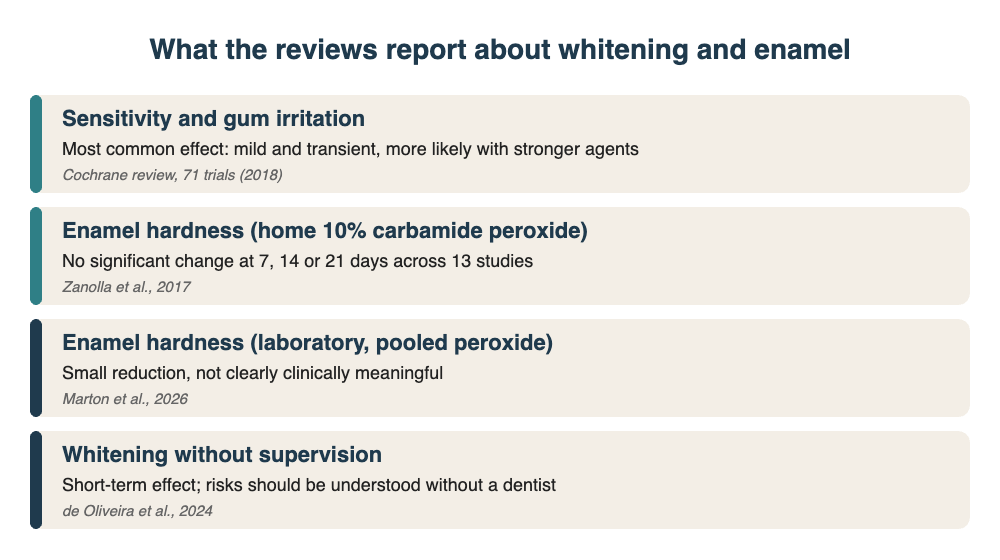
On side effects in patients, a Cochrane review of 71 trials of home-based whitening, including dentist-dispensed and over-the-counter products, found that tooth sensitivity and oral irritation were the most common side effects, were more frequent with higher concentrations of active agent, and were mild and transient. The same review rated the certainty of its evidence as low to very low and said it could not name a superior product or protocol (Eachempati et al., Cochrane Database Syst Rev 2018).
On enamel itself, a meta-analysis of 13 studies of home bleaching with 10% carbamide peroxide found no significant change in enamel microhardness over 7, 14 or 21 days (Zanolla et al., Aust Dent J 2017). A newer meta-analysis of laboratory studies pooled hydrogen and carbamide peroxide and did find a small reduction in hardness. The authors concluded the change was sensitive to individual outlier studies, showed no clear evidence of a clinically meaningful effect, and that peroxide bleaching appears unlikely to cause clinically meaningful harm to enamel when used according to recommended protocols. They also noted that these were laboratory findings and called for more standardized measures (Márton et al., J Dent 2026).
| Question | What the reviews report | How firm is it |
|---|---|---|
| Does whitening cause sensitivity? | Yes, commonly; mild and temporary, higher with stronger agents | Low to very low certainty (Cochrane) |
| Does home 10% carbamide peroxide soften enamel? | No significant change in hardness over 7 to 21 days | Meta-analysis of 13 laboratory studies |
| Does pooled peroxide bleaching soften enamel? | Small reduction, not clearly meaningful; sensitive to outliers | Laboratory studies only |
| Do over-the-counter products work? | Yes in the short term, with a caution about unsupervised use | Network meta-analysis, low-level evidence |
Why “how” matters more than “whether”
The reassuring findings above come from products used as directed. They do not describe every product or every habit. A network meta-analysis of 37 studies on over-the-counter bleaching found satisfactory short-term results compared with placebo, with little to no impact on dentin sensitivity and gum irritation, but it rated the evidence as low and advised that people should be told about the risks of whitening without professional supervision (de Oliveira et al., Clin Oral Investig 2024).
In practice the variables that change risk are concentration, how long the gel stays on the teeth, how well the tray or strip fits, and the starting condition of the tooth. Gel that leaks onto gums irritates them. Gel applied over a cavity, a crack or exposed root surface reaches the nerve more easily. These are the reasons a clinic examines the mouth first, and they are also why we do not give a single “safe” number of sessions: trials are short and varied, so no evidence-based interval exists.
What we check before whitening
Our whitening visits start with an examination, not with gel. We look for untreated decay and cracks, exposed root surfaces, gum inflammation and the state of existing restorations. Crowns, veneers and fillings do not change color with peroxide, so we plan the order of treatment around them; our guide to whitening with crowns, veneers and fillings explains how. Patients with a history of strong sensitivity are guided through the steps in our article on sensitivity after whitening.
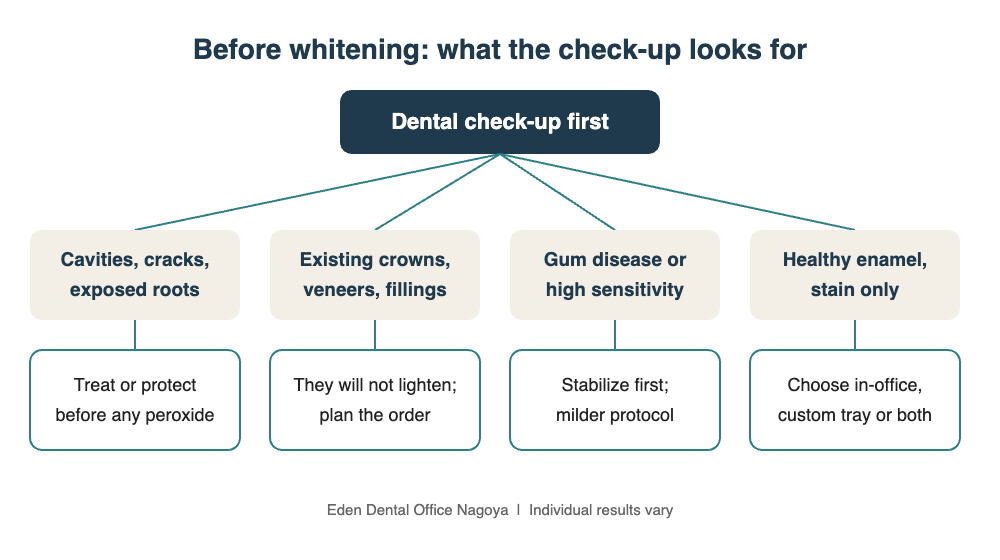
Teeth that pass this check can be whitened in the clinic, with custom trays at home, or with a combination, and the choice depends on how quickly you want a change and how your teeth respond. Custom trays are made to fit your teeth closely, which limits gel contact with the gums. The full range of options and fees is in our teeth whitening in Japan guide, and the difference between removing surface stain and changing the shade of the tooth is covered in whitening or cleaning: which removes stain.
What this costs and how long it takes
The whitening package on our fees page is ¥75,000, and a check-up package is ¥40,000; the fees page lists current figures, and any additional treatment found necessary at the examination is quoted separately in writing in English before it begins. The number of visits and days depends on the route chosen and how your teeth respond. How long the result holds depends on your diet and habits, which we discuss in how long whitening lasts. Patients visiting from overseas can arrange the examination and whitening within one trip, and the practical steps are in our guide to a dental treatment trip to Nagoya.
For the related question of whether lamps or lasers add benefit or risk, see light-activated whitening in Japan.
Frequently Asked Questions
Does teeth whitening damage enamel?
Laboratory reviews report at most a small change in enamel hardness that is not clearly clinically meaningful, and a meta-analysis of home 10% carbamide peroxide found no significant change. Sensitivity is the effect people actually notice.
Is professional whitening safer than strips?
Reviews show over-the-counter products can lighten teeth in the short term, but they advise that users should understand the risks of going without professional supervision. A check-up beforehand is the main difference.
Can I whiten if I already have sensitive teeth?
Often, with a gentler protocol. Cavities, cracks and exposed roots should be treated first, and a desensitizing plan is usually part of the process.
How often can I whiten my teeth?
There is no single evidence-based interval. Trials are short and varied, so frequency is set by your dentist from how your teeth respond rather than by a fixed calendar.
Does whitening hurt the gums?
Gum irritation is a recognized, usually mild and temporary effect, and it is more likely with stronger products or poorly fitting trays.
Risks, limits and what to expect
Whitening commonly causes temporary sensitivity to cold and sometimes irritation of the gums, and both usually settle after treatment stops. It does not lighten crowns, veneers or fillings, and results differ according to the cause of discoloration: age-related yellowing responds more readily than gray banding or a single dark tooth. The evidence summarized here is largely short-term, includes laboratory studies that do not fully reproduce the mouth, and is graded low in certainty by the reviewers themselves, so it supports “unlikely to cause meaningful harm when used as directed” rather than “no effect on teeth.” Individual results vary.
If you would like your teeth examined and a whitening plan explained before committing, a consultation is the right first step. We give a written estimate in English, and you can reach the clinic on WhatsApp. Our whitening page sets out the service, and the guide to whitening during clear aligner treatment helps if orthodontic treatment is also planned.
More on this topic: Whitening Guides — every article we have published in this cluster, grouped by stage.