
Dental Implant Maintenance Cost in Japan: The 10-Year View
Reviewed by Dr. Ryosuke Murai, DDS, MSD — Prosthodontist, trained at Indiana University School of Dentistry (U.S.). Last updated July 2026.
Ten years after surgery, the difference between an implant that still looks like the day it was fitted and one heading for retreatment usually comes down to maintenance. Dental implant maintenance cost in Japan is modest compared with the surgery itself — typically a professional check-up and cleaning cycle two to three times a year, plus occasional small repairs — but it is a real line in the lifetime budget, and most cost guides ignore it entirely. This article lays out what a well-maintained implant asks of you over a decade: the appointment schedule, what those visits involve, what breaks and what fixing it entails, and how clinic warranties actually work. It is written for self-pay patients anywhere in Japan who are planning implant treatment and want the full ten-year picture, not just the invoice for year one.
Why an implant needs maintenance at all
An implant cannot get a cavity, which leads some patients to conclude it needs no attention. The tissue around it disagrees. The gum and bone surrounding an implant are vulnerable to plaque-driven inflammation, in two stages: peri-implant mucositis, a reversible inflammation of the soft tissue, and peri-implantitis, a deeper process that destroys supporting bone and can end in implant loss. The clinical consensus is blunt on this point: managing mucositis early through professional plaque removal is the primary prevention of peri-implantitis (Jepsen et al., Journal of Clinical Periodontology, 2015).
Professional maintenance matters precisely because the research shows there is no shortcut. A systematic review of treatment protocols found that once inflammation is established, adjunctive measures — antiseptics, antibiotics — add little beyond mechanical professional cleaning, and complete resolution is not always achieved (Schwarz et al., 2015). In other words, prevention on a schedule is cheaper and more reliable than rescue. That is the entire economic logic of implant maintenance.
The 10-year schedule, and where the money goes
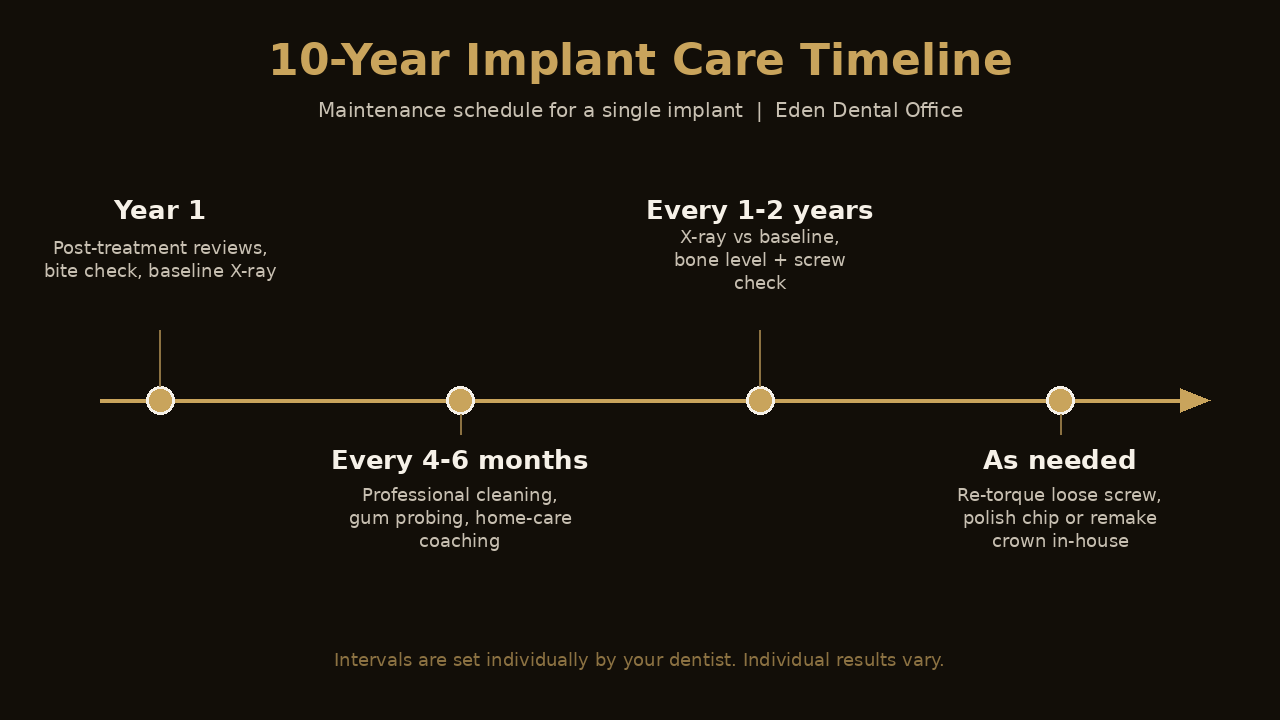
A typical maintenance decade for a single implant in a stable mouth looks like this. Frequencies vary with your gum health, smoking status and home care — your dentist should set the interval, not a brochure.
| Period | What happens | Cost character |
|---|---|---|
| Year 1 | Post-treatment reviews, bite check after the bone and gum settle, baseline X-ray of the implant | Often included in the treatment fee — confirm this when you compare what an implant quote includes |
| Every 4–6 months, years 1–10 | Professional cleaning around the implant, probing of gum pockets, oral hygiene coaching | Recurring self-pay visits; at Eden these are covered within an annual membership (¥88,000–¥288,000/year) or booked as a comprehensive check-up package (¥40,000) |
| Every 1–2 years | X-ray comparison against baseline to confirm stable bone levels; screw-tightness check | Usually folded into the check-up visit |
| As needed | Small repairs: loose screw re-torqued, chipped porcelain polished or crown remade | Case-by-case; a written estimate in English before any work |
Two things are worth noticing. First, the recurring cost is essentially the cost of excellent routine dentistry — the implant rides along with the check-up you should be having anyway. Second, because implants placed as self-pay treatment are maintained as self-pay treatment, none of this runs through Japanese health insurance; if that framework is new to you, our guide to how insurance treats implants in Japan explains the boundary in detail.
What actually breaks, and what repair involves
Over ten years, the fixture — the titanium root itself — is rarely the problem when maintenance has been consistent. The mechanical events cluster in the parts you can see. The most common is a loosened abutment screw: the crown feels slightly mobile, and the fix is to access the screw and re-torque it to the manufacturer’s specification. Next is porcelain chipping on the crown, more likely in patients who clench or grind. A small chip can often be polished; a larger fracture means remaking the crown, which is a laboratory event, not a surgical one.
At Eden, this is where our in-house digital laboratory changes the arithmetic. Every implant we place is documented at surgery — Straumann BLX or TLX reference numbers, insertion torque in Ncm, and the full digital scan of the finished crown. If that crown chips in year six, we do not start from zero: the stored design file goes back to our own milling and 3D-printing equipment, and the remake is produced under the same roof rather than through an external lab’s queue. Patients who travel to us from Tokyo or overseas feel this difference most, because fewer round trips are needed; the same logic that enables treatment trips from other cities applies to repairs.
How implant warranties in Japan really work
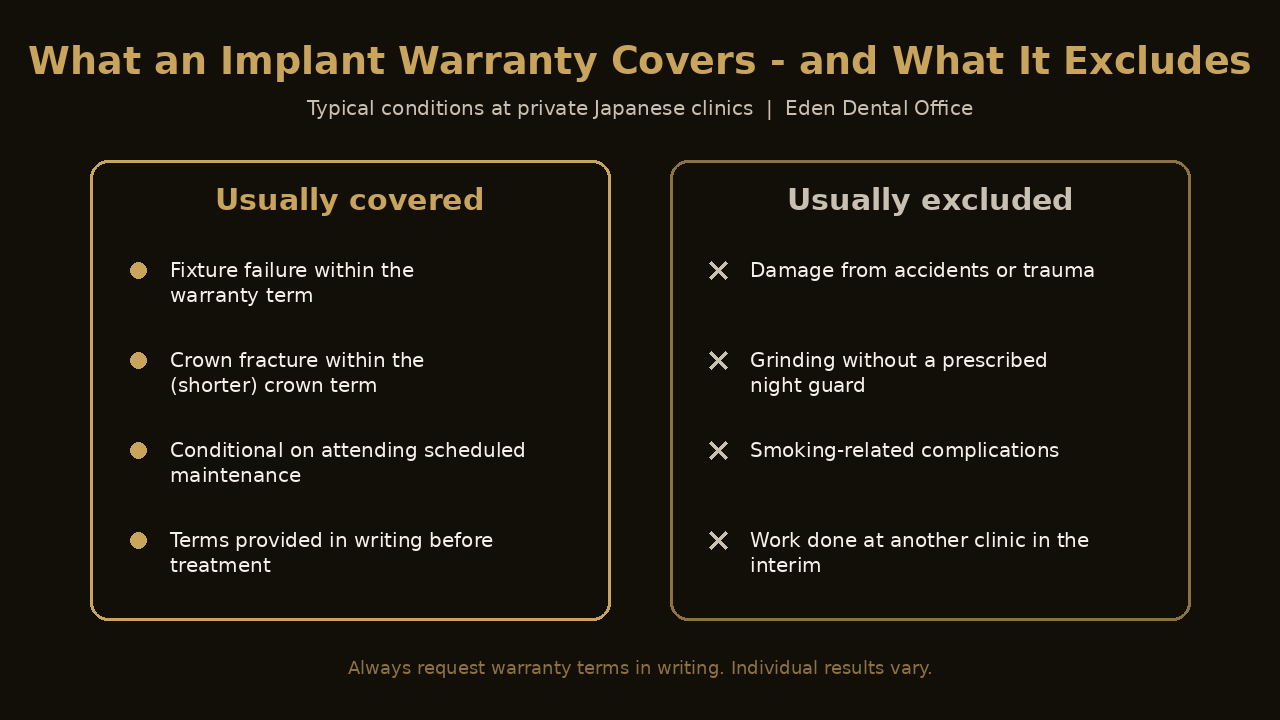
Many Japanese clinics attach a warranty to self-pay implant work — commonly several years on the fixture and a shorter term on the crown. Read the conditions before you rely on them. Almost every warranty in this market is conditional on attending the clinic’s maintenance program; skip the check-ups and the coverage quietly lapses. Exclusions typically include damage from accidents, untreated grinding without a night guard, smoking-related failure, and work done at another clinic in the meantime. A warranty is more accurately understood not as a promise that nothing will fail, but as the clinic pricing its own confidence — and contracting you into the maintenance behavior that protects the result. Ask for warranty terms in writing, in English, alongside the treatment estimate; the practice of demanding paperwork is the same one we recommend for premium implant pricing generally.
What this costs
Maintenance economics at Eden Dental Office are deliberately simple. A comprehensive check-up package is ¥40,000, and annual membership tiers run from ¥88,000 to ¥288,000 per year depending on the level of care included — for implant patients, membership usually replaces per-visit maintenance billing entirely. Repair work, when it is ever needed, is quoted individually: you receive a written estimate in English before anything is done, and current treatment fees are listed on our fee page. Compared with the figures discussed in our complete guide to implant costs in Japan, a decade of maintenance is a small fraction of the original treatment — and the cheapest insurance the implant will ever have. For context on how these totals compare internationally, see our Japan-versus-U.S. cost comparison.
Maintenance is the recurring side of the ledger; for the up-front side, our breakdown of how implant payments are staged and financed in Japan shows when each fee is due.
Frequently Asked Questions
How often should a dental implant be checked in Japan?
Most stable patients are seen every four to six months for professional cleaning and probing, with an X-ray comparison every one to two years. Higher-risk patients — smokers, grinders, those with gum disease history — are seen more often.
Does Japanese health insurance cover implant maintenance visits?
No. Implants placed as self-pay treatment are maintained on a self-pay basis. Routine insurance dental care continues to apply to your natural teeth as usual.
What happens if my implant crown chips?
Small chips are often polished smooth in one visit. Larger fractures mean remaking the crown from the stored digital design — a lab procedure, with a written estimate provided first.
Do implant warranties cover every kind of failure?
No. Warranties are conditional — typically requiring regular maintenance attendance — and exclude accidents, unprotected grinding, and smoking-related complications. Always request the terms in writing.
Can I maintain my implant at a different clinic from where it was placed?
Yes, and if you relocate you should. Bring your implant passport or records — fixture brand, size, torque values — so the new clinic can service it properly. We provide these records to every patient.
Risks, limits and a note on honesty
Maintenance improves the odds; it does not abolish risk. Even well-cared-for implants can develop peri-implantitis, mechanical complications, or bone changes related to general health, medications or smoking, and some complications require surgical treatment or, rarely, implant removal. Costs above reflect currently published Eden Dental Office fees; repair and retreatment fees depend on the individual case and are always quoted in writing beforehand. Individual results vary.
If you are weighing implant treatment and want the ten-year plan — not just the surgery — discussed openly before you commit, our implant treatment page explains our approach, and you can reach us in English on WhatsApp to arrange a consultation.