
Porcelain Veneer Care in Japan: Night Guards & Daily Habits
Reviewed by Dr. Ryosuke Murai, DDS, MSD — Prosthodontist, trained at Indiana University School of Dentistry (U.S.). Last updated August 2026.
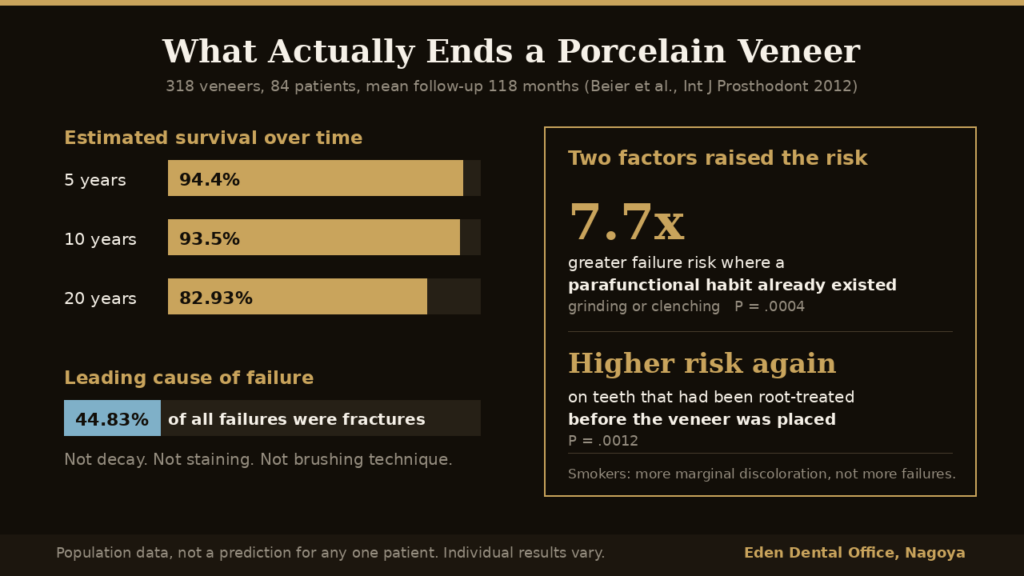
Porcelain veneer care in Japan is mostly ordinary: brush, floss, come in twice a year. The part that decides whether your veneers last five years or twenty is not on that list. In a 20-year Innsbruck follow-up of 318 porcelain laminate veneers, the estimated survival rate was 94.4% at five years, 93.5% at ten years and 82.93% at twenty — and the leading cause of failure was fracture of the ceramic, not decay, not staining, not poor brushing. This article is for self-pay patients who have already invested in veneers, or are about to, and want to know precisely what protects that investment: night guards, bite management, daily technique, and a realistic maintenance schedule. If you are still deciding whether to proceed, start instead with our guide to porcelain veneer costs, materials and longevity in Japan.
What twenty years of data actually shows
The most useful long-term study on this question followed 318 silicate glass-ceramic veneers placed in 84 patients, with a mean observation time of 118 ± 63 months. Twenty-nine failures were recorded — a relative failure rate of 17.24% across two decades. Of those failures, 44.83% were fractures of the ceramic itself. Two risk factors reached statistical significance: teeth that had been root-treated before veneering carried a higher failure risk (P = .0012), and patients with an existing parafunctional habit carried a 7.7-times greater risk of failure (P = .0004). Smokers showed significantly more marginal discoloration, though not more failures. You can read the full analysis in the International Journal of Prosthodontics report on 20-year veneer performance.
Read that list again, because it reorders the usual priorities. Nothing in it is about plaque. The dominant threat to a bonded ceramic restoration is mechanical load — how hard your teeth hit each other, and in which direction.
Your bite matters more than your brushing
A separate Spanish study isolated the same variable and looked specifically at what happens when you intervene. Researchers placed 323 veneers in 70 patients, 30 of whom had some form of parafunctional habit; 170 of the veneers went into patients with active bruxism. The failures were then analyzed for association with bruxism and with the use of occlusal splints. Of 13 fractures and 29 debondings recorded, 8 fractures and 22 debondings occurred in the bruxism group. The Medicina Oral study on bruxism and laminate veneer survival reached the conclusion most clinicians already suspect: veneers are predictable, and the grinding population is where the exceptions live.
Grinding and clenching are rarely conscious. Most patients who grind at night have no idea until someone points at the wear facets on their canines. Stress, disturbed sleep, evening alcohol and certain medications all raise nocturnal muscle activity. The clinical response is not to talk you out of it — it is to put something between the ceramic and the opposing arch.
Do you need a night guard?
Not every veneer patient does. The honest answer depends on evidence found in your own mouth, not on a blanket policy. Here is how we sort it at the planning stage, before the veneers are ever bonded.
| What we find | Night guard? | Type and reasoning |
|---|---|---|
| Existing wear facets, chipped enamel, or a partner who reports grinding sounds | Yes — planned before treatment starts | Hard acrylic full-coverage guard on the veneered arch. Distributes load across all teeth rather than the thin incisal edges. |
| Masseter tenderness, morning jaw fatigue, or headaches on waking | Yes | Muscle activity is present even without visible wear. The guard also serves as a diagnostic — wear patterns on the acrylic show us where the force goes. |
| Veneers placed on lower incisors, or an edge-to-edge bite | Usually yes | These positions load ceramic in shear. Protection matters more than in a deep-bite case with generous overjet. |
| Clean occlusion, no wear, no symptoms, upper veneers only | Not routinely | Reassessed at every recall. If facets appear on the new ceramic, the recommendation changes that day. |
| Contact or combat sports | Separate device | A sports mouthguard is a different appliance from a night guard and does not substitute for one. |
At Eden we take the guard impression digitally with an intraoral scan and produce the appliance through our in-house lab, which means the fit is checked against the same digital record used to design the veneers. When a guard needs adjusting after a few weeks of wear — and most do — that is a short appointment rather than a two-week send-out. For patients traveling in from Tokyo or overseas, we sequence the guard delivery into the same visit block as the veneer fitting wherever the schedule allows.
Daily care: what helps, what is theatre
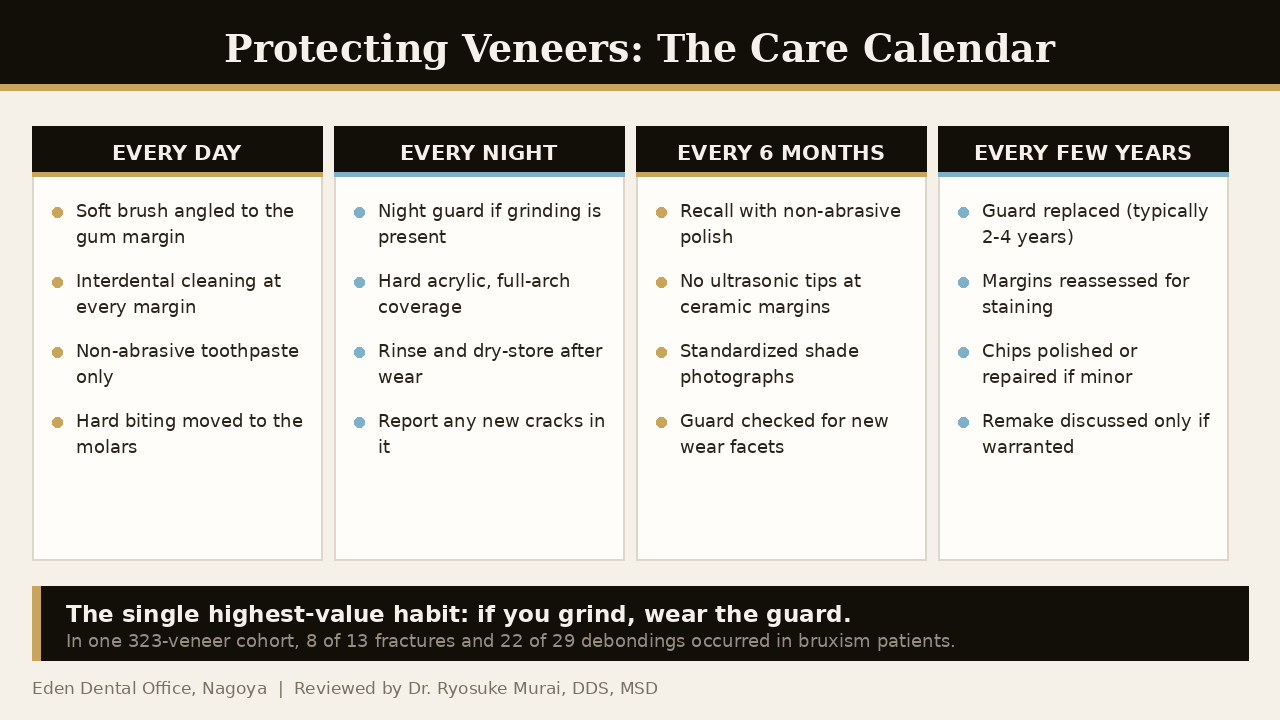
Porcelain does not decay. The tooth underneath it does, and the margin where ceramic meets tooth is the vulnerable line. So the technique that matters is unglamorous: a soft brush angled into the gum margin, and interdental cleaning every day. Floss will not lift a well-bonded veneer; a veneer that comes off during flossing was already debonded.
Three things genuinely damage ceramic surfaces over time. Highly abrasive whitening toothpastes dull the glaze and make veneers look flat and grey under photography. Acidic exposure — citrus habits, sparkling water sipped all day, reflux — attacks the resin cement at the margin rather than the porcelain. And chlorhexidine mouthrinse used continuously stains the cement line. None are emergencies, but over a decade they change how the work looks.
What does not help: charcoal pastes, whitening strips over the veneers, and at-home polishing kits. Bleaching gel has no effect on bonded ceramic, which is why shade decisions are settled with whitening before the ceramic is made, not afterwards. A patient who whitens two years later ends up with natural teeth lighter than the restorations and no way to correct it short of remaking them.
Habits that crack ceramic
Ceramic is strong in compression and weak in point loading. The failure list in every practice is the same: opening packaging with front teeth, biting fingernails, chewing pens and ice, holding hairpins between the incisors, and biting hard-crusted bread or unshelled nuts with the veneered teeth rather than the molars. None of these breaks a veneer on the first occasion. All of them propagate microscopic cracks that eventually meet.
Two adjustments cover most of it: move hard biting to the back teeth, and keep non-food objects away from the front teeth entirely. Patients who play wind instruments or free-dive should mention it at consultation — both apply sustained anterior load, and both can be designed around if we know in advance. Preparation depth changes the margin for error here too, which is one reason no-prep veneers suit some bites and not others.
The maintenance schedule we actually use
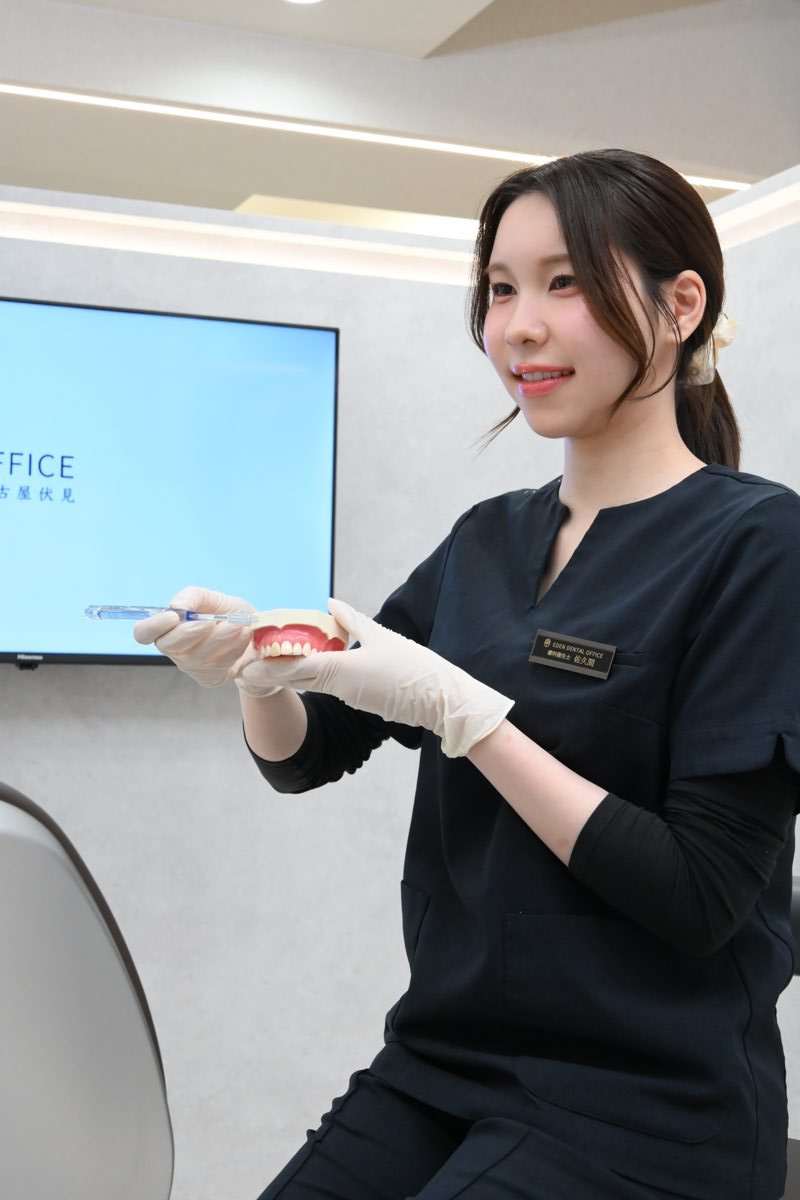
Veneer patients at Eden come in at six-month intervals, and the appointment differs from a standard cleaning in three ways. First, the hygienist uses non-abrasive polishing paste and avoids ultrasonic tips at the ceramic margins, since aggressive scaling can chip the porcelain edge. Second, we photograph the veneers under standardized lighting so shade drift and marginal staining are measured against the previous record rather than estimated. Third, if a night guard is in use, it is inspected for new wear facets — the appliance tells us how the bite is behaving between visits, and it is the earliest warning we get.
Guards are consumable. A hard acrylic appliance in a moderate grinder lasts two to four years before thinning and perforation make replacement sensible — the same decade-long arithmetic that applies to the ten-year maintenance picture for implant patients.
What this costs
Our published fee anchors are a comprehensive check-up package at ¥40,000 and a whitening package at ¥75,000; annual membership tiers run from ¥88,000 to ¥288,000 depending on the level of preventive coverage included. Night guard fabrication and veneer recall visits are not on that published list, because both vary with the number of restored units and the complexity of the occlusion. What we commit to is process: an examination, a written estimate in English covering every component, and no treatment started before you hold that estimate. Published fees are on the clinic fee page, and our overview of aesthetic treatment planning sets out the sequence.
Whitening around existing veneers needs care — see our overview of professional whitening options in Japan for what peroxide can and cannot change.
Heavy grinding also influences the initial choice of restoration, not only its aftercare — a point we take up in veneers versus crowns.
If the proportions still look wrong after a finished case, the gum margin rather than the ceramic may be the reason; our article on crown lengthening before cosmetic ceramics explains how that is assessed.
Frequently Asked Questions
Can I whiten my teeth after getting veneers?
Bleaching gel does not lighten bonded ceramic. It can lighten the natural teeth around and behind the veneers, which creates a mismatch. Shade is settled before fabrication.
Will a night guard change how my veneers look?
No. It is worn during sleep and removed in the morning. A well-made hard acrylic guard is invisible during the day and does not alter tooth position.
How often do veneers need replacing?
There is no fixed interval. Published survival was 93.5% at ten years and 82.93% at twenty in the study cited above, with parafunction the dominant risk factor.
Can a chipped veneer be repaired without remaking it?
Small incisal chips can sometimes be polished or repaired with composite. Fractures that expose the underlying tooth generally require a new veneer. Where a chip is repairable, the material used is the same resin discussed in our comparison of composite bonding against ceramic veneers.
Is an electric toothbrush safe on veneers?
Yes, with a soft head and no added pressure. The risk comes from abrasive paste, not from the brush mechanism itself.
Risks and limitations
Porcelain veneers are a bonded restoration, and every bonded restoration can chip, debond or discolour at the margin. Root-treated teeth carry a measurably higher failure risk. Grinding raises that risk several-fold, and a night guard reduces exposure but does not eliminate it. Underlying teeth remain susceptible to decay and gum disease, so the standard of daily cleaning has to rise, not fall, after treatment. Longevity figures quoted here come from published cohorts and describe populations, not predictions for one person. Individual results vary.
If you have veneers already and are unsure whether your bite is protecting or eroding them, a consultation in English at our Sakae clinic — two minutes from Fushimi Station, one stop from Nagoya Station — starts with photographs, a scan and an honest assessment of what the wear pattern shows. Our aesthetic dentistry page lists the restorative options we work with. We reply to WhatsApp enquiries in English.