
Dental Second Opinion in Japan: When and How, in English
Reviewed by Dr. Ryosuke Murai, DDS, MSD — Prosthodontist, trained at Indiana University School of Dentistry (U.S.). Last updated August 2026.
A reader wrote to us from Yokohama last spring. Her dentist had proposed extracting two upper molars, placing three implants, and crowning four more teeth — a plan quoted at a figure that would buy a small car. Nothing about the plan was obviously wrong. But nothing about it had been explained in a language she fully understood, and no alternative had been offered. What she needed was a dental second opinion in Japan, delivered in English: an independent review of the diagnosis, the plan, and the price before anything irreversible happened. This guide explains when that review is worth arranging, what records to gather, and how the process works at our Nagoya clinic — written for self-pay patients anywhere in Japan or abroad who want the plan checked before they commit, whether the first proposal came from a clinic in Tokyo, Osaka, or overseas. Our treatment services page outlines the disciplines we can review.
Why Competent Dentists Disagree
A second opinion is not an accusation. It is a response to a well-documented reality: dentistry involves judgment calls, and judgment varies. In a classic study published in the Journal of Dental Research, Bader and Shugars had multiple dentists examine the same patients and found that agreement on which individual teeth needed restorative treatment was only moderate — and it was weakest of all for teeth that had been restored before (Bader & Shugars, J Dent Res 1993). Much of the variation in dentists’ practice profiles, the authors concluded, comes down to basic differences in the decision to treat at all.
That finding is three decades old, and imaging has improved since, but the underlying point has not changed: two conscientious clinicians can look at the same mouth and propose different plans. One may watch an early lesion; another may restore it. One may attempt to save a compromised tooth with root canal retreatment; another may recommend extraction and an implant. Neither is necessarily careless — but the difference matters enormously to you when the plans differ by thousands of dollars, months of treatment, or the loss of a tooth that might have been kept.
Seven Signals a Plan Deserves an Independent Review
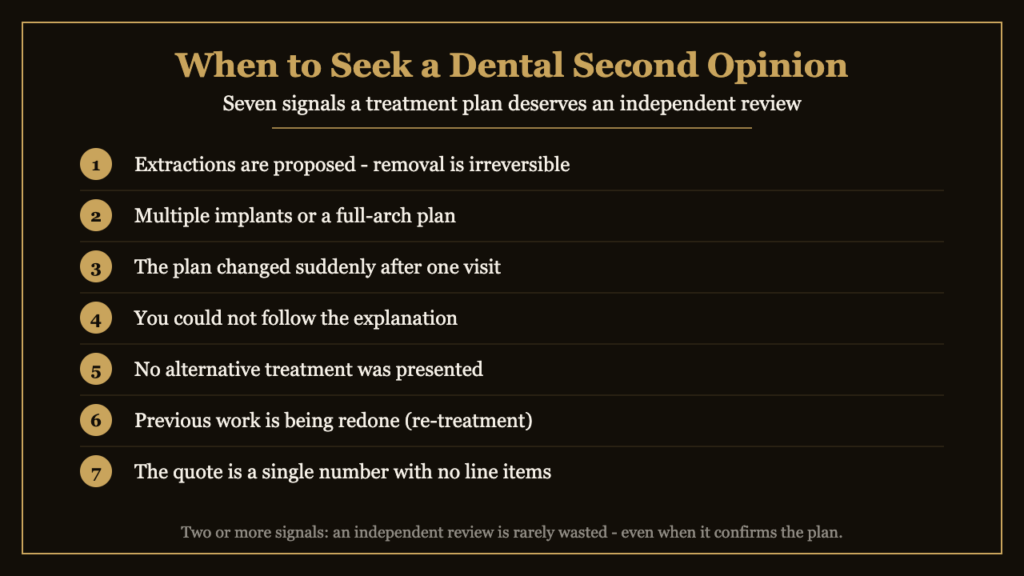
Not every filling needs a committee. The case for a second opinion strengthens as the plan becomes larger, less reversible, and less clearly explained. These are the signals we weight most heavily:
| Signal | Why it matters |
|---|---|
| Extractions are proposed | Removal is irreversible. The question “can this tooth be predictably kept?” deserves two answers before it is answered once, surgically. |
| Multiple implants or a full-arch plan | Implant dentistry offers several defensible routes (single implants, bridges, All-on-4). Route choice changes cost and maintenance for decades. |
| The plan changed suddenly | A check-up that becomes a ten-tooth plan overnight warrants an outside look at the radiographs behind it. |
| You could not follow the explanation | Language barriers compound clinical uncertainty. If you agreed to a plan you could not interrogate, you have not really consented to it. |
| No alternative was presented | Almost every situation has at least two defensible answers, even if one is “monitor and re-assess”. A single-option plan is incomplete. |
| A previous treatment is being redone | Re-treatment — a root canal being redone, a failing implant revised — is exactly where the 1993 data shows dentists agree least. |
| The quote is a single number | A lump sum with no line items makes comparison impossible. What a complete quote itemizes is covered in our guide to reading an implant quote in Japan. |
If two or more of these describe your situation, an independent review is rarely wasted money — even when it confirms the original plan. Confirmation has value too: you proceed with confidence instead of doubt.
What the Research Says About Second Opinions
The strongest quantitative evidence on second opinions comes from medicine rather than dentistry, and it is worth reading carefully rather than sensationally. A Mayo Clinic study followed 286 patients referred from primary care providers for a second, more advanced evaluation. In only 12% of cases did the final diagnosis match the referral diagnosis exactly. In 66% the diagnosis was refined or better defined, and in 21% it was distinctly different — and cases where the diagnosis changed carried significantly higher costs, because the original path would have treated the wrong problem (Van Such et al., J Eval Clin Pract 2017).
Two honest caveats. First, this is medical, not dental, data — referred patients are a pre-selected group with harder problems, so the percentages should not be transplanted directly onto dentistry. Second, “refined” is not “overturned”: in most cases the second look sharpened the picture rather than reversing it. That is precisely what a good dental second opinion does. It rarely declares the first dentist wrong; it more often adds options, sequences the work differently, or confirms the plan and lets you proceed without hesitation.
There is also a structural reason disagreement persists: dentists differ in where they set the threshold for intervention. Some clinicians are trained toward aggressive early restoration; others toward watchful preservation. Prosthodontic training pushes in a particular direction — planning backwards from the final result rather than forwards from the first problem tooth — and that lens frequently changes the sequence of a plan even when it does not change the diagnosis. Imaging quality matters as well. A plan built on a small two-dimensional X-ray and a plan built on a full three-dimensional scan are not resting on the same evidence; our explanation of what a CBCT scan shows covers why that difference is decisive for implant and extraction decisions in particular.
How a Records-Based Review Works From Anywhere
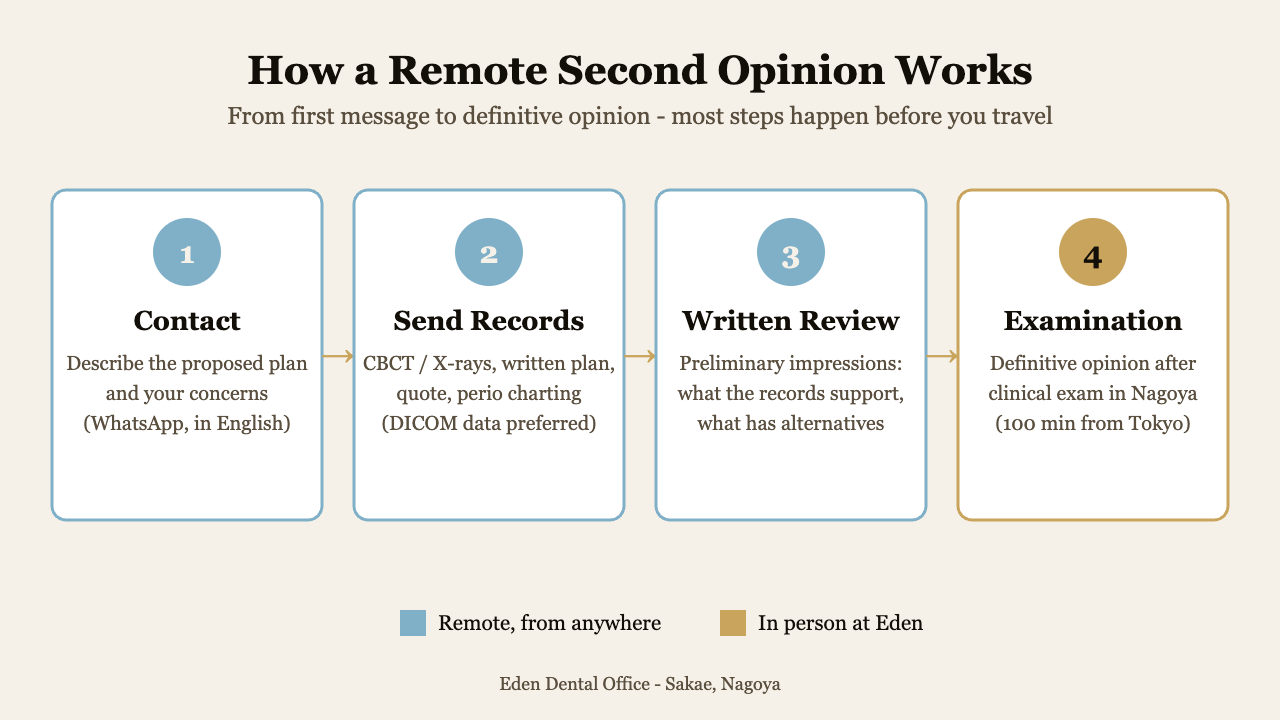
You do not need to live in Nagoya to start. Most of our second-opinion work begins remotely, in English, with the records you already have. The sequence looks like this:
- Contact and framing (WhatsApp preferred). You tell us what was proposed, what you were told, and what worries you. English is our working language for international patients.
- Records transfer. You send radiographs, CBCT data if it exists, photographs, and the written plan or quote. The checklist below covers exactly what to request from your current clinic.
- Preliminary written impressions. We review the materials and set out, in writing, which parts of the plan the records support, which parts have defensible alternatives, and which questions cannot be answered without an examination.
- In-person examination. A records review has hard limits — it cannot probe pockets, test vitality, or assess how you bite. The definitive opinion requires a visit. Patients come to us from across Japan; Nagoya is about 100 minutes from Tokyo by Shinkansen, and our clinic is a two-minute walk from Fushimi Station. For treatment-stage planning, our guide to planning a dental treatment trip to Japan explains how visits are structured for traveling patients.
What to Send: The Records Checklist
In Japan you are entitled to request your own imaging and records, and clinics routinely provide them — usually on a CD-ROM or via a download link, sometimes for a small copying fee. Ask for the following, in descending order of importance:
| Item | Japanese term to use | Notes |
|---|---|---|
| CBCT scan (3D) | “CT gazo data” (CT image data) | The single most useful item for implant, extraction, and root canal questions. Ask for DICOM data, not screenshots. |
| Panoramic and periapical X-rays | “rentogen gazo” (X-ray images) | Digital files preferred; phone photos of a screen are a last resort but still useful. |
| The written treatment plan and quote | “chiryo keikakusho” / “mitsumorisho” | Line items matter more than the total. Undated or single-number quotes tell us little. |
| Periodontal charting | “shishu kensa kekka” (perio exam results) | Pocket depths change whether teeth are savable. Often omitted — worth asking for specifically. |
| Intraoral photographs | “kokunai shashin” (intraoral photos) | Helpful context for aesthetic and wear cases. |
Missing items are not fatal. We frequently begin with nothing but a panoramic X-ray photographed on a phone and a one-line quote — the review simply carries more caveats until better records or an examination fill the gaps.
How We Conduct a Second-Opinion Consultation at Eden
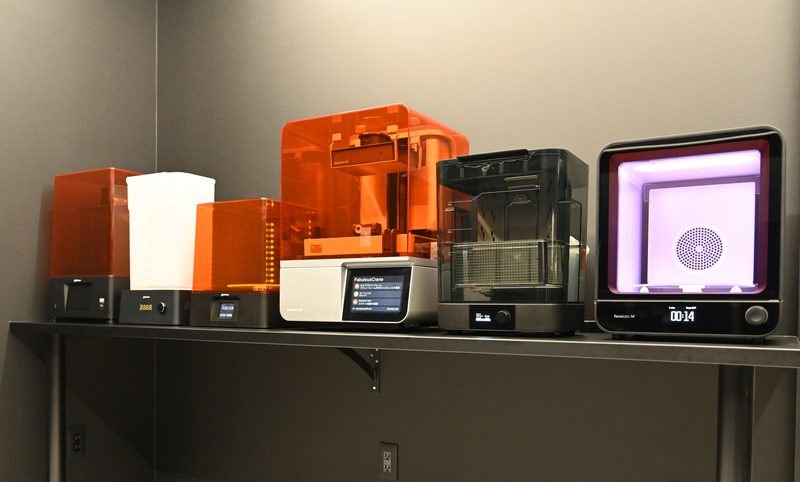
At Eden, a second-opinion case is planned with the same tools we use for our own treatment planning. Imported CBCT data goes into our guided-surgery planning software, where implant positions proposed elsewhere can be checked against bone volume, nerve position, and the restorative plan — not just eyeballed on a flat X-ray. When the question is restorative (veneers, crowns, full-mouth rehabilitation), we can have our in-house digital laboratory print study models or a diagnostic mock-up, so you can see physically what a different plan would look like. Where implants are indicated, we plan around the Straumann BLX and TLX systems we place ourselves, and we say so plainly — an honest second opinion discloses its own preferences rather than pretending to have none. Dr. Murai’s postgraduate training in prosthodontics at Indiana University School of Dentistry shapes the lens: the first question is never “where can implants go?” but “what should the final teeth be, and what is the least invasive route there?”
The output is a written opinion in English: what we agree with, where we differ and why, what alternatives exist, and — if you ask for one — our own itemized written estimate for comparison. What happens to costs when plans differ across clinics and countries is a topic of its own; our analysis of Japanese dental costs against the world explains how to compare quotes without being misled by the headline number.
Is It Rude to Ask? Second-Opinion Etiquette in Japan
Many international patients hesitate because they sense that questioning a doctor is culturally awkward in Japan. In practice, second opinions — “sekando opinion”, the English loanword is used as-is in Japanese — are an established part of Japanese healthcare, and university hospitals run formal second-opinion clinics for exactly this purpose. You do not need your current dentist’s permission, and you do not need to announce your reasons when requesting records; “for my personal files” is sufficient and normal. A reputable clinician is not offended by a patient verifying a large, irreversible plan. If a clinic reacts badly to a records request or discourages outside review, treat that reaction itself as information.
The same applies in reverse: patients sometimes bring us plans we largely agree with. We say so. A second opinion that always disagrees is a sales channel, not a review. This distinction matters most in implant dentistry, where revision work is hardest — if you are being told an existing implant is failing, our article on implant and full-arch failure covers what a rescue assessment involves.
Questions Worth Asking — of Both Dentists
A second opinion is most valuable when it sharpens your questions rather than simply adding a second verdict. Whether you are sitting in the first clinic or ours, the same short list does most of the work. Ask what happens if you do nothing for six or twelve months — the answer separates urgent problems from elective ones faster than any other question. Ask which parts of the plan are reversible and which are not, because irreversible steps deserve disproportionate scrutiny. Ask what the alternative plan would be if the proposed one were unavailable; a clinician who cannot describe a second-choice route has not fully mapped the territory. Ask how the recommended option performs over ten years, not one — longevity, maintenance, and re-treatment cost are where cheap plans and expensive plans often trade places. And ask to see the finding on the image itself. You will not read a radiograph like a clinician, but watching someone point to specific anatomy while explaining is a reliable filter for explanations that are actually grounded in your records.
Orthodontic questions deserve one extra note. Plans that involve moving teeth — including aligner treatment — interact with everything else in the mouth, and the order of operations matters: alignment before veneers or implants can change how much tooth reduction or grafting is needed at all. If aligner treatment is part of what you are weighing, our guide to Invisalign treatment in Japan in English explains case selection and its limits.
What a Second Opinion Costs
We do not publish a standalone second-opinion fee, because the work varies too much — reviewing one X-ray and a two-line quote is a different task from re-planning a full-arch case from CBCT data. What we can anchor: our comprehensive check-up package, which includes the examination, imaging, and a structured findings report, is ¥40,000, and an in-person second opinion is usually built on exactly that examination. Records-only preliminary reviews are quoted individually before any work begins, and every opinion concludes with a written estimate in English if treatment with us is even a possibility — see our fee page for the published anchors. You will never be asked to decide anything in the chair.
Getting the records themselves across borders is a separate practical problem, covered in what to send us before you fly.
Frequently Asked Questions
Do I need my dentist’s permission for a second opinion?
No. In Japan you may consult another clinic freely and request copies of your own records and imaging. No referral letter is required for a second-opinion consultation, although one can be helpful when it exists.
Can you give a second opinion entirely in English?
Yes. English is our working language for international patients, from the first WhatsApp message to the written opinion and estimate. No interpreter is needed.
Can a second opinion be done without visiting Nagoya?
Partially. A records-based review can be done remotely and in writing, but it cannot replace an examination. We state clearly which conclusions are provisional until we have seen you in person.
Will you criticize my current dentist’s plan?
Only where the records support a different view, and we often confirm plans rather than overturn them. You receive reasons and alternatives, not a verdict on another clinician.
What if your opinion differs from the first plan?
You decide what happens next. Some patients return to their original clinic with better questions; some ask us to treat; some seek a third view. The written opinion is yours either way.
Risks, Limits and a Necessary Disclaimer
A second opinion has limits of its own. A records-only review can miss what only an examination reveals, and even two thorough examinations can support different, equally defensible plans — that is the nature of clinical judgment, not a flaw in it. Delaying urgent treatment while collecting opinions carries risk too: infection, fracture, and bone loss do not wait. If any clinician tells you a situation is time-critical, verify quickly rather than slowly. Costs for any treatment that follows a second opinion depend on diagnosis, materials, and complexity, and are always provided as a written itemized estimate in English before anything begins. Individual results vary.
If you are weighing a significant treatment plan and want an independent, unhurried review in English, start a conversation on WhatsApp or see the treatments we evaluate and provide. Bring the plan, the images, and the questions — the more you send, the more useful the answer.