Dental Implant Payment Plans in Japan: How Patients Pay
Reviewed by Dr. Ryosuke Murai, DDS, MSD — Prosthodontist, trained at Indiana University School of Dentistry (U.S.). Last updated July 2026.
Almost no one pays for a dental implant in Japan in a single lump sum on day one. Dental implant payment plans here usually mirror the treatment itself: a diagnostic fee at the start, a surgical fee around placement, and a restorative fee when the final crown is fitted. This article explains when each payment is actually due, which payment methods private Japanese clinics commonly work with — bank transfer, credit cards, and dental loans — and how Japan’s medical expense deduction can return part of what you pay. It is written for self-pay patients weighing premium implant treatment in Japan, whether you live in Tokyo, Osaka, or overseas.
Payments Follow the Stages of Treatment
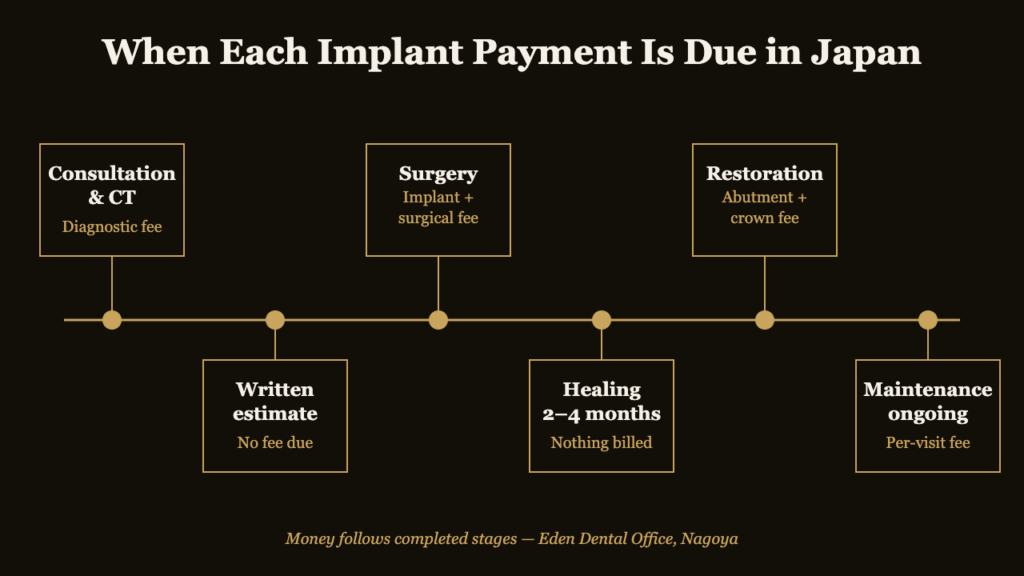
An implant is not one procedure but a sequence spread over several months, and reputable clinics bill it that way. You are never asked to fund work that has not yet been planned. A typical payment calendar looks like this:
| Stage | What is billed | When payment is due |
|---|---|---|
| Consultation & CT imaging | Diagnostic fee | On the day of the visit |
| Treatment plan & written estimate | Usually nothing further | — (you decide before paying more) |
| Implant surgery | Implant body + surgical fee, plus any grafting | Around the surgical appointment |
| Healing period (2–4 months) | Typically nothing | — |
| Final restoration | Abutment + crown fee | At or around crown fitting |
| Maintenance | Per-visit fee | Ongoing, 1–2 visits per year |
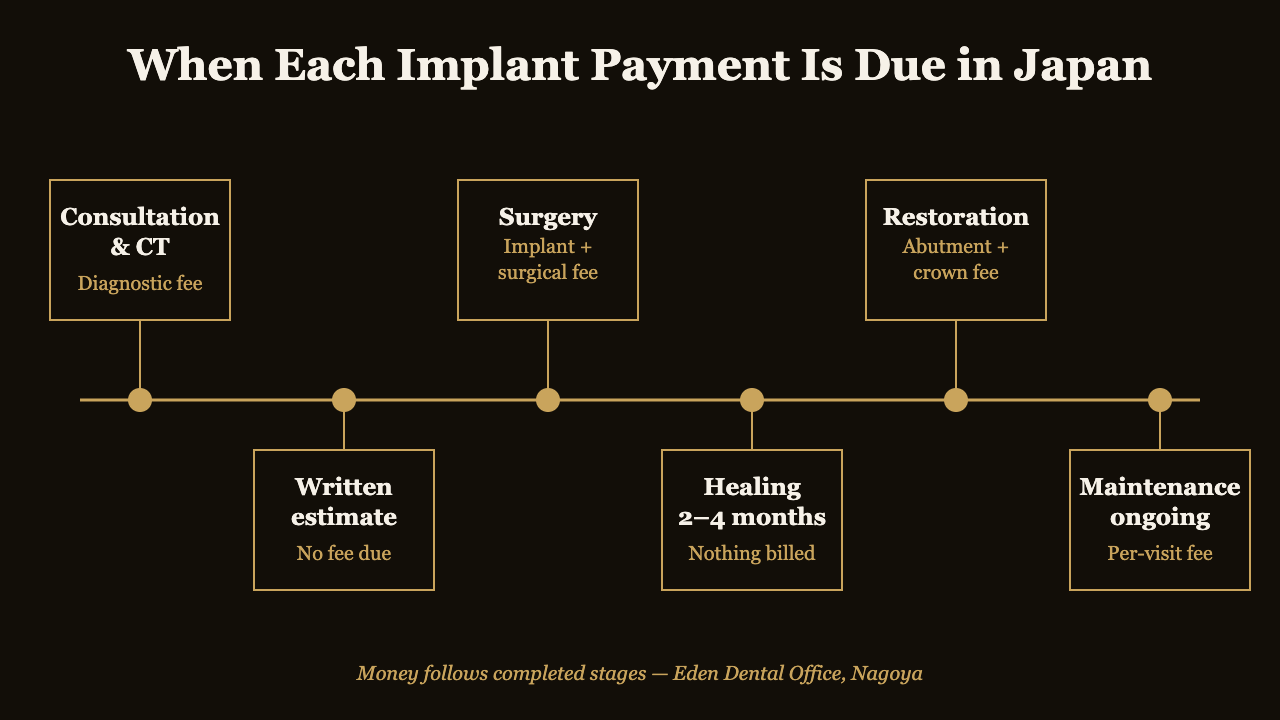
The exact split varies by clinic, but the logic is consistent: money follows completed stages. What each of those stages costs — and why quotes differ so widely — is covered in our complete guide to dental implant costs in Japan, and the line items a proper estimate should list are examined in our article on what a Japanese implant quote actually includes.
How Patients Actually Pay: Transfer, Card, or Dental Loan
Once you know when payments fall due, the second question is the instrument. Three methods cover nearly every self-pay implant case in Japan:
| Method | Added cost to you | Where it fits |
|---|---|---|
| Bank transfer | Only the transfer charge | Larger stage payments; the default for many patients |
| Credit card | None if paid in full; issuer interest if converted to installments | Convenient, earns points; installment terms are set by your card issuer, not the clinic |
| Dental loan | Interest set by the lender; screening required | Spreading a large full-arch or multi-implant plan over years |
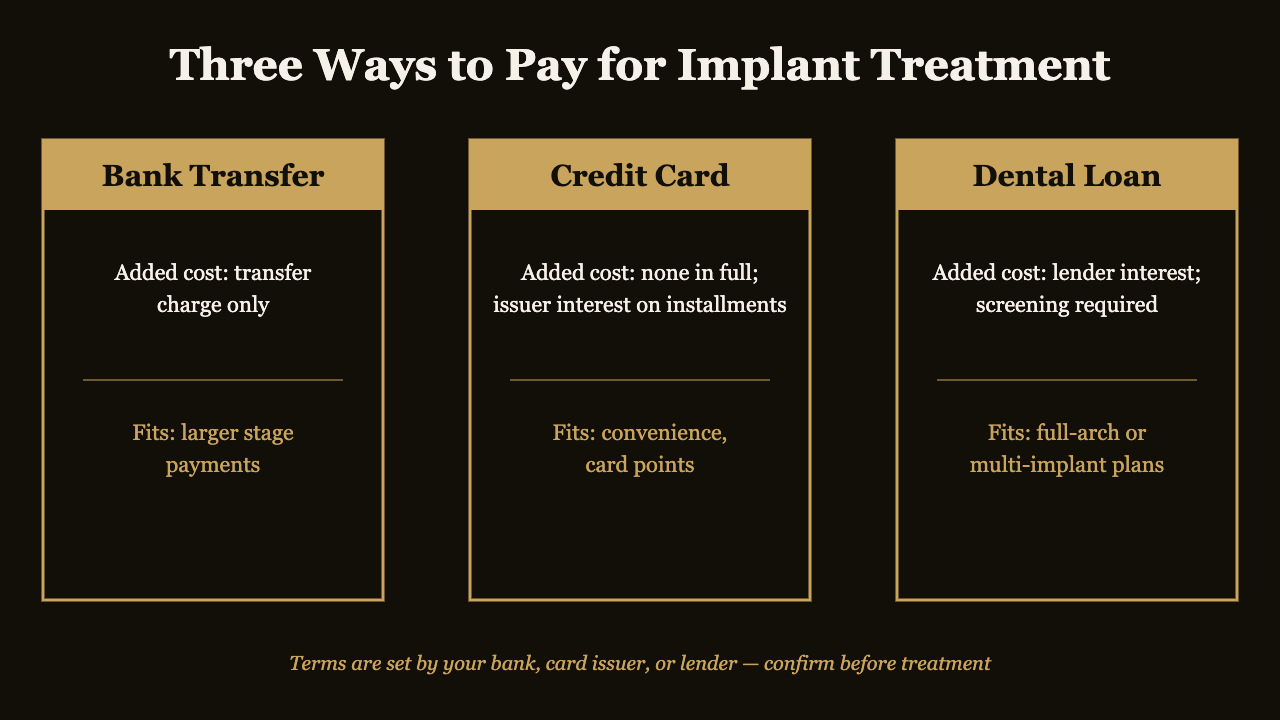
Two practical notes. First, card installment and revolving plans are contracts between you and the card issuer — the clinic receives full payment, and any interest is charged by the issuer under your card agreement, so read those terms before assuming a card is the cheaper route. Second, dental loans (a form of medical loan offered through banks and credit companies) usually offer longer terms and lower rates than card revolving credit, but involve an application and screening. Whether financing makes sense at all depends on the total, which is why comparing offers matters; our comparison of implant costs in Japan and the United States shows how much geography alone changes the arithmetic.
What a Clinic’s Payment Structure Tells You
Payment structure is a quiet indicator of clinical philosophy. A clinic that bills stage by stage is financially exposed if its own work fails between stages — its incentives are aligned with yours. Be more careful with heavy discounts offered only for full prepayment of every stage before surgery: you would be funding a crown that cannot even be designed until the implant has integrated.
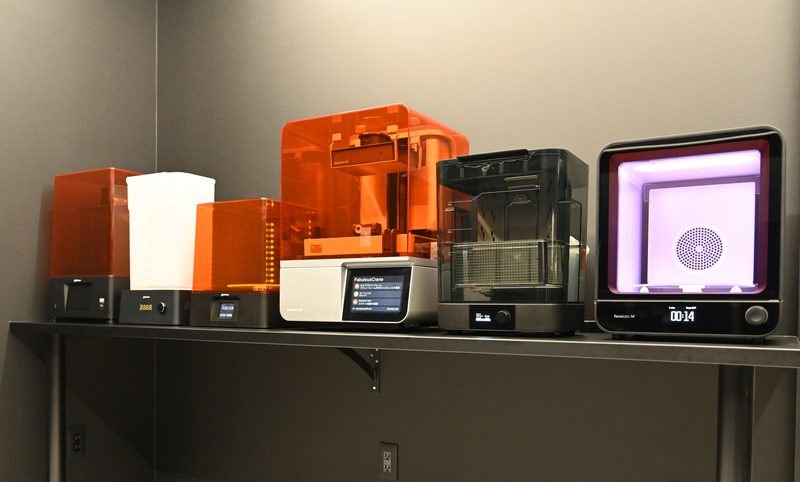
At Eden, every implant case is planned in our in-house digital lab before any surgical fee is discussed: CT data is merged with an intraoral scan, a surgical guide is 3D-printed on site, and a Straumann BLX or TLX implant is selected for the specific bone situation. The written English estimate you receive maps each fee to a treatment stage, so you always know what the next payment covers and when it falls due. Long-term data supports treating an implant as a decade-scale asset rather than a one-day purchase — a 10-year study of 511 Straumann implants reported survival above 98% (Buser et al., 2012, PubMed) — and the ongoing side of that asset, professional maintenance, has its own modest price tag, detailed in our 10-year view of implant maintenance costs in Japan.
The Medical Expense Deduction: Timing Can Matter
Implant treatment performed to restore chewing function is generally accepted as a medical expense for Japan’s income-tax medical expense deduction (iryōhi kōjō), even though the treatment itself is self-pay — a distinction we unpack in our article on whether implants are covered by Japanese health insurance. The deduction is claimed for the calendar year in which you actually paid, via a final tax return (National Tax Agency, Tax Answer No. 1120, Japanese). That makes payment timing worth a thought: a treatment that straddles December and January spreads its payments — and therefore its deductions — across two tax years. Dental loan amounts paid on your behalf in a given year can also count for that year. Rules depend on your income and residency status, so confirm the specifics with a tax professional or the tax office before relying on an estimate.
What This Costs at Eden Dental Office
Implant fees depend on the number of implants, the bone situation, grafting, and the final restoration, so we do not publish a single implant price — no serious clinic can quote accurately before imaging. What we commit to instead: a diagnostic visit first (our comprehensive check-up package is ¥40,000), then a written estimate in English itemizing every stage and its payment timing before any treatment begins. Current package pricing is listed on our fee page. Payment method and staging for your specific plan are confirmed in that estimate, so there are no surprises mid-treatment.
If you are financing full-arch treatment, it helps to first understand what an All-on-4 quote in Japan actually covers before structuring the payments.
Frequently Asked Questions
Can I pay for a dental implant in Japan by credit card?
Many private clinics accept major credit cards for self-pay treatment. Whether you can split the charge into installments depends on your card issuer’s terms, not the clinic — confirm both before treatment starts.
Do Japanese clinics require full payment before implant surgery?
Stage-based billing is the usual practice: diagnostics first, the surgical fee around placement, and the restorative fee at crown fitting. Treat requests for full prepayment of all stages with caution.
Do dental implants qualify for Japan’s medical expense deduction?
Implants placed to restore function are generally eligible, including for foreign residents who pay Japanese income tax. You claim the deduction for the calendar year of payment through a final tax return; confirm your case with a tax professional.
Is a dental loan cheaper than paying by credit card?
Often, for large amounts: dental loans tend to carry lower interest than card revolving plans and allow longer terms, but they require lender screening. Compare the total repayment, not the monthly figure.
What if my treatment spans two calendar years?
The medical expense deduction follows when you paid, not when treatment finished. Payments made in December and February belong to different tax years and are claimed separately.
Costs, Risks, and What to Expect
Implant treatment carries surgical risks — infection, injury to nerves or the sinus, and the possibility that an implant fails to integrate and must be removed — and staged payments do not remove those risks; they simply align cost with progress. Total treatment time is commonly three to eight months depending on healing and any grafting. Fees, financing eligibility, and deduction outcomes differ from case to case. Individual results vary. A consultation with imaging is the only reliable way to turn all of the above into numbers for your own mouth.
If you are comparing clinics for Straumann implant treatment planned with guided surgery, we are happy to walk you through a staged, written estimate in English — the fastest way to reach us is WhatsApp, in English, and Nagoya is about 100 minutes from Tokyo by Shinkansen.