
Invisalign in Japan in English: Costs, Timeline & Results
Reviewed by Dr. Ryosuke Murai, DDS, MSD — Prosthodontist, trained at Indiana University School of Dentistry (U.S.). Last updated August 2026.
A project manager who moved from Chicago to Tokyo wrote to us with a question we hear often: she had wanted straighter front teeth for a decade, assumed orthodontics in Japan would mean two years of metal brackets and appointments conducted entirely in Japanese, and shelved the idea. Neither assumption holds. Invisalign treatment is well established in Japan, it is a self-pay treatment planned and monitored much as it would be in the U.S., and at Eden Dental Office in Nagoya the entire process — consultation, treatment simulation, written estimate, every check — runs in English. This guide explains what clear aligners can and cannot do, how the timeline works, what drives the fee, and how we structure monitoring for patients who fly in from other cities or countries for treatment planned around alignment.
What Clear Aligners Do Well — and Where They Struggle
Invisalign is a system of removable, transparent aligners that move teeth in small programmed steps, each tray worn for one to two weeks. The evidence on what it does reliably is now reasonably mature. A systematic review in Progress in Orthodontics covering 22 studies concluded that the Invisalign system is a viable alternative to conventional orthodontic treatment for mild to moderate malocclusions in non-growing patients that do not require extraction, and that aligners can predictably level, tip, and derotate most teeth — with canines and premolars being the stubborn exceptions.
The same review is equally clear about the limits: arch expansion through bodily tooth movement, closing extraction spaces, correcting how the back teeth actually meet, and larger front-to-back or vertical discrepancies all showed limited efficacy. In plain terms: crowded or spaced front teeth in an adult with a stable bite are an excellent aligner case. A collapsed bite, missing posterior teeth, or a jaw-relationship problem is not — and a clinic that says otherwise before examining you is not doing you a favor.
This is why case selection, not the aligner brand, is the variable that decides your result. The diagnostic question is never “can trays be made for these teeth” — it always can be — but “will programmed tooth movement alone produce a bite that is stable, cleansable, and worth what you paid.” Two patients with visually similar crowding can be entirely different cases once you look at root position, gum thickness, and how the back teeth function. One is a straightforward ten-month aligner case; the other needs the crowding resolved as part of a broader rehabilitation, and treating them identically would shortchange the second patient.
It is also worth understanding what the research literature says about study quality itself, because aligner marketing routinely outruns the evidence. The Progress in Orthodontics review graded most of the available studies as carrying moderate or high risk of bias, and noted that heterogeneous protocols prevented pooling results into a single clean number. The honest summary is not “aligners work as well as braces for everyone” but “aligners work predictably for a defined range of movements in a defined type of patient.” A clinician’s job is to tell you, before you commit, which side of that line your teeth are on.
Invisalign vs Fixed Braces for Adults in Japan
A meta-analysis in BMC Oral Health comparing clear aligners with fixed appliances found that aligner patients finished on average 6.31 months sooner in mild-to-moderate cases, while braces retained the advantage in producing tight occlusal contacts, controlling root torque, and holding the result. The overall quality of the final outcome showed no statistically significant difference between the two. For the adult professionals we treat, the practical comparison looks like this:
| Factor | Invisalign (clear aligners) | Fixed braces |
|---|---|---|
| Visibility at work | Barely noticeable at speaking distance | Visible; ceramic versions less so |
| Duration, mild-moderate cases | About 6 months shorter on average (meta-analysis above) | Longer, but less compliance-dependent |
| Complex movements (torque, space closure, bite settling) | Less predictable; may need refinements or hybrid approach | More predictable control |
| Eating and hygiene | Remove trays; brush and floss normally | Food restrictions; harder cleaning |
| Discomfort pattern | Pressure for 1-2 days per new tray | Soreness after adjustments; occasional bracket irritation |
| Appointment rhythm | Every 6-10 weeks; partly remote-friendly | Every 4-6 weeks, in person |
| Compliance burden | 20-22 hours of wear per day, every day | None — appliance works constantly |
That last row deserves emphasis. Aligners only work while they are on your teeth. Patients who leave trays in their pocket through long client dinners consistently fall behind their simulated schedule, and no amount of clinical skill compensates for a tray that is not being worn.
Living With Aligners: The Day-to-Day Reality
The clinical literature measures tooth movement; it does not tell you what eight months of trays feel like in a working week built around meetings, client dinners, and travel. A few practical realities are worth knowing before you commit. Speech changes slightly for the first several days — a faint lisp on “s” sounds that resolves as your tongue adapts, and that colleagues rarely notice even when you are convinced they do. Anything other than water requires taking the trays out: coffee and red wine stain them, sugar pools under them, and heat warps them. In practice this compresses grazing and turns drinks into deliberate decisions, which some patients count as an unplanned benefit and others find to be the hardest part of treatment.
Hygiene is the other daily discipline. Trays go back onto clean teeth, which means brushing or at minimum rinsing thoroughly after meals — an easy habit at home, a planning exercise during a day of back-to-back meetings. The trays themselves are cleaned with a soft brush and cool water, never hot. Attachments, the small tooth-colored studs bonded to selected teeth, are unobtrusive at conversational distance but you will feel them with your tongue for the first week, and they make wearing the trays — not skipping them — the more comfortable state, which is precisely their point.
For frequent travelers, the system is forgiving in one important way: your treatment travels with you. You carry your next several trays, change them on schedule wherever you are, and keep the previous set as a fallback. What does not travel is judgment — if a tray stops seating properly, pushing ahead makes things worse, which is why we ask traveling patients to send photos over WhatsApp before deciding anything. Most mid-course questions resolve in a two-minute exchange rather than an appointment.
The Treatment Timeline: From First Scan to Retainers
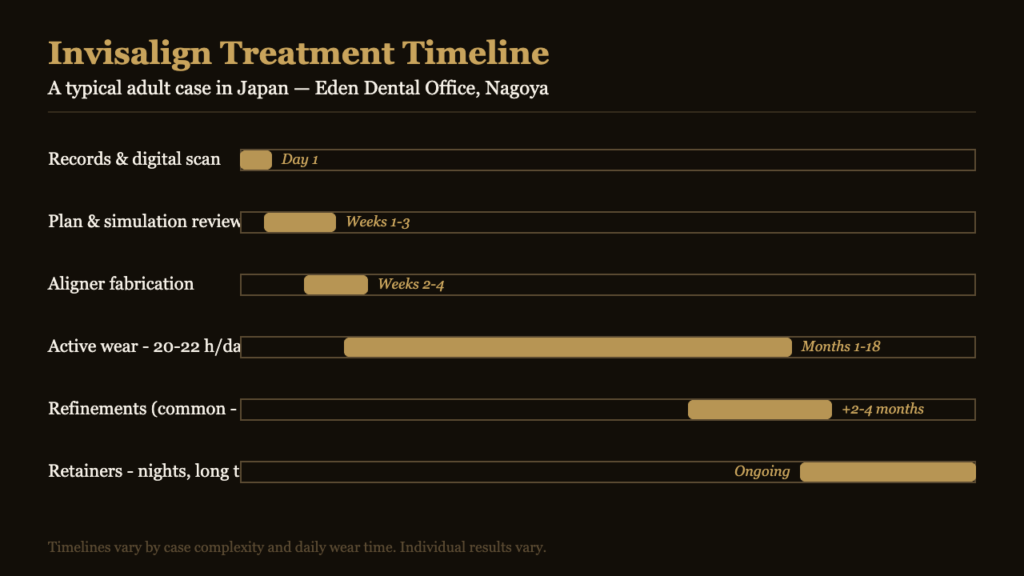
An aligner case at Eden follows five phases. First, records: a digital intraoral scan, photographs, and radiographs, reviewed alongside a full examination — because moving teeth you have not fully diagnosed is how small problems become expensive ones. Second, planning: we build a digital simulation of the proposed movement and review it with you on screen, in English, before anything is fabricated. You see the projected end position, the number of trays, and where attachments or interproximal polishing are planned. Third, fabrication, typically two to four weeks. Fourth, active treatment: trays changed every one to two weeks, with progress checks every six to ten weeks. Most adult cosmetic-priority cases run six to eighteen months; refinements — a second, shorter series of trays to finish details — are common and should be assumed in your planning. Fifth, retention: teeth drift back without retainers, so nighttime retainer wear is a long-term commitment, not a suggestion.
Refinements deserve their own honest paragraph, because they are where aligner timelines quietly grow. A refinement is a second series of trays ordered after the first series finishes, correcting the gap between simulated and actual movement — biology does not follow software exactly, and teeth with rounded or short roots, dense bone, or inconsistent wear time drift from the plan. Roughly speaking, the more rotation and vertical movement your case involves, the more likely a refinement becomes. We treat refinements as an expected part of moderate cases and say so in the estimate, because a quoted timeline that assumes zero refinements is a marketing number, not a clinical one. Retention planning is equally concrete: printed models from your final scan let us produce replacement retainers from our in-house lab years later without re-scanning, one of the quieter advantages of keeping the digital records under one roof.
Doing Invisalign When You Don’t Live in Nagoya
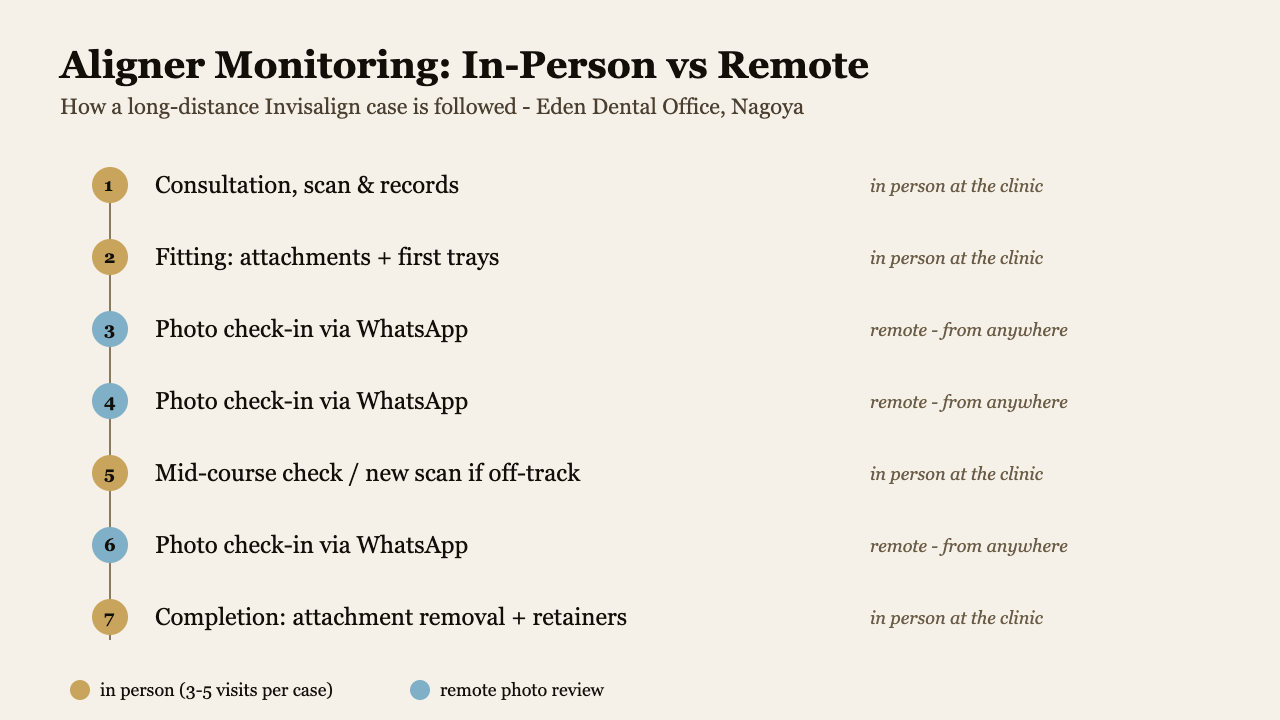
Aligner treatment suits long-distance patients unusually well, because the appliance does its work between visits. What must happen in person is concentrated at the start: the scan and records visit, and the fitting visit where attachments are bonded and your first trays are checked. After that, much of the routine monitoring can run remotely — photographs submitted through WhatsApp at scheduled intervals, reviewed against your simulation, with in-person checks aligned to your travel. Nagoya is roughly 100 minutes from Tokyo by shinkansen and about 40 minutes from Chubu Centrair International Airport, which is what makes this cadence realistic; we cover the general logistics of treatment travel in our guide to planning dental visits to Japan around a small number of trips.
| Visit | Purpose | In person? |
|---|---|---|
| Consultation + records | Scan, exam, simulation review, written estimate | Yes |
| Fitting | Attachments, first trays, wear coaching | Yes |
| Routine progress checks | Tracking against simulation | Often remote (photo review) |
| Mid-course corrections | New scan if teeth are off-track; refinement planning | Yes |
| Completion + retainers | Attachment removal, retainer delivery | Yes |
Plan on three to five in-person visits across a typical case. Patients based overseas usually anchor these to trips they were making to Japan anyway.
Why a Prosthodontist Plans Aligners Differently
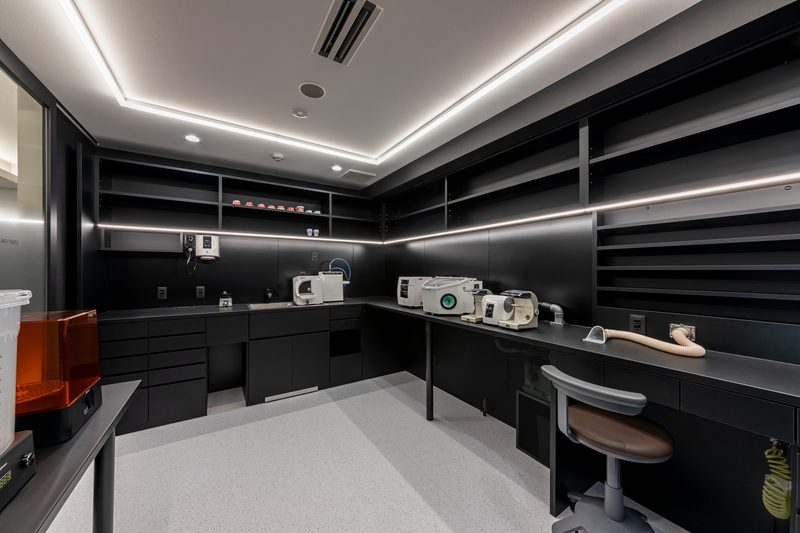
Orthodontic tooth movement is usually the first step of a larger plan, not the whole plan. A prosthodontist is trained in rebuilding and replacing teeth, so we evaluate alignment as a foundation: are these teeth being straightened so that veneers can be thinner or avoided entirely, so that a worn edge can be rebuilt in ceramic, so that a future implant space opens correctly? At Eden, we run this analysis with Digital Smile Design and our in-house digital lab — the same 3D-printing workflow we use for ceramic veneer planning produces printed study models for aligner cases, and treatment simulations are checked against the restorative end point, not just against straight-looking front teeth. In several cases each year, that review changes the plan: a patient convinced they need eight veneers turns out to need alignment plus far more conservative ceramic work afterward, or none at all. Aligning first and restoring second is almost always the least destructive sequence, which is the argument we lay out in our comparison of bonding, veneers, and when tooth movement should come first.
What Invisalign Costs in Japan
Invisalign in Japan is self-pay: national health insurance does not cover orthodontics for cosmetic or elective purposes, so the fee is set by each clinic rather than by the insurance schedule — one reason quoted figures vary so widely between offices, a dynamic we examine in our review of how dental fees in Japan compare internationally. What actually drives an aligner fee: case complexity and projected tray count, whether refinements are bundled or billed separately, the length of monitoring included, and retainers. Diagnostic records at Eden are part of our published check-up package (¥40,000), and current treatment fees are listed on our fee schedule; before any treatment begins you receive a written estimate in English itemizing exactly what the figure includes. Aligner treatment may also qualify for Japan’s medical expense deduction when there is a functional indication — we flag this during consultation where relevant. If a quote elsewhere is dramatically cheaper, ask what happens when trays go off-track: unbundled refinements are the most common source of surprise cost in aligner treatment.
Three questions will surface most hidden costs in any aligner quote, here or abroad. Are refinements included, and how many? Are retainers — and their eventual replacements — part of the fee? And what does monitoring actually consist of: scheduled reviews against your simulation, or a quick look if you happen to ask? A complete Japanese quote at a mid-range figure is routinely better value than a low headline number that unbundles all three, which is the same quote-completeness logic that applies across every treatment category we price.
Weighing an aligner recommendation you are not sure about? Our walkthrough of getting a dental second opinion in Japan, in English explains how an independent, records-based review works before you commit.
Aligners are sometimes weighed against a purely restorative plan rather than against fixed braces. That trade — time and tooth movement versus enamel and ceramics — is examined separately, including the enamel cost on each side.
Frequently Asked Questions
How long does Invisalign take in Japan?
Mild adult cases often finish in 6-10 months; moderate cases 12-18 months, plus refinements. The technology is the same as in the U.S.; duration depends on your teeth and wear time, not geography.
Can I do Invisalign if I live in Tokyo or overseas?
Yes. Records and fittings happen in person; much routine monitoring runs by photo review over WhatsApp. Most cases need three to five visits, and Nagoya is about 100 minutes from Tokyo.
Does Invisalign hurt more than braces?
Most patients report pressure for a day or two with each new tray rather than the adjustment soreness of braces. Discomfort is real in both systems, just distributed differently.
Do I need attachments or interproximal reduction?
Usually some of each. Attachments are small tooth-colored bumps that give trays grip; interproximal reduction polishes fractions of a millimeter between teeth to create space. Both are shown in your simulation beforehand.
What happens if I lose an aligner while traveling?
Contact us on WhatsApp; the usual answer is to move to your next tray early or step back to the previous one while a replacement is arranged. Travel with your current and previous trays.
Risks, Limitations, and Costs — Read Before Deciding
Clear aligner treatment carries real limitations and risks: movements may progress more slowly than simulated, refinements can extend the timeline, root resorption and gum recession occur in a small share of orthodontic patients regardless of appliance, bite contacts can feel different during and after treatment, and results relapse without disciplined retainer wear. Aligners are also poorly suited to skeletal discrepancies and complex bite reconstruction, where fixed appliances or a restorative approach may serve you better. Fees are self-pay, depend on complexity, and are always confirmed in a written English estimate before treatment. Individual results vary.
If you are weighing aligners against other paths to a straighter, more functional smile, start with an in-person consultation: a scan, an honest assessment of whether you are an aligner case at all, and a simulation you can react to. You can read more about how we sequence orthodontic and restorative treatment, or message us on WhatsApp in English to arrange a consultation.