Braces or Veneers in Japan: Should You Align Teeth First?
Reviewed by Dr. Ryosuke Murai, DDS, MSD — Prosthodontist, trained at Indiana University School of Dentistry (U.S.). Last updated August 2026.
Braces or veneers is rarely a question about appearance. It is a question about what you are willing to spend to get a straight-looking smile: time, or tooth structure. Moving a crooked tooth into position costs months and a retainer afterwards. Covering it with ceramic costs enamel, and enamel does not grow back. For self-pay patients in Japan comparing an aesthetic quote here against one in Tokyo, Singapore or at home, that trade is the whole decision, and it is usually settled in the first consultation rather than examined. This article sets out what each route removes, what the evidence supports, and the third option most consultations skip — limited alignment followed by minimal ceramics, planned together from the start of aesthetic treatment at Eden Dental Office in Nagoya.
What each route spends
Orthodontics and ceramics arrive at a similar photograph by opposite means. Alignment relocates the teeth you already have, and the tooth ends treatment as intact as it began, minus whatever interproximal enamel was needed to create space. Veneers leave the tooth where it is and rebuild its outline in porcelain, which means reducing the labial surface so the ceramic has room to sit without leaving the tooth bulky. The further a tooth is out of line, the deeper that reduction runs on the prominent side.
| Align first, then restore | Ceramics only | Alignment only | |
|---|---|---|---|
| What is removed | Interproximal enamel where space is needed | Labial enamel, more on prominent teeth | Little or nothing |
| Typical duration | Alignment phase, then restorative phase | Weeks | Months |
| Changes tooth color | Only in the restorative phase | Yes | No |
| Changes tooth shape | Yes, with less ceramic | Yes | No |
| Reversible | Alignment phase largely; ceramics no | No | Largely |
| Ongoing commitment | Retainer, then normal maintenance | Night guard, hygiene reviews | Retainer |
Neither column is a recommendation. They are different bills, and which is cheaper in biological terms depends on how far the teeth sit from where they should be.
What the evidence supports about aligners
Patients are frequently told that clear aligners cannot achieve what braces achieve, or that they achieve exactly the same thing. Both statements outrun the data. A 2025 systematic review and meta-analysis in the Journal of Evidence-Based Dental Practice pooled 21 randomized controlled trials covering 970 participants and found no significant difference between clear aligners and fixed appliances on the three standard finish metrics — the ABO Objective Grading System, the Little Irregularity Index and PAR scores. Aligners scored significantly better on periodontal measures during treatment: plaque index mean difference −0.76 (95% CI −1.14 to −0.38), gingival index −0.61 (−0.78 to −0.44), bleeding index −0.71 (−0.92 to −0.49), and quality of life at six months was better as well.
The caveats matter more than the headline. The authors rated the overall quality of the evidence as low, only one of the 21 trials was at low risk of bias, and the conclusion was limited to simple malocclusions treated without extractions. Complex cases were not answered. Read honestly, the finding is that for mild to moderate crowding — exactly the presentation that sends people to a veneer consultation — aligners are a reasonable instrument, not that they are interchangeable with braces in every mouth. Aligner scope is covered further in the guide to clear aligner treatment in English.
What a veneer costs a crooked tooth in enamel
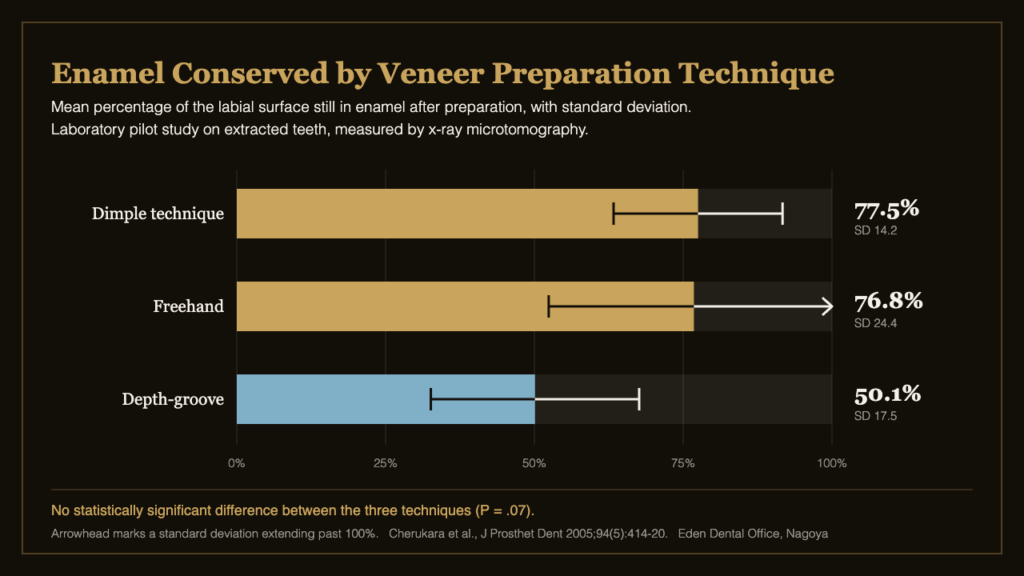
The usual reassurance is that a veneer takes only half a millimeter. That figure is accurate for a tooth that is already in the arch. A pilot study in the Journal of Prosthetic Dentistry used x-ray microtomography and coordinate metrology to map how much enamel survives three common preparation techniques and found preparation depths of 0.4 to 0.6 mm were largely within enamel except in the cervical region — but that the proportion of the labial surface left in enamel ranged widely by technique, from a mean of 50.1% (SD 17.5) with depth grooves to 77.5% (SD 14.2) with the dimple technique, with no statistically significant difference between them. In other words, even a disciplined 0.5 mm preparation on a well-positioned tooth leaves a meaningful fraction of the surface at or through the enamel–dentin junction.
Now rotate that tooth fifteen degrees. The prominent corner has to come back to the arch line, so it absorbs several times the planned depth while the recessed corner is barely touched. That is how a case sold as conservative becomes a case bonded largely to dentin, and porcelain bonded to dentin does not hold the way porcelain bonded to enamel holds. The same retention argument decides whether a case belongs to a bonded shell or to full coverage, and it is why no-preparation veneers only suit teeth already set back from where the final surface needs to be.
Align a little, restore a little
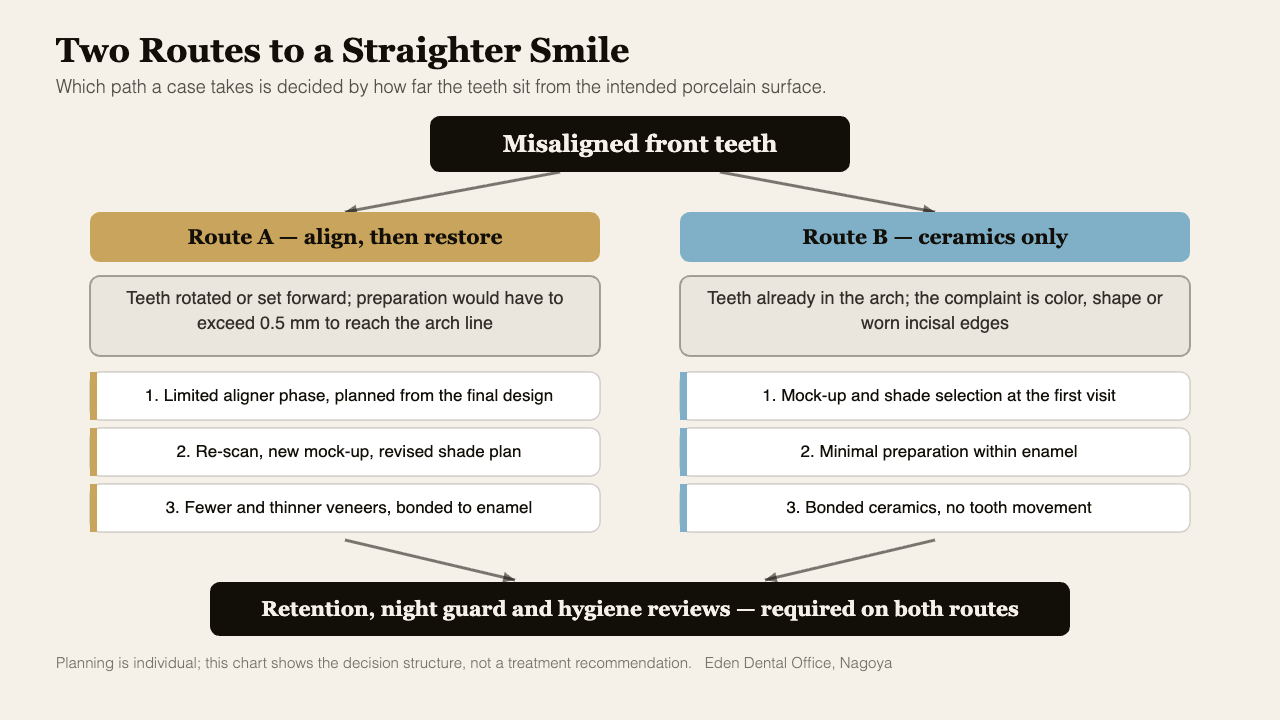
The route skipped most often is the one that usually wins on tooth structure: a short alignment phase whose only job is to put the teeth where the ceramic wants them, followed by thinner, fewer veneers. Six months of aligner wear can convert a case needing ten aggressive veneers into one needing four thin ones. This orthodontics is not comprehensive treatment; it is preparation, planned backwards from the final restorative design rather than toward an ideal occlusal outcome.
Honesty about the alignment side is required too. Aligner plans create space with interproximal enamel reduction, and that reduction is not delivered as planned. A Progress in Orthodontics study of 40 patients across ten clinicians found the amount of enamel actually removed differed from the digital plan by 0.55 mm on average in the upper arch and 0.82 mm in the lower, with accuracy estimated at 44.95% and 37.02% respectively; in most cases less enamel was removed than planned, and the authors judged the absolute differences unlikely to be clinically important. Two readings follow: interproximal reduction is real enamel loss and belongs in the ledger, and a digital setup is a proposal rather than a record of what happened in the mouth.
How the decision is made at Eden
At Eden we settle this before any tooth is touched, using an intraoral scan, standardized photographs and a Digital Smile Design mock-up of the intended outcome. The scan is overlaid on the proposed final contours and we measure the gap between where each tooth sits and where the porcelain surface needs to be. Where that gap exceeds what 0.5 mm of preparation can absorb, the case is an alignment case first; where the teeth are already close and the complaint is color, shape or edge wear, ceramics alone is the direct answer. The mock-up is then placed in the mouth so the discussion happens in front of a mirror rather than on a screen. Appliances and provisional restorations come from our in-house digital laboratory, which is what makes a combined plan practical for patients traveling in.
| Finding at examination | Which way it pushes |
|---|---|
| Mild crowding, teeth good color and shape | Alignment alone may finish the case |
| Rotated or labially placed anterior teeth | Align first; the veneer becomes thinner and safer |
| Teeth in line, discolored or worn edges | Ceramics alone, minimal preparation |
| Existing crowns or heavily filled teeth in the smile | Restorative-led plan; alignment may still assist |
| Short-looking teeth with a low gum line | Assess the gum before either route |
| Patient unwilling to wear a retainer | Alignment result will drift; plan accordingly |
The gum-line entry is not a footnote. A tooth can look short because it is buried rather than worn, which is settled by assessing the soft tissue before ceramics are designed. Rebuilt in stages, the sequence is gum, then position, then porcelain.
What this costs in Japan
Both routes are self-pay; neither aligner treatment nor cosmetic ceramics is covered by Japanese national health insurance. Published anchors at Eden are the check-up package at ¥40,000, the whitening package at ¥75,000, and annual membership from ¥88,000 to ¥288,000. Fees for aligners and for veneers depend on how many teeth are involved, the ceramic system chosen and the number of stages, so they are quoted individually rather than advertised as a figure — see the fee page for current published items. Every patient receives a written estimate in English, itemized by stage, before treatment begins.
One practical point: a combined case has two phases and therefore two schedules. Patients flying in should read it alongside the practicalities of arranging dental treatment around a trip to Nagoya, since remote aligner monitoring can absorb most of the alignment phase while the ceramic phase is compressed into one visit. Long-term running costs sit with the restorations, and are set out in the guide to veneer materials, longevity and cost.
Frequently Asked Questions
Can veneers straighten teeth without braces?
They can make teeth look straight if the misalignment is slight. The correction is cosmetic camouflage achieved by removing enamel from the prominent surfaces, and the further a tooth sits out of line, the more of it is spent.
How long does alignment before veneers usually take?
Limited alignment intended only to position teeth for restoration is shorter than comprehensive orthodontics, often months rather than years. The figure depends on the movements required and is estimated after the scan.
Will I need a retainer if I have veneers afterwards?
Yes. Teeth moved by any appliance tend to drift back, and drift under bonded ceramics puts stress on the margins. Retention is part of the plan, not an optional extra.
Is composite bonding a shortcut for crooked teeth?
Sometimes, for small corrections and with a shorter service life. The comparison is set out in the review of veneers against composite bonding.
I already have a veneer quote. Should I get another opinion?
If the plan involves preparing several healthy front teeth, a second reading of the case is reasonable. We offer second opinions in English as a standalone appointment.
Risks, limits and what to expect
Aligner treatment requires wear discipline; results depend on hours worn, and teeth relapse without retention. Interproximal enamel reduction is irreversible and imprecise, as the data above shows. Veneer preparation is also irreversible: a prepared tooth needs a restoration from then on, veneers can debond, chip or fracture, margins can discolor over years, and teeth may be sensitive after preparation. Cases finished on dentin rather than enamel carry a higher debonding risk. Bruxism raises the restorative risk and is managed with a night guard, as described in the notes on daily veneer care. No route removes the need for maintenance, and none is covered by insurance. Individual results vary.
If you want this trade explained against your own scan rather than in general terms, an examination and a Digital Smile Design mock-up will answer it in one appointment. The wider service is described on the aesthetic treatment page, and English enquiries are handled by WhatsApp.