Porcelain Veneers in Japan: Costs, Materials and Longevity
Reviewed by Dr. Ryosuke Murai, DDS, MSD — Prosthodontist, trained at Indiana University School of Dentistry (U.S.). Last updated August 2026.
A porcelain veneer is a thin shell of ceramic bonded to the front of a tooth. That single sentence hides every decision that matters: how much enamel is removed, which ceramic is used, who designs the shape, and whether a veneer is the right restoration for your tooth in the first place. This guide covers porcelain veneers in Japan for self-pay patients — what the published evidence says about how long they last, how feldspathic porcelain and lithium disilicate genuinely differ, how much tooth structure a careful preparation removes, when a crown is the more honest recommendation, and how the fee is built. It is written for patients comparing Japan against clinics in Tokyo, Singapore, London or the United States, and it assumes you would rather read the reasoning than a list of promises.
What a veneer is, and what it is competing against
A veneer covers the visible face of a tooth and usually wraps slightly over the biting edge. It is held on by an adhesive bond, and the strength of that bond depends almost entirely on the substrate it meets. Ceramic bonded to enamel forms a durable, well-documented union. Ceramic bonded to dentin — the softer, more organic layer beneath enamel — does not perform as well, and every reputable preparation protocol is designed around staying in enamel wherever possible.
This is why “how much tooth is removed” is not a cosmetic detail but the central clinical question. It determines whether the restoration is bonded to the substrate that holds it most reliably, and it determines whether the change is reversible in any meaningful sense. Enamel does not regenerate.
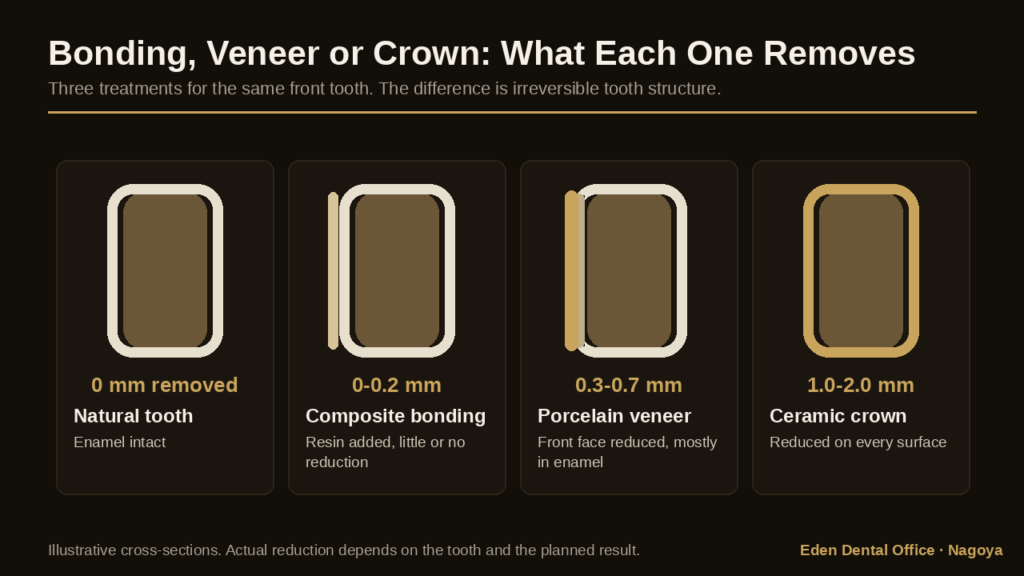
Three treatments compete for the same patient. Composite bonding is resin sculpted directly onto the tooth in a single visit: reversible, far less expensive, and it stains and chips sooner. A porcelain veneer is laboratory-made ceramic covering the front surface. A ceramic crown encircles the entire tooth and requires reduction on all sides. The three are not a ladder from cheap to good — they answer different problems, and choosing the largest one by default is how patients end up with more dentistry than they needed.
Materials: feldspathic, lithium disilicate, zirconia
Most conversations about veneer materials are conducted as though one is simply better than the others. The published data does not support that framing, and it is worth looking at what it does show.
| Material | Typical thickness | Optical character | Where it fits |
|---|---|---|---|
| Feldspathic porcelain | 0.3–0.6 mm | Highest translucency; layered by hand | Front teeth where the goal is depth and life-like light behavior, with intact enamel underneath |
| Lithium disilicate | 0.5–0.8 mm | Translucent, with more control over masking | The general-purpose choice: discoloration to hide, edge wear to rebuild, or heavier function |
| Zirconia | 0.5–1.0 mm | Strongest, least translucent | Rarely a first choice for a veneer; used where strength dominates the requirement |
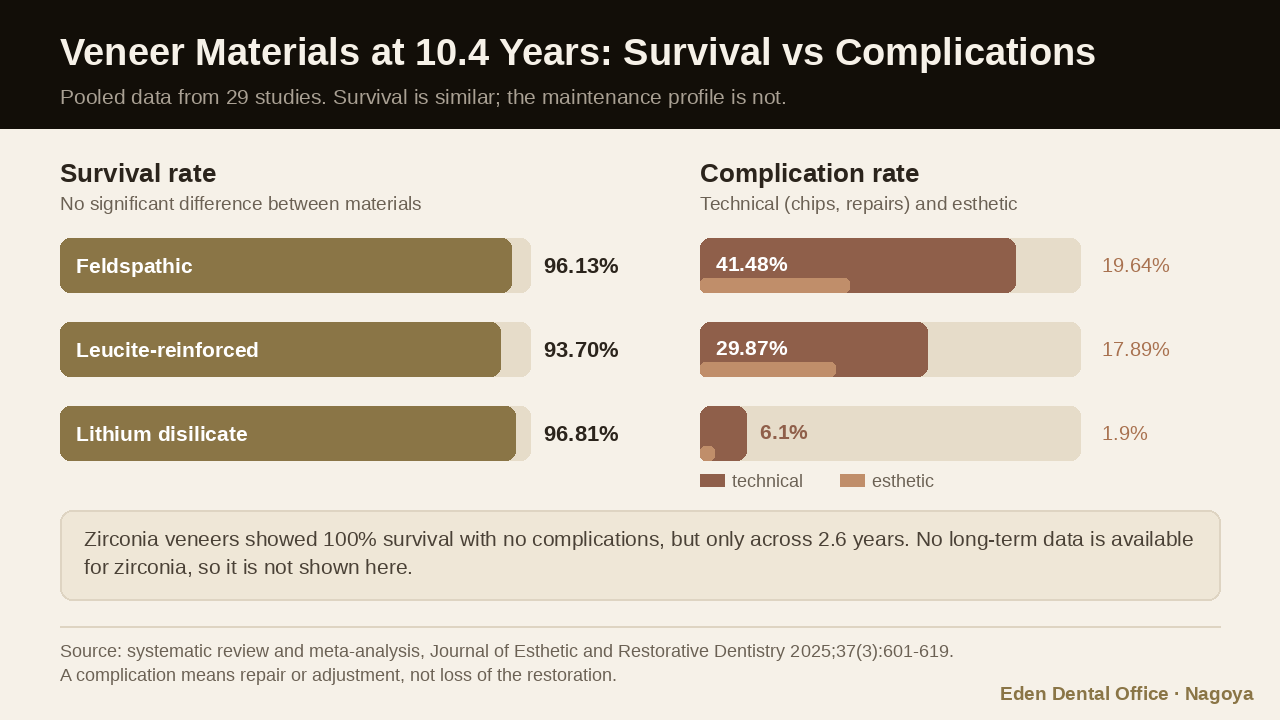
A 2025 systematic review and meta-analysis in the Journal of Esthetic and Restorative Dentistry pooled twenty-nine studies and found survival rates at 10.4 years of 96.13% for feldspathic, 93.70% for leucite-reinforced and 96.81% for lithium disilicate veneers, with no statistically significant difference between the materials. Survival, in other words, is not where they separate.
Complications are. In the same review, technical complication rates at 10.4 years ran to 41.48% for feldspathic and 29.87% for leucite-reinforced, against 6.1% for lithium disilicate; esthetic complications followed the same pattern (19.64% and 17.89% against 1.9%). A “complication” here covers chipping, marginal discoloration and repairs — not loss of the restoration. So the practical reading is that a feldspathic veneer is likely to still be in place at ten years, but considerably more likely to have needed attention along the way. Zirconia veneers showed 100% survival with no complications, but only across 2.6 years of observation, and the authors note there is no long-term data. That absence should be stated plainly rather than presented as a strength.
None of this makes the material choice automatic. Feldspathic porcelain remains the finest instrument available for a single front tooth that must disappear beside its natural neighbor, because it can be layered to match translucency that a pressed ceramic approximates. The trade-off is a higher maintenance profile. That is a conversation to have before treatment, not after.
How much enamel is actually removed
Preparation depth is where marketing and clinical reality diverge furthest. “No-prep” veneers are genuinely possible on some teeth — typically small or retruded teeth with room to add volume outward. They are not possible on a tooth that is already in a normal position, because bonding ceramic to its unreduced surface makes it bulkier and pushes the gum. Promising a no-prep result before seeing the tooth is not a clinical judgment.
A conventional veneer preparation removes roughly 0.3 to 0.7 mm from the front surface, tapering thinner toward the gum. Done well, most of that remains within enamel. Done to hide heavy discoloration or to correct crowding, it goes deeper and may reach dentin in places, which changes both the bond and the long-term outlook. The honest way to present a plan is to say which of these two situations applies to your teeth.
At Eden, the sequence is deliberately reversed from the way it is often done. We design the intended result first — using Digital Smile Design against photographs, an intraoral scan and facial reference — and produce a physical mock-up you wear before anything is touched. The preparation is then guided through that mock-up, so ceramic thickness is cut for where the final tooth will be, not measured from where the tooth happens to sit now. In practice this removes less enamel than freehand preparation, and it means you have seen and approved the shape before it becomes irreversible. Our in-house laboratory then builds to that approved design rather than interpreting it secondhand.
When a crown is the more honest recommendation
A veneer is the conservative option only when the tooth can support one. Where a tooth is heavily filled, root-treated, fractured, or has lost a substantial part of its structure, there may not be enough sound enamel left to bond to — and a veneer placed on such a tooth transfers force to a weakened remainder. A crown, which distributes load around the whole tooth, is then the more predictable choice even though it removes more.
Crowns carry their own complication profile, and it is not trivial. A systematic review in Clinical Oral Implants Research found that about 86.7% of metal-ceramic single crowns and 83.8% of zirconia single crowns were free of any biological or technical complication over the observation period — good figures, but a reminder that no restoration is a finished transaction. Choosing a crown should follow from what the tooth requires, not from a preference for the more definitive-sounding option.
Signals that point toward a crown rather than a veneer: a large existing restoration occupying much of the tooth, previous root canal treatment, a visible crack, severe wear that has removed the biting edge, or a bite that loads the tooth heavily. Signals that favor a veneer: intact or lightly filled teeth, discoloration that whitening has not resolved, small chips, minor rotations, and gaps. Where a bite problem is driving the wear, the honest answer is often that material selection matters less than the forces acting on it, and the forces have to be addressed first.
There is a third category worth naming, because patients rarely arrive expecting it: teeth that are in the wrong position rather than the wrong shape. Grinding down a rotated or protruding tooth so that ceramic can sit flush with its neighbors is a large, irreversible correction of a problem that aligners often solve without touching enamel at all. Where the underlying issue is position, our treatment overview covers the orthodontic route, and a veneer — if still wanted — becomes a much smaller procedure afterward.
How treatment runs, visit by visit
Veneer treatment in Japan is self-pay and typically runs across three to four appointments over two to four weeks. The sequence we use is:
| Stage | What happens | What you decide |
|---|---|---|
| Records and design | Photographs, intraoral scan, shade analysis, bite assessment, Digital Smile Design | Nothing yet — you review a proposal |
| Mock-up | The design is transferred to your teeth in temporary material and worn | Whether the shape and length are right, before any preparation |
| Preparation and provisionals | Guided preparation through the approved design; temporary veneers fitted | Refinements carried into the final design |
| Try-in and bonding | Ceramic tried in with water or paste, checked in daylight, then bonded | Final approval — the last point at which the shade can change |
Two points matter for patients traveling in. First, the mock-up stage is the one that should never be compressed — it is the only opportunity to change your mind at no cost. Second, having the laboratory in the building is what makes a shortened schedule feasible at all: design, milling and layering run on our timetable rather than a courier’s. Patients arriving from Tokyo by Shinkansen, or from overseas through Chubu Centrair, are usually planned as either two separate visits or one extended stay, and we will tell you which your case needs before you book. Whitening, if you want it, is done before the ceramic is made, because a veneer cannot be lightened afterward — the shade is fixed at the laboratory stage. Our whitening page sets out the packages and how they are sequenced.
What porcelain veneers cost in Japan
Veneers are not covered by Japanese health insurance under any circumstance, so every quote you receive is a private fee. Clinics differ in what they include, which is why comparing headline numbers between two estimates is close to meaningless without the detail. The components that move a veneer fee are the ceramic used and whether it is layered by hand or pressed and milled; whether the laboratory is in-house or external; whether Digital Smile Design, a mock-up and a try-in stage are included; how many teeth are treated, since a single front tooth beside natural neighbors is the hardest shade problem in dentistry and often costs more per unit than eight teeth done together; and whether provisionals and follow-up adjustments are inside the fee or billed separately.
Our published fees, including the comprehensive check-up package at ¥40,000 and whitening at ¥75,000, are set out on the fee page. Veneer figures depend entirely on the assessment — the number of teeth, the material, and whether the bite needs addressing first — and are confirmed in a written, itemized estimate in English before anything is scheduled. We do not quote a per-tooth number before examining the teeth, because a number given without a diagnosis is not a quote. The range and its drivers are explained at the consultation, in writing, and the treatment approach is described on our aesthetic dentistry page.
Patients weighing a smaller, less invasive option first should read our comparison of composite bonding against porcelain veneers on cost and lifespan, which sets out the findings that push a case one way or the other.
If you are weighing how much preparation your teeth actually need, our breakdown of no-prep versus conventional veneer preparation explains which teeth suit each approach and why enamel is the deciding factor.
Once the ceramic is bonded, longevity depends far more on load than on cleaning technique. We set out the evidence and the protocol in our guide to protecting veneers with night guards and daily habits.
One planning note: if crowding or rotation is part of what bothers you, moving teeth before preparing them often means thinner veneers or fewer of them. We cover candidacy, timelines and monitoring in our guide to Invisalign treatment in Japan in English.
If whitening is part of your veneer plan, our guide to teeth whitening in Japan explains why the shade change comes first and how long it needs to stabilize.
Where a tooth has lost too much structure for a bonded shell, the comparison changes shape entirely: our discussion of veneers versus crowns in Japan sets out the three structural questions that decide it.
Where a smile looks short because the gum sits low rather than because the teeth are worn, the ceramic stage waits on a separate decision entirely — set out in our guide to gum contouring and crown lengthening before veneers.
Where teeth are not only discolored but out of position, the material choice is only half the question. The sequencing decision — whether to align the teeth before any porcelain is designed — often decides how much enamel the case ends up spending.
Where only one tooth needs restoring, the color problem changes character entirely; we set out what governs the result in matching a single front tooth veneer.
Frequently Asked Questions
How long do porcelain veneers last?
Pooled ten-year survival across the main ceramics sits around 94–97%. Longevity depends more on bite forces, grinding and the amount of enamel remaining than on which porcelain was chosen.
Do veneers damage the teeth underneath?
Preparation removes enamel that does not grow back, so the tooth will need a restoration from that point onward. A conservative, enamel-limited preparation keeps that commitment as small as it can be.
Can I have veneers on just one front tooth?
Yes, and it is the most demanding case there is, because the result must match a natural neighbor exactly. It usually calls for layered ceramic and a shade appointment in daylight.
Will veneers look obviously artificial?
That depends on design and translucency, not on the material category. The mock-up stage exists so you can see and adjust the proposed shape on your own face before anything is prepared.
Should I whiten my teeth before getting veneers?
If you want a lighter overall result, yes. Ceramic does not respond to whitening agents, so the shade of the surrounding natural teeth should be settled before the veneers are made.
Risks, limits and what to expect
Veneers are an irreversible commitment. Enamel removed for a preparation does not return, and from that point the tooth will always require a restoration of some kind. Ceramic can chip or debond, particularly under grinding, and a night guard is commonly part of the plan rather than an upsell. Temperature sensitivity is usual for a few weeks and occasionally persists. Gum tissue takes time to settle around new margins, and a tooth that was already heavily restored may later need root canal treatment for reasons that predate the veneer. Shade matching against natural teeth has a genuine limit, and a single unit beside untouched neighbors is the hardest case to make disappear. Published survival figures describe populations, not individuals — your bite, enamel and habits determine your own outcome. Individual results vary.
If you are weighing a veneer proposal — ours or another clinic’s — the most useful hour you can spend is a consultation that separates what your teeth require from what could be done to them. Records, a design proposal and a written estimate in English come before any preparation, and you can reach the practice on WhatsApp. Our aesthetic and cosmetic dentistry page sets out how consultation, design and laboratory work fit together, and patients considering wider reconstruction may find our guide to implant costs in Japan a useful comparison of how self-pay fees are built here.