
Veneers vs Composite Bonding in Japan: Cost and Lifespan
Reviewed by Dr. Ryosuke Murai, DDS, MSD — Prosthodontist, trained at Indiana University School of Dentistry (U.S.). Last updated August 2026.
A patient who flew in from Singapore last spring asked the question almost everyone asks eventually: “Couldn’t you just bond the chipped edge instead?” Often the answer is yes. Choosing between veneers and composite bonding in Japan is not a ranking exercise — the two treatments remove different amounts of tooth, age at different speeds, and suit different problems. This guide is for self-pay patients who want the reasoning: what each procedure physically does, what the published survival data shows, how the cost behaves over ten years rather than on the day, and where the line between them falls in our own planning.
The physical difference: sculpted resin versus a bonded ceramic shell
Composite bonding is tooth-colored resin placed and shaped by hand in the mouth and hardened with a curing light, freehand or against a silicone index, in a single appointment. Nothing goes to a laboratory, and in many cases little or no enamel is removed — a chipped incisal edge or a small gap can be closed with the tooth left essentially intact.
A porcelain veneer is a thin ceramic shell made outside the mouth and bonded to the prepared tooth. Because ceramic must occupy space to look natural and resist fracture, some enamel usually has to be reduced — a fraction of a millimetre on the facial surface, more where the tooth sits forward of the intended smile line. That reduction cannot be undone, which is the most important distinction between the two options. The ceramic side of the decision is covered in full in our guide to how porcelain veneers are planned, priced and maintained in Japan.
What the evidence says about how long each one lasts
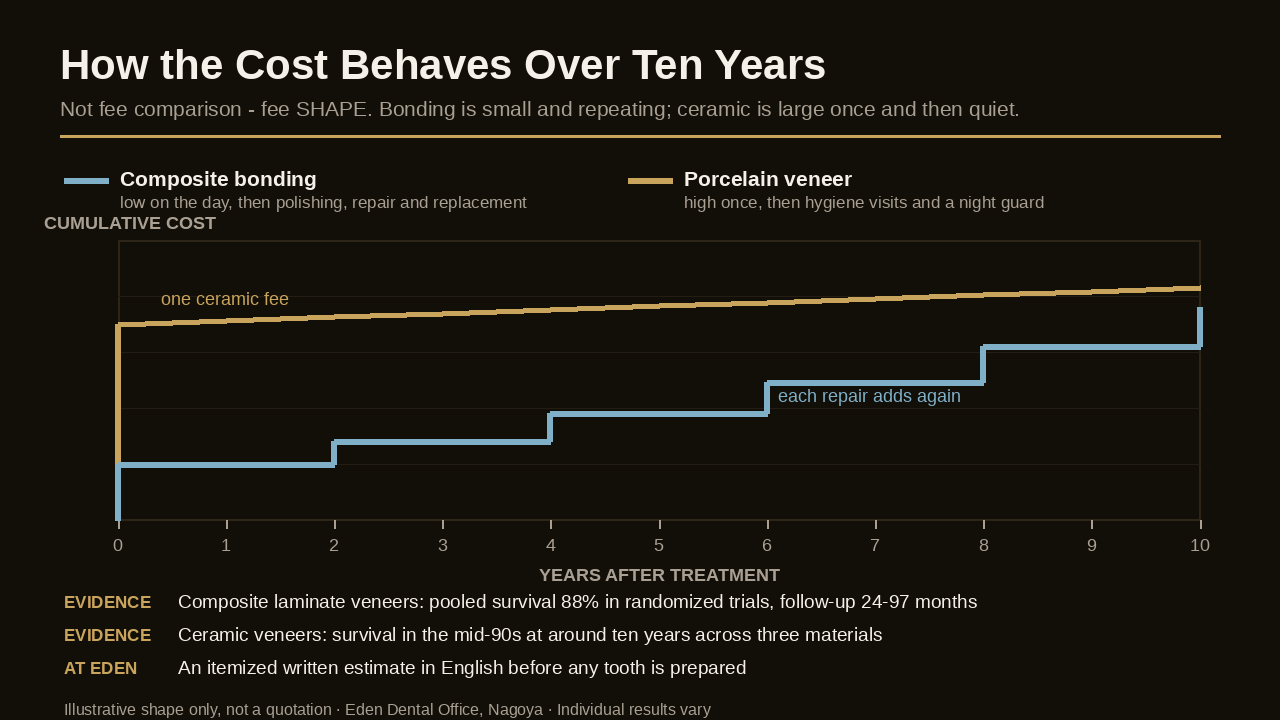
This is where the conversation usually gets vague, so it is worth quoting real numbers. A 2023 systematic review and meta-analysis in the Journal of Evidence-Based Dental Practice screened 827 articles and pooled seven studies on resin composite laminate veneers. Across the randomized trials, pooled survival was 88% (95% CI 81–94%), with mean follow-up of 24 to 97 months. The most frequently reported problems were fracture and chipping, color mismatch, and marginal discoloration — and the directly placed group survived better than the lab-made composite group, which is not what most patients assume.
For directly placed anterior composite more broadly, a 2021 systematic review in the Journal of Conservative Dentistry evaluated 75,637 restorations and found annual failure rates spanning 0% to 27.11%, with survival rates from 28.6% to 100%, and fracture as the leading cause of failure. That spread is the real message: composite outcomes depend heavily on case selection, the bite, and the hand that placed it. Ceramic results cluster far more tightly: the meta-analysis reviewed in our article on veneer materials and ten-year longevity puts survival for feldspathic, leucite-reinforced and lithium disilicate veneers in the mid-90s, with no significant difference between them.
| Composite bonding | Porcelain veneer | |
|---|---|---|
| Where it is made | In your mouth, freehand | Our in-house laboratory, from a digital scan |
| Enamel removed | Often none or minimal | Usually required; not reversible |
| Appointments | Typically one | Records and design, preparation, fitting |
| Published longevity | Wide range; RCT-pooled survival 88% for composite laminates | Mid-90s percent survival at around ten years |
| Main failure mode | Fracture, chipping, staining at the margin | Debonding or fracture, usually from bite forces |
| Repairability | Repaired or re-polished chairside | Usually replaced rather than repaired |
| Color stability | Dulls and picks up stain over years | Glazed ceramic does not absorb stain |
Why composite changes color and ceramic does not
Composite is a resin matrix loaded with glass or ceramic filler. The resin phase absorbs water and stains, and its surface polish degrades under brushing and chewing; a microscopically rougher surface holds pigment from coffee, tea, red wine and tobacco. Patients notice it first at the margin, where resin meets enamel — a fine dark line appears long before the restoration is failing structurally.
Glazed porcelain has no organic matrix to absorb anything. It holds its color, which is both an advantage and a planning constraint: it will not lighten later. If you are considering professional whitening, do it before ceramic shades are selected, not after. It is also worth knowing how long that lighter shade will last, since the ceramic keeps the shade it was made in while the surrounding enamel does not — whitening longevity and what makes it fade sets a realistic expectation for the years after bonding.
What each costs, and why the ten-year figure is the one that matters
Eden publishes fixed prices for the treatments that can honestly be fixed: a comprehensive check-up package at ¥40,000, a whitening package at ¥75,000, and annual membership tiers from ¥88,000 to ¥288,000. Aesthetic work on individual teeth cannot be priced that way from a distance — the fee depends on how many teeth are involved, whether the bite has to be adjusted, the ceramic system chosen, and whether orthodontic movement comes first. What we do commit to is process: an itemized written estimate in English before any tooth is touched. Current ranges are set out on our fee page.
The shape of the cost is more useful than any single number. Bonding is inexpensive on the day and recurring afterwards — polishing appointments, repairs after a chip, replacement as the shade drifts from the neighbouring teeth. Ceramic is expensive once and then largely quiet, with upkeep limited to hygiene visits and, for patients who grind, a night guard. Over ten years the two curves often converge. We make the same argument about full-arch prosthetics in our comparison of acrylic-titanium versus monolithic zirconia bridges, and about implant upkeep in our ten-year maintenance cost breakdown.
How we decide, case by case
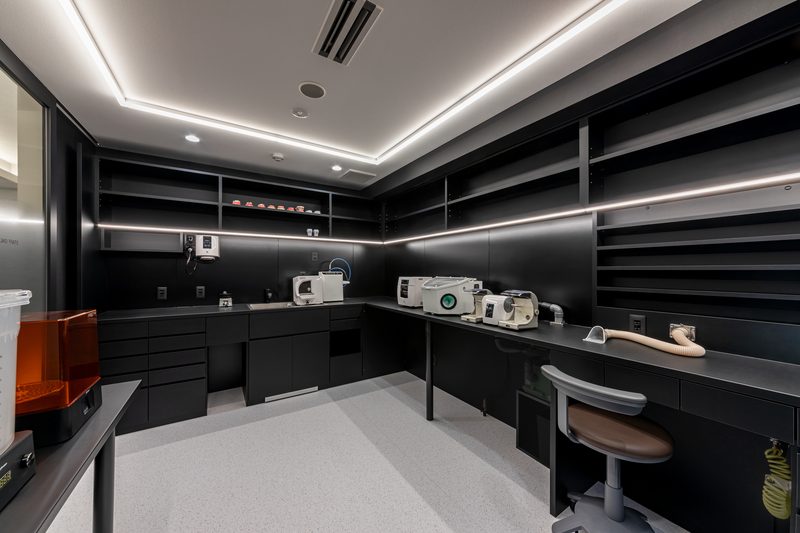
At Eden the decision is made against a design rather than a preference. Every aesthetic case starts with photographs, an intraoral scan and a Digital Smile Design study, from which our in-house laboratory produces a physical mock-up you wear before anything is prepared. Seeing the proposed shape in your own mouth settles questions that discussion does not, and it regularly changes the plan — patients often ask for less change than they did at the first appointment.
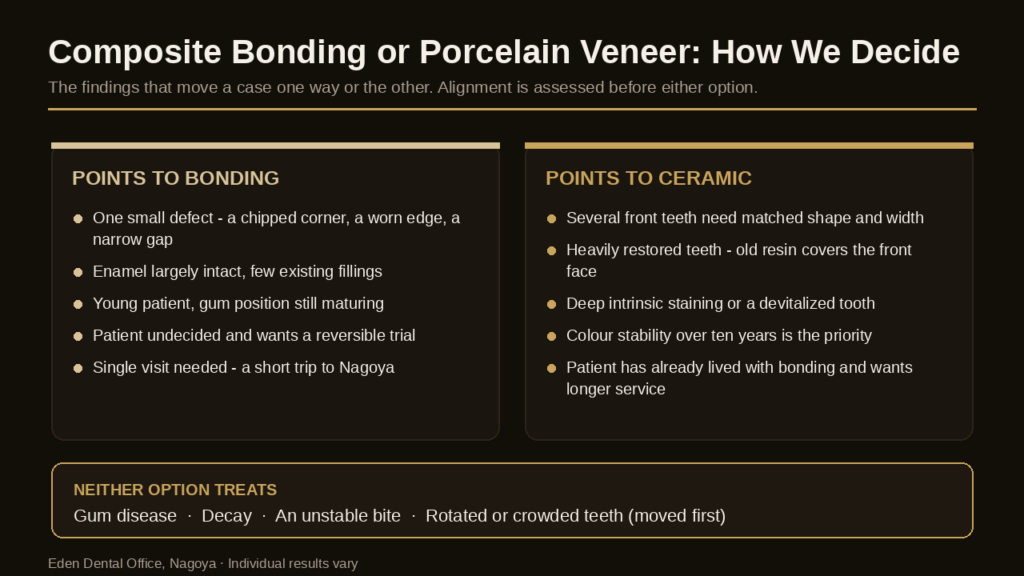
Three findings push us toward bonding. A single small defect: a chipped corner, a worn edge, a narrow gap between otherwise well-aligned teeth. A young patient whose gum position is still maturing, where removing enamel now commits them to a lifetime of replacements. Or an undecided patient — bonding works as a reversible trial they live with for a year before committing to ceramic.
Three findings push us toward ceramic. Heavily restored teeth, where old fillings already occupy much of the facial surface and more resin means bonding to resin rather than enamel. Teeth needing a real change in shape, position or width across several units, where hand-sculpting six matched teeth asks more of the material than it can deliver. And discoloration deep in the dentine — tetracycline staining or a devitalized tooth — which resin tends to show through.
Alignment sits above both. If teeth are rotated or crowded, the honest recommendation is usually to move them first, because straightening a tooth costs no enamel at all. Our orthodontic and general treatment page covers the aligner route; we would rather run a patient through six months of aligners than reduce four healthy teeth to disguise their position.
If you are traveling to Nagoya for treatment
Patients coming from Tokyo, Osaka or overseas ask which option compresses better into a short trip. Bonding is single-visit, so a chipped edge is handled in one afternoon. Ceramic needs records and design, preparation with provisional restorations, and a fitting — but because our laboratory sits inside the clinic rather than three days away by courier, we can often stage a veneer case into two visits inside one week instead of three visits over two months. Nagoya is roughly 100 minutes from Tokyo by Shinkansen and 40 minutes from Chubu Centrair Airport, and we sequence appointments around your travel dates before you book anything. The full range of options is described on our aesthetic treatment page.
And once ceramic is the direction, the next decision is preparation depth — see who suits a no-prep veneer and who does not before booking records.
Whichever material you choose, the maintenance rules diverge less than people expect. See how veneers are protected day to day, and when a night guard becomes necessary.
There is also a third path worth naming: when the underlying issue is position rather than shape or color, neither bonding nor ceramic is the first move — an aligner case planned and explained in English may resolve it with no tooth reduction at all.
Both materials are matched to the shade your natural teeth hold, so read our guide to whitening in Japan for English speakers before finalizing either plan.
If the tooth in question has already been heavily restored, the more relevant comparison may not be ceramic against composite but a veneer against a full-coverage crown.
Frequently Asked Questions
Can composite bonding be replaced with veneers later?
Yes. Resin is removed and the tooth is then prepared for ceramic. Starting with bonding does not close the ceramic door.
How long does composite bonding actually last?
Published survival varies widely. Pooled data on composite laminate veneers shows 88% survival in randomized trials over follow-ups of two to eight years, but longevity depends on your bite, grinding habits and diet.
Does bonding damage the tooth underneath?
Bonding is minimally invasive and often needs no enamel removal. The risk sits at the margin, where an unpolished edge can trap plaque and cause decay if hygiene slips.
Will my bonded teeth whiten with the rest?
No. Whitening gel lightens natural enamel and dentine only. Resin and ceramic keep their original shade, so whitening comes before shade selection.
Do you offer consultations in English?
Yes. Consultations, written estimates and follow-up are handled in English, and WhatsApp is the fastest way to reach the clinic from outside Japan.
Costs, risks and limitations
Both treatments carry real downsides. Composite bonding stains, dulls and chips, and needs periodic polishing, repair and eventual replacement; margins can discolor within a few years. Porcelain veneers require irreversible enamel reduction, can debond or fracture — particularly in patients who clench or grind — and are usually replaced rather than repaired when they fail. Sensitivity after preparation is common and normally settles within weeks. Neither option treats gum disease, decay or an unstable bite, all of which are addressed first. Outcomes depend on hygiene, bite forces, diet and attendance at maintenance appointments. Individual results vary.
If you are weighing the two, the next step is a consultation with photographs, a scan and a written estimate in English before any commitment. Details sit on the page covering our cosmetic and aesthetic work, and WhatsApp is the quickest route to an appointment from anywhere in Japan or abroad.
If you already have veneers and wonder whether they are due for attention, our article on replacing old veneers in Japan explains when repair, re-bonding or replacement makes sense.
More on this topic: Veneer and Cosmetic Guides — every article we have published in this cluster, grouped by stage.