No-Prep Veneers in Tokyo & Japan: Who They Fit
Reviewed by Dr. Ryosuke Murai, DDS, MSD — Prosthodontist, trained at Indiana University School of Dentistry (U.S.). Last updated August 2026.
“No drilling” is the phrase that sells no-prep veneers, and it deserves a closer look. No-prep veneers in Japan are a genuine option — ultra-thin ceramic bonded to the tooth with little or no reduction — but they fit a narrower range of teeth than the marketing suggests. Place them on the wrong tooth and you trade enamel preservation for a bulky contour and an irritated gumline. This guide is written for self-pay patients comparing cosmetic dentistry options in English: what “no-prep” technically means, which teeth it suits, what the survival data show, and how we make the call at our Nagoya clinic. If you are still weighing veneers as a category, start with our complete guide to porcelain veneers in Japan and return here for the preparation decision.
What “No-Prep” Actually Means
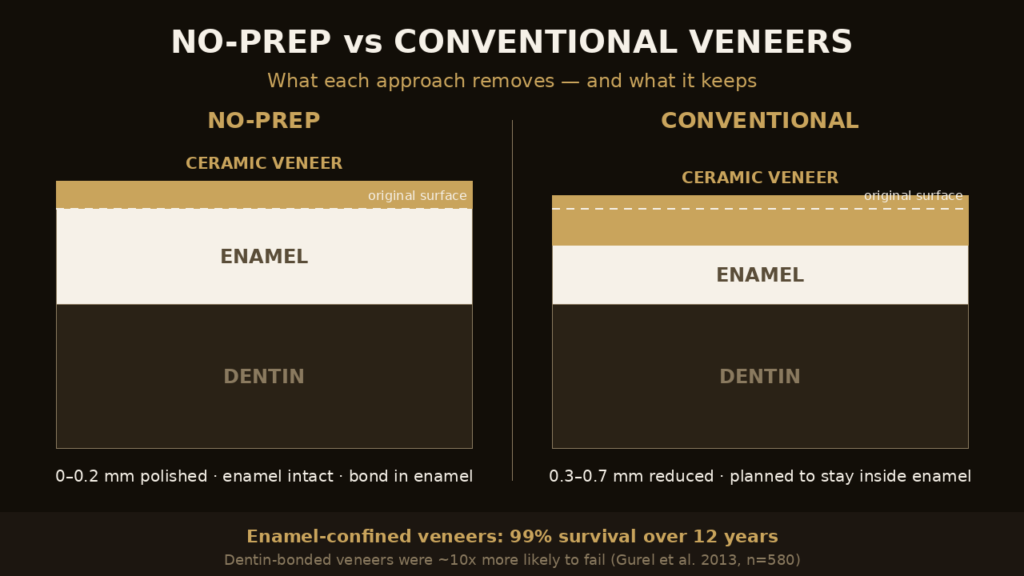
A conventional porcelain veneer requires the tooth surface to be reduced by roughly 0.3–0.7 mm so the ceramic can replace that thickness without changing the tooth’s overall contour. A no-prep veneer skips or nearly skips that step: the ceramic — usually feldspathic porcelain or lithium disilicate pressed to about 0.2–0.5 mm — is bonded directly onto the unreduced surface, sometimes after light polishing of less than 0.2 mm.
The distinction that matters clinically, however, is not “drilled versus not drilled.” It is enamel versus dentin. Bonding to enamel is the strongest, most durable adhesive interface in dentistry; once a preparation cuts through to the softer dentin underneath, bond strength and longevity drop sharply. A well-planned conventional preparation stays inside enamel. A no-prep veneer makes staying in enamel automatic — that is its real advantage, not the absence of a drill.
No-Prep vs Conventional Preparation, Side by Side
| Factor | No-prep veneer | Conventional veneer |
|---|---|---|
| Tooth reduction | None, or under 0.2 mm polishing | Approx. 0.3–0.7 mm, planned within enamel |
| Anesthesia | Usually unnecessary | Often used for comfort |
| Reversibility | Largely reversible if enamel untouched | Not reversible — ceramic must stay |
| Ceramic thickness | 0.2–0.5 mm | 0.5–0.8 mm |
| Masking dark teeth | Limited — thin ceramic is translucent | Better — more thickness to block color |
| Correcting position | Can add out, cannot pull in | Moderate corrections possible |
| Contour risk | Can look or feel bulky on prominent teeth | Contour controlled by the preparation |
| Typical fit | Small, worn, spaced or set-back teeth | Most other veneer cases |
Who Suits No-Prep — and Who Does Not
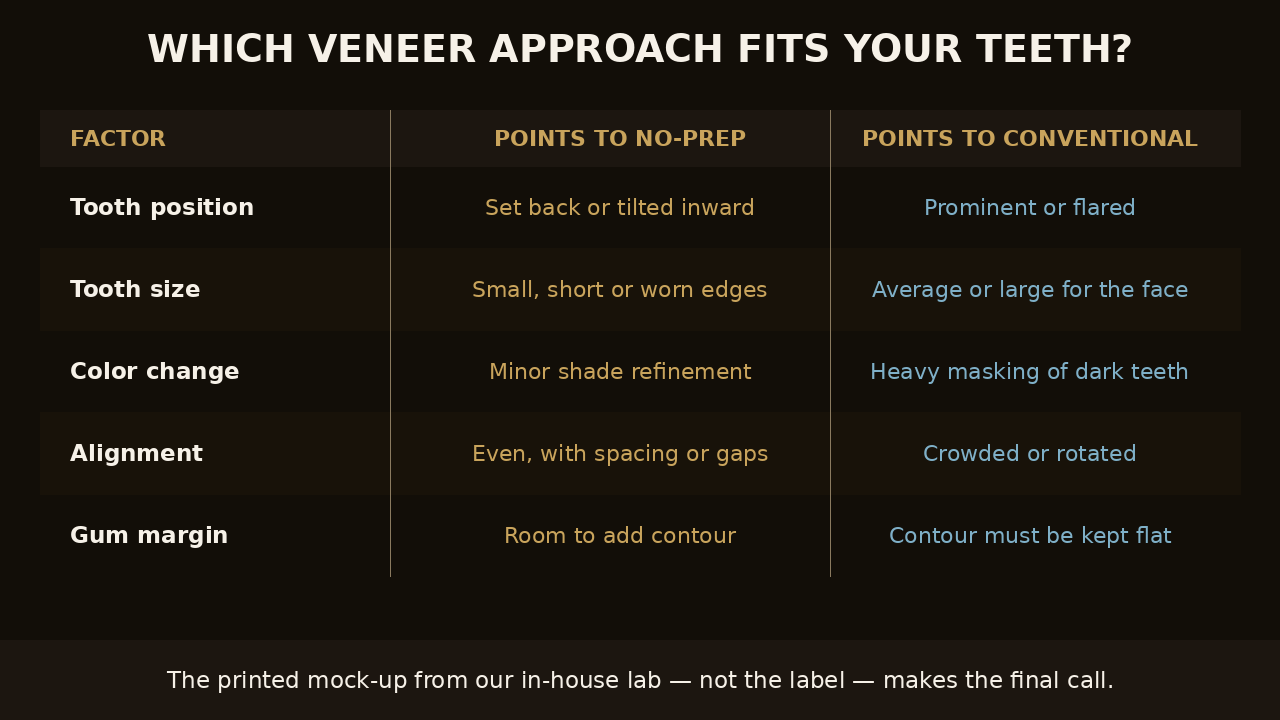
Because a no-prep veneer only adds material, the starting geometry of your teeth decides almost everything. The approach tends to work well for teeth that are small for the face, worn short at the edges, spaced with gaps, or positioned slightly inward — situations where adding 0.3 mm of ceramic moves the result toward the ideal contour rather than past it.
It tends to work poorly for teeth that are already prominent or flared, for crowded and rotated teeth, and for deeply discolored teeth. On a prominent tooth, added ceramic pushes the surface outward into an over-contoured shape; at the gumline, an over-bulked margin collects plaque and can keep the gum chronically inflamed. A single dark, root-treated tooth is similarly better lightened by internal bleaching before ceramic is considered. Crowding is usually better solved by moving the teeth first — we cover the alignment-first logic on our orthodontic and restorative treatments page — and severe internal staining usually needs either the masking thickness of a conventional veneer or a whitening phase beforehand. Since ceramic does not bleach, we sequence any professional whitening before the shade of a veneer is chosen, never after.
Two boundary cases are worth naming. If the tooth needs only a minor edge repair or a single small gap closed, composite bonding may be the more proportionate choice — we compare the two directly in that article. And if the tooth is missing rather than intact, no veneer applies at all; that conversation starts with implant treatment and its costs in Japan.
What the Evidence Says About Longevity
The strongest argument for keeping veneer preparations minimal comes from a retrospective study of 580 porcelain laminate veneers followed for up to 12 years by Gurel and co-workers. Overall cumulative survival was 86%, but the figure concealed a sharp split: veneers with preparations confined to enamel survived at 99%, while veneers bonded to dentin — or with margins ending in dentin — were roughly 10 times more likely to fail (Int J Periodontics Restorative Dent 2013). Enamel preservation is not a stylistic preference; it is the single variable with the largest measured effect on whether a veneer is still in place a decade later.
For no-prep and vertical-preparation techniques specifically, a 2022 retrospective study followed 170 feldspathic ceramic veneers placed with minimally invasive protocols for up to 7 years and reported 91.77% survival, with core fracture the main failure mode and minor chipping managed by polishing (Materials 2022). Read together, the two studies frame the trade honestly: no-prep secures the enamel bond that drives longevity, but very thin ceramic accepts a modest fracture and chipping risk — which is exactly why case selection, bite analysis and a night guard for grinders matter more than the technique’s name.
How We Decide at Eden: The Mock-Up Comes First
At Eden, no veneer case starts with a drill. We photograph and scan the teeth, plan the target shapes with Digital Smile Design, and have our in-house laboratory print a trial version you wear over your own teeth — so you see the proposed result in your mouth before any preparation is chosen. That trial answers the no-prep question mechanically rather than rhetorically: if the mock-up looks right with material only added, your case is a no-prep candidate; if it only looks right when some surfaces come back, we plan the smallest reduction that stays inside enamel, verified against the scan. Because milling and printing happen in-house, patients flying in from Tokyo or from abroad can usually compress the mock-up, refinement and final bonding into a short series of visits — WhatsApp us in English and we will map the schedule before you book travel.
Preparation depth is only half the durability question; the other half is what happens to the restoration every night. Read what actually protects a porcelain veneer over twenty years.
And when teeth are too rotated or crowded for any no-prep approach, alignment first can bring them into range, and we plan and monitor that stage before any veneer work begins.
At the other end of the spectrum, when little sound enamel remains, no preparation design will help. That threshold is mapped in our guide to choosing between veneers and crowns.
Minimal preparation depends on the tooth already having the right visible length. When it does not, the gum line is addressed first — see how gum contouring is planned before veneers.
Thin ceramic has little capacity to hide a dark substrate, which is one reason single-unit shade matching is planned around the prepared tooth rather than the material.
Frequently Asked Questions
Are no-prep veneers really reversible?
Largely, yes. If no enamel was reshaped, the ceramic can be removed and the tooth returns close to its original state, though removal takes careful work.
How long do no-prep veneers last?
Published data show 91.77% survival at up to 7 years for minimally invasive feldspathic veneers, and enamel-bonded veneers generally show the strongest long-term results. Individual results vary.
Do no-prep veneers look bulky?
On well-selected teeth — small, worn or set slightly inward — no. On prominent or crowded teeth they can, which is why we test contours with a mock-up first.
Can no-prep veneers cover very dark teeth?
Rarely well. Ceramic under 0.5 mm stays translucent, so deep discoloration usually calls for whitening first or a conventional veneer with more masking thickness.
How many visits does veneer treatment take?
Typically consultation and records, a mock-up review, and final bonding. Our in-house lab lets us shorten the sequence for patients traveling to Nagoya.
What This Costs
Veneer fees at Eden depend on the number of teeth, the ceramic chosen, and whether a diagnostic mock-up and whitening phase are part of the plan — our fee page explains how self-pay pricing is structured. Every case begins with a comprehensive examination (check-up package ¥40,000), and if whitening precedes the veneer phase, that program is ¥75,000. Before any treatment starts you receive a written estimate in English covering each stage, so a fly-in patient knows the full figure before committing to travel.
Risks and limitations. Veneers of any preparation style carry a risk of chipping, fracture, debonding and post-operative sensitivity; very thin no-prep ceramic is more technique-sensitive and less able to change tooth color, and over-contoured margins can inflame the gum if case selection is poor. Ceramic cannot be whitened after placement, and night grinding shortens the lifespan of any veneer unless a guard is worn. Individual results vary. A consultation with records and a mock-up is the only reliable way to know which approach fits your teeth.
If you are comparing veneer approaches from anywhere in Japan or overseas, our aesthetic treatment page outlines the full planning process, and our English-speaking team answers questions directly on WhatsApp.
Whether a tooth can take a no-prep result is checked during Digital Smile Design planning before treatment is decided.
More on this topic: Veneer and Cosmetic Guides — every article we have published in this cluster, grouped by stage.