
What If an Implant Fails Under an All-on-4 Bridge in Japan?
Reviewed by Dr. Ryosuke Murai, DDS, MSD — Prosthodontist, trained at Indiana University School of Dentistry (U.S.). Last updated July 2026.
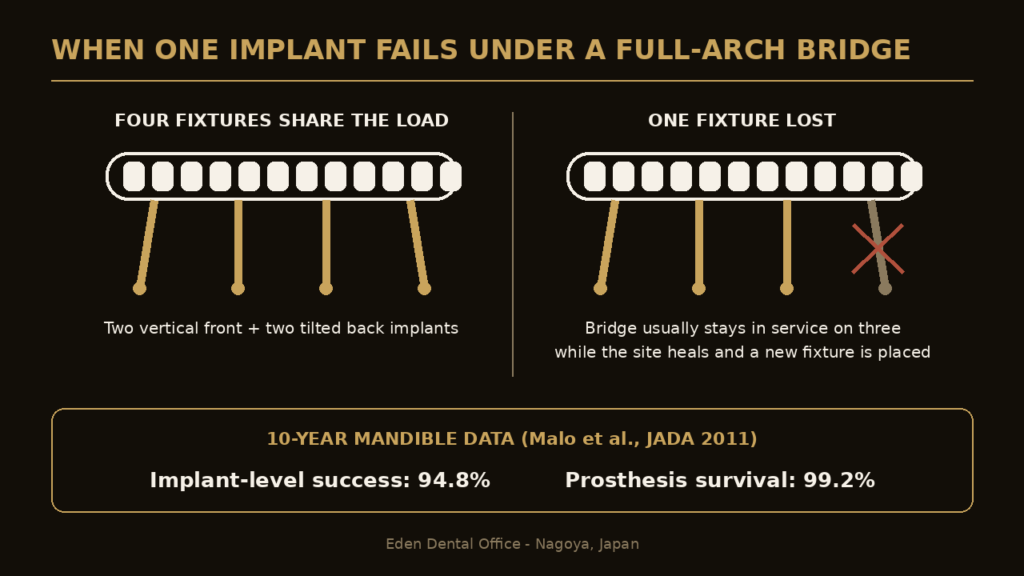
A failed implant under an All-on-4 bridge is rarely the disaster patients imagine. In the longest-running study of the technique, implant-level success over ten years was 94.8% — yet 99.2% of the bridges themselves survived. Those two numbers differ because the treatment is engineered so that the loss of one fixture does not mean the loss of your teeth. This article explains what All-on-4 implant failure actually looks like, how early and late failures differ, and how a repair is planned and priced in Japan. It is written for self-pay patients across Japan and overseas who are weighing full-arch implant treatment and want the engineering explained honestly before they commit.
How Often Do Implants Under a Full-Arch Bridge Fail?
The most cited long-term data comes from Maló and colleagues, who followed All-on-4 patients in the mandible for up to ten years. Across 245 patients, 21 implants failed in 13 patients — a cumulative implant success rate of 98.1% at five years and 94.8% at ten, while prosthesis survival stayed at 99.2%. A later report from the same group extended follow-up to 10 to 18 years across 471 patients and 1,884 implants, with cumulative implant survival of roughly 94%.
Read those figures the way a prosthodontist does: over a decade, roughly one implant in twenty may be lost, but fewer than one bridge in a hundred fails with it. The gap between the two numbers is the whole point of the design, and it is why a single failed fixture is treated as a repair, not a restart. If you are still comparing full-arch options, our guide to how All-on-4 treatment works in Japan covers the concept from the beginning.
Early vs Late Failure: Two Different Problems
Failures cluster at two very different moments, and they have little in common.
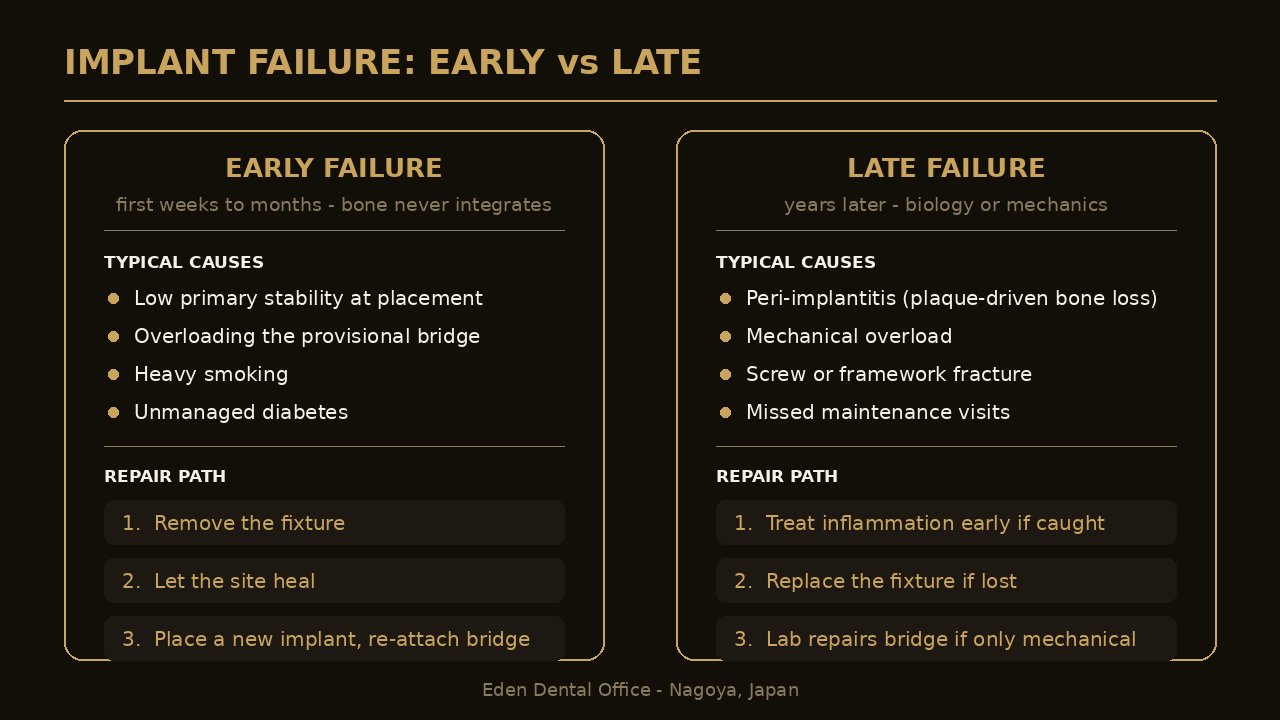
Early failure happens in the first weeks to months, before the bone has fully fused to the fixture. The implant never integrates: it loosens, sometimes with dull discomfort, sometimes silently. Typical contributors are insufficient primary stability at placement, uncontrolled loading of a provisional bridge, heavy smoking, or unmanaged diabetes — the same factors we screen for when assessing whether a patient is a suitable All-on-4 candidate. The remedy is usually contained: remove the fixture, let the site heal, place a new one.
Late failure arrives years afterward, and the dominant cause is biological: peri-implantitis, a progressive inflammation of the bone around the implant driven by plaque accumulation. Reviews of implant patients generally report peri-implantitis in roughly a fifth of patients across all implant types — which is why we treat hygiene under a full-arch bridge as a clinical matter, not an afterthought. Mechanical overload and component fracture make up most of the remainder. The daily routine that protects the investment is described in our article on cleaning and maintaining All-on-4 implants.
Why the Design Tolerates a Single Failure
An All-on-4 bridge is supported by four fixtures — two vertical in the front, two tilted in the back — sharing load across the whole arch. That redundancy is deliberate. If one implant is lost, the remaining three can usually carry a reinforced or temporarily shortened bridge while the site heals. What actually happens depends on which fixture fails and where:
| Scenario | What happens to the bridge | Typical response |
|---|---|---|
| One tilted (posterior) implant fails early | Usually stays fixed on the remaining three; the span over the failed site may be relieved | Remove fixture, allow healing, place a new implant, re-attach or remake the bridge section |
| One front implant fails | Load is redistributed; the bridge is often kept in service with reinforcement | Replace the fixture; in some arches a fifth implant is added for insurance against recurrence |
| Two implants fail in the same arch | The bridge cannot be safely supported on two fixtures | Provisional removable prosthesis while the case is re-planned, sometimes with grafting |
| Screw loosening or framework fracture | The implants themselves are healthy | The prosthesis is repaired or remade in the lab; no surgery involved |
Anatomy also matters: upper-jaw bone is softer and failure management differs between arches, a distinction we examined in detail in our comparison of All-on-4 in the upper versus lower jaw.
How We Plan a Repair at Eden
At Eden, every full-arch case is planned digitally from the start, and that is what makes a repair manageable rather than traumatic. We place Straumann BLX and TLX fixtures through 3D-printed surgical guides designed in our in-house digital lab, and we keep the complete design file of your bridge on record. If a fixture is ever lost, the replacement is planned on the original CT and scan data: the new implant position is chosen on screen, a fresh guide is printed in-house, and the existing bridge is modified — or a new section milled — without starting the diagnostic process from zero. For patients who travel to Nagoya from Tokyo, Osaka or overseas, this is also what keeps the number of required visits low; the sequence of surgical and lab appointments follows the same logic as the original All-on-4 treatment timeline, compressed where healing allows.
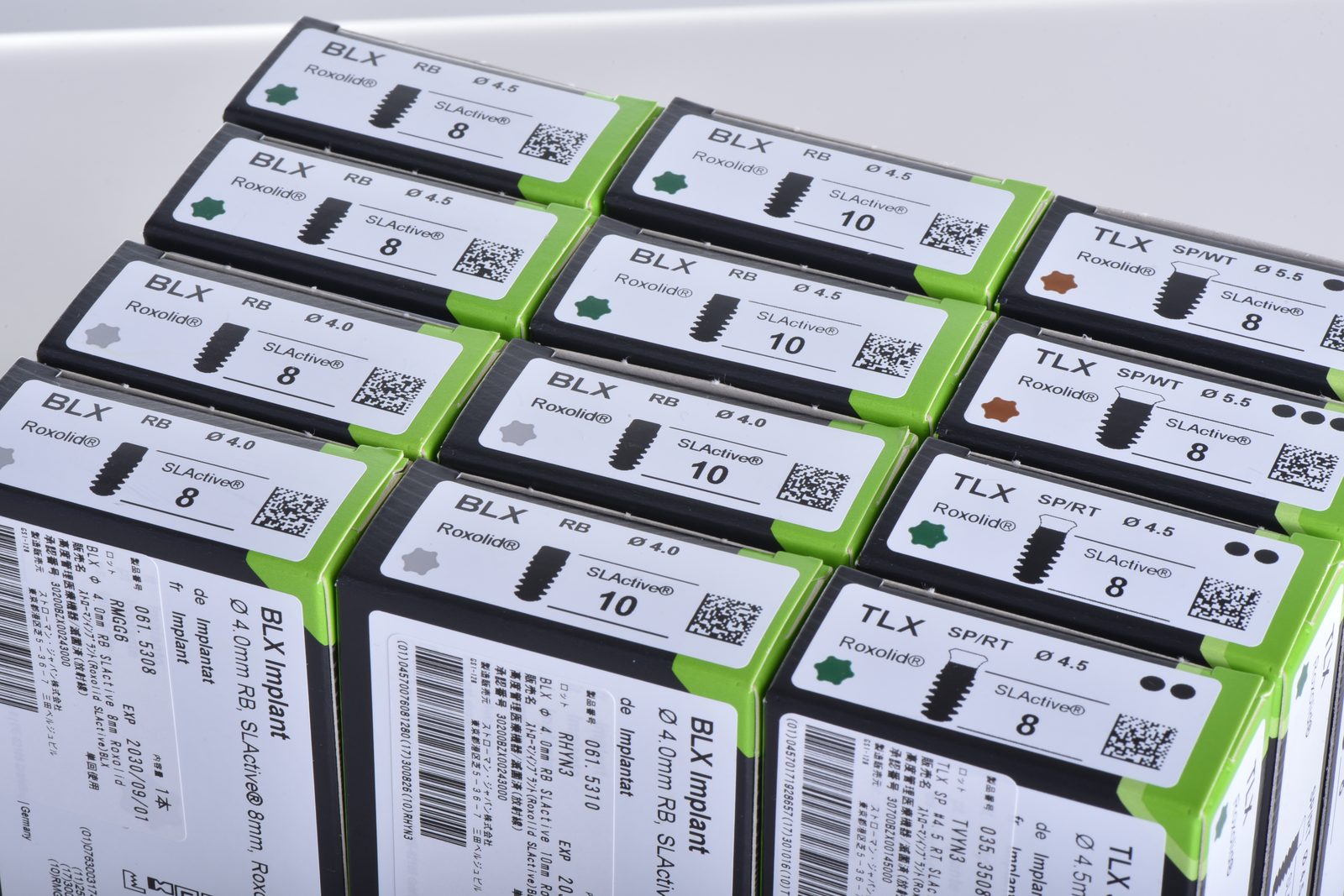
One practical reason we work exclusively with Straumann: a failed fixture from a widely documented Swiss system can be diagnosed and replaced by any trained clinician worldwide, with compatible components available for decades. Patients who received a lesser-known system abroad sometimes discover that no Japanese lab stocks its parts — an avoidable problem.
What a Repair Costs in Japan
There is no honest single figure, because the range is driven by what the failure requires: whether a new fixture is placed, whether grafting is needed at the healed site, whether your existing bridge can be modified or must be remade, and what the warranty terms of the original treatment cover. At Eden, repair work is quoted from our published fee schedule, and every plan is presented as a written estimate in English before any treatment begins — including the scenario where the most economical answer is monitoring rather than surgery. Ongoing protection is comparatively predictable: our check-up package is ¥40,000, and structured recall is the single cheapest way to catch a failing implant early, as we outlined in our review of long-term implant maintenance costs in Japan.
If you have been told an implant or full-arch bridge is failing, consider a second opinion on the diagnosis and rescue plan before agreeing to removal or revision.
Frequently Asked Questions
How common is implant failure with All-on-4?
Long-term studies report roughly 94–95% implant survival over ten or more years — about one fixture in twenty — while bridge survival stays near 99%.
Does one failed implant mean the whole treatment has failed?
No. In most documented cases the bridge continues to function on the remaining implants while the failed site is treated and a new fixture is placed.
Will I be without teeth during the repair?
Usually not. The existing bridge is typically kept in service, reinforced, or temporarily shortened. Only multi-implant failures normally require a removable provisional.
What are the warning signs of a failing implant?
Bleeding or swelling around the bridge margin, a new rocking or clicking sensation, discomfort on chewing, or a screw that repeatedly loosens. Any of these deserves prompt review.
Can you repair an All-on-4 done at another clinic?
Often, yes — particularly for internationally documented systems such as Straumann or Nobel. We start with your records and a CT, then confirm component compatibility before proposing anything.
Risks, Costs and a Realistic Summary
Every implant repair carries the ordinary risks of implant surgery: infection, incomplete integration of the replacement fixture, temporary swelling or bruising, and — in the upper jaw — sinus involvement. Re-treatment at a previously failed site can have a somewhat lower success rate than first-time placement, especially in smokers and patients with untreated gum disease. Costs depend on the scope of the repair and are always confirmed in writing before treatment. Individual results vary.
If an implant under your full-arch bridge feels wrong — or you simply want the state of your arch assessed by a U.S.-trained prosthodontist — you can read how we approach implant treatment at Eden Dental Office or message us directly on WhatsApp in English. A quiet, unhurried consultation with your CT on screen is the right first step.
More on this topic: Implant Guides — every article we have published in this cluster, grouped by stage.