
Single Front Tooth Veneer in Japan: How Shade Matching Works
Reviewed by Dr. Ryosuke Murai, DDS, MSD — Prosthodontist, trained at Indiana University School of Dentistry (U.S.). Last updated August 2026.
Ten veneers are a design problem. One veneer is a matching problem, and it is the harder of the two. If you are researching a single front tooth veneer in Japan, the honest summary is this: the ceramic is rarely what decides whether the result reads as natural. The color of the tooth stump underneath it does, followed by how carefully that color was recorded and communicated to the person who builds the restoration. A laboratory two prefectures away working from a shade tab photograph has a different chance of success than a ceramist who can walk into the operatory and look at the tooth. This article is written for self-pay patients who want to understand what actually governs the outcome before committing — including patients flying in from Tokyo, Singapore or further. For the wider treatment context, see our aesthetic treatment overview.
Why one tooth is the hardest case in cosmetic dentistry
When a full set of veneers is made, the ceramist sets the reference. Every unit is built to the same recipe, so small departures from nature are shared across the arch and the eye reads them as a consistent smile. A single unit has no such freedom. The tooth beside it — usually the other central incisor, sitting a millimeter away under the same light — is the reference standard, and it is always on display for comparison. Nobody has to remember what the old tooth looked like; they can simply look left.
Natural incisors also do things that are difficult to reproduce on demand. They are more translucent at the edge than at the neck, they carry internal white flecks and faint crack lines, and their appearance shifts under daylight, restaurant light and a phone camera flash. Our general guide to porcelain veneers and how they are planned covers the shared ground; this article stays on the specific problem of making one new unit agree with the teeth it sits next to.
How close is close enough
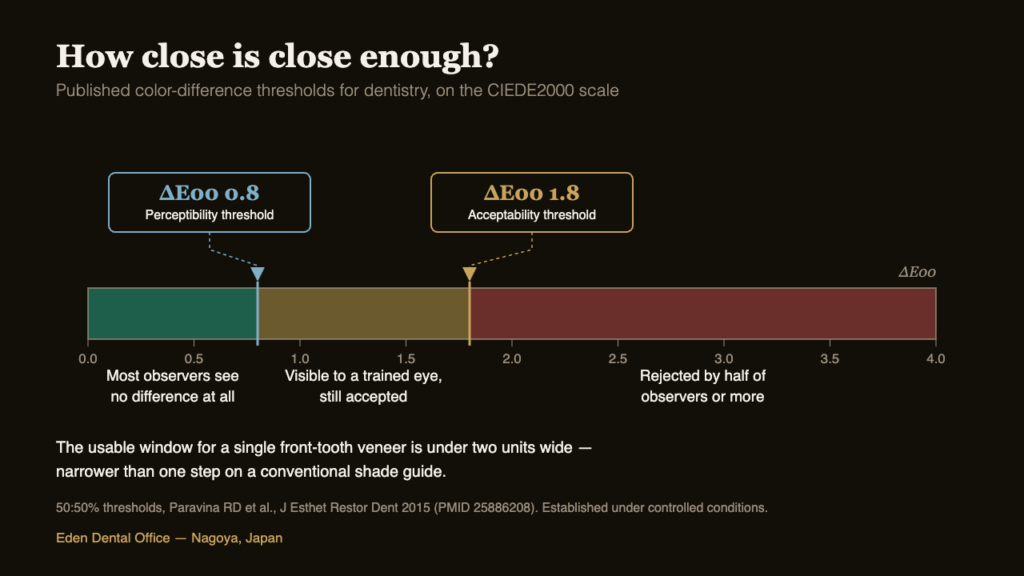
Color science gives this an actual number. Working under controlled conditions, an international group led by Paravina established the two thresholds dentistry now uses: the point at which 50% of observers notice a difference at all, and the point at which 50% stop accepting it. On the CIEDE2000 scale those values came out at ΔE00 = 0.8 for perceptibility and ΔE00 = 1.8 for acceptability (Paravina RD et al., J Esthet Restor Dent 2015).
Read that carefully, because it is often quoted as a promise. It is not. It says that a difference can be measurable, visible to a trained eye, and still sit comfortably inside what patients accept. It also says the useful working window is narrow — under two units on a scale where a shade tab step is often larger than that. A clinician who tells you a single unit will be indistinguishable in every light is describing an ambition, not a specification.
Recording the color: eye, instrument, or both
There are three ways the color leaves the operatory, and they are not interchangeable.
| Method | What it captures | Where it falls down |
|---|---|---|
| Visual shade tab | An overall match to a manufactured scale, judged by a human under clinic light | Reduces a living tooth to one of ~26 steps; observers disagree with each other more than most patients assume |
| Spectrophotometer / scanner reading | Reproducible numeric values (L*, a*, b*) for defined spots on the tooth | Reads small areas; cannot describe crack lines, halo effects or surface texture |
| Cross-polarized photography | Internal color and character with surface reflection removed, plus the neighboring teeth in the same frame | Needs calibration and a reference tab in shot; useless without a ceramist who reads photographs |
The evidence for preferring instruments is reasonable but modest. An in vivo study of 107 subjects’ central incisors compared visual assessment by a dentist and by a dental technician against digital determination, and found measuring accuracy of 43.9% for the intraoral scanner’s color module versus 35.5% and 34.6% for the two visual assessors (Brandt J et al., Clin Oral Investig 2017). The number worth noticing is a different one: the two experienced human observers agreed with each other in only 45.8% of cases. Shade taking is not a solved skill that one dentist happens to lack — it is genuinely unreliable, which is why we treat every method as one input rather than an answer.
At Eden we record all three for anterior single units, and the photographs go to our in-house laboratory rather than into a courier bag. The practical difference is that the ceramist can come to the chair, look at the tooth in the patient’s own mouth, and adjust characterization the same day. For a patient who has flown in, that shortens a problem that otherwise costs a return trip.
The tooth underneath decides more than the ceramic over it
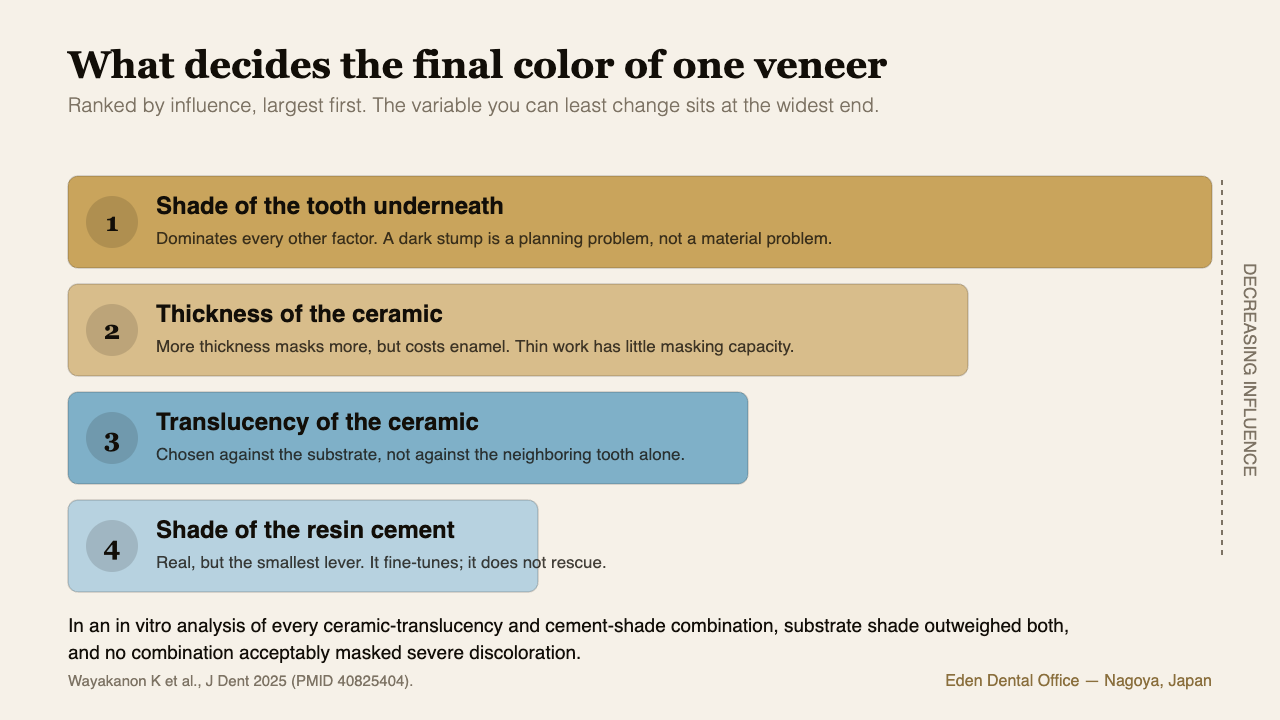
This is the part most consultations skip. A veneer is thin and partly translucent, so it transmits whatever it is bonded to. If the prepared tooth is dark — from an old root canal treatment, internal staining, a metal-containing core, or simply heavy dentin chroma — the ceramic has to fight that, and it frequently loses.
A 2025 in vitro analysis paired IPS e.max CAD ceramics in high, medium and low translucency with four shades of resin cement, in every combination, bonded to either natural-dentin or discolored-dentin substrates, and measured the result with a spectrophotometer. Cement shade and ceramic translucency both shifted the outcome, but substrate shade dominated both — and no tested combination achieved clinically acceptable masking of severe discoloration (Wayakanon K et al., J Dent 2025). The authors’ conclusion is blunt: material selection alone is insufficient.
That laboratory finding is why an experienced plan starts by asking what the stump will look like on the day of bonding, not which ceramic brand to order.
| What we find under the tooth | What changes in the plan |
|---|---|
| Healthy, close in color to the neighbor | Thin translucent ceramic; cement shade used for fine tuning |
| Mildly discolored, vital tooth | External whitening of the whole arch first, then match to the settled result |
| Dark, root-canal-treated tooth | Internal bleaching before any impression; re-assess the stump afterwards |
| Severely discolored or metal-cored | A veneer is the wrong instrument — a full-coverage restoration is discussed instead |
The last row matters. When masking is the main job, extra ceramic thickness and opacity are needed, and the decision moves toward a crown — a trade-off we set out in choosing between a veneer and a crown. It also explains why an ultra-thin approach has limits: no-preparation veneers are a poor answer to a dark substrate, because thinness is exactly what removes the masking capacity. If a previous clinic has proposed a single veneer over a dark stump without discussing this, that is a reasonable trigger for a second opinion before treatment begins.
Sequence: whiten, align, contour, then match
A single ceramic unit cannot be re-whitened once it is bonded. Anything you intend to change about the surrounding teeth therefore has to happen first, and the ceramic is matched to the finished state — never the reverse. In practice that means whitening runs to completion and is allowed to stabilize before the shade is recorded; our guide to whitening in Japan covers the timings. Where a tooth is rotated or out of the arch, moving it before restoring it often means less preparation and a shallower stump. Where the gum levels are uneven, soft tissue is settled first, because the visible length of the tooth changes the shade you are trying to hit.
For a smaller defect — a chipped corner rather than a color problem — direct composite bonding is sometimes the more conservative starting point, and it can be revised later without cutting more enamel.
What this costs and how long it takes
Anterior single-unit work is quoted per case at Eden rather than from a menu, because the number of preparatory steps varies so widely: internal bleaching, a period of whitening, or a diagnostic mock-up each change the total. We publish our fixed packages — a comprehensive check-up at ¥40,000 and a whitening package at ¥75,000 — on the fee page, and you receive a written estimate in English covering every stage before anything is prepared. We do not quote a ceramic price before seeing the stump, because as the evidence above shows, the stump is the variable that decides how much work the case actually contains.
On timing, allow one visit for records and planning, a settling period if whitening or internal bleaching is involved, then preparation and a provisional, and a bonding visit with a try-in step beforehand. Patients travelling to us usually compress this into two trips; the sequencing options are set out in our treatment-trip planning guide.
Frequently Asked Questions
Can one veneer ever match a natural tooth exactly?
Not exactly. The realistic goal is a difference small enough that observers accept it, which published thresholds place at around ΔE00 1.8 under controlled conditions.
Should I whiten before or after the veneer?
Before, always. Ceramic does not respond to whitening gel, so the natural teeth must reach their final color first.
Why does my dentist want a photo with a shade tab in it?
Because a tab in the same frame gives the ceramist a fixed reference, allowing color to be judged relative to a known standard rather than from the screen.
My tooth is dark after a root canal. Is a veneer still possible?
Sometimes, but usually only after internal bleaching. If the stump stays dark, a full-coverage restoration is the more predictable route.
Can the shade be corrected after bonding?
Only within narrow limits by surface staining. A significant mismatch means remaking the unit, which is why the try-in appointment exists.
Risks, limits and next steps
Single-unit anterior ceramics carry real trade-offs. Preparation removes enamel that does not grow back; a veneer may chip or debond and will need maintenance and eventual replacement, as covered in our note on protecting veneers with a night guard. Temporary sensitivity after preparation is common. Color can appear to drift over time as the neighboring natural teeth continue to age and stain while the ceramic does not. Some cases cannot be matched acceptably at all, and we would rather say so at the planning stage than after bonding. Individual results vary.
If you are weighing a single anterior unit and want a considered assessment rather than a sales appointment, our aesthetic treatment page explains how consultations run, and English enquiries by WhatsApp are answered directly.