
Dental Implants in Japan: Medications and Medical Conditions
Reviewed by Dr. Ryosuke Murai, DDS, MSD — Prosthodontist, trained at Indiana University School of Dentistry (U.S.). Last updated August 2026.
Somewhere between the referral and the consultation, most patients are told to stop something. Stop the warfarin three days before. Stop the aspirin for a week. It is well-meant advice, and for dental implant treatment in Japan it is frequently the wrong advice. The pooled evidence on implant surgery in patients who stayed on their anticoagulant does not show a significant increase in bleeding. Meanwhile, an interrupted blood thinner carries a risk that has nothing to do with your mouth. This article is for self-pay patients — in Japan or flying in — who take medication or live with a chronic condition and want to know, before booking anything, what actually changes and what does not.
Blood thinners: stopping the drug is usually the larger risk
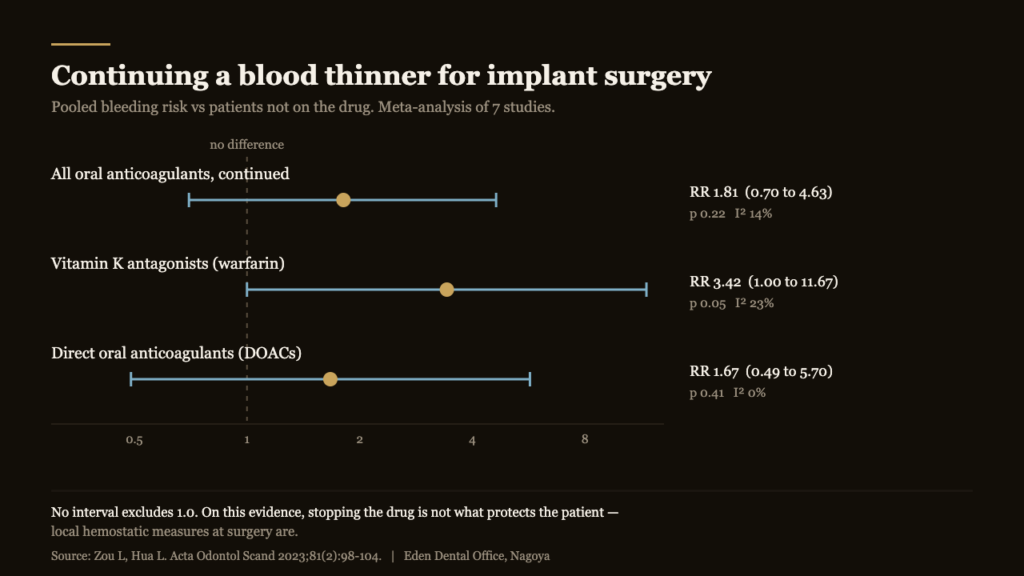
A 2023 systematic review and meta-analysis in Acta Odontol Scand pooled seven studies comparing bleeding after implant placement in patients who continued oral anticoagulant or antiplatelet therapy against patients who did not take these drugs. The pooled risk ratio was 1.81, with a 95% confidence interval of 0.70 to 4.63 (I² 14%, p 0.22) — an interval wide enough to include no difference at all. Split by drug class, vitamin K antagonists such as warfarin showed a non-significant tendency toward more bleeding (RR 3.42, 95% CI 1.00 to 11.67, p 0.05), while direct oral anticoagulants did not (RR 1.67, 95% CI 0.49 to 5.70, p 0.41). The authors’ conclusion is the practical one: continuation does not increase bleeding risk provided local hemostatic measures are used. You can read the full abstract on PubMed.
Read that caveat carefully, because it is where the responsibility sits. The evidence does not say anticoagulated patients bleed the same no matter who operates. It says the bleeding is manageable when the surgery is planned for it — a flap sized to the job, sutures placed rather than skipped, a longer appointment, and a review the same day rather than a phone number and hope. That is a scheduling decision made weeks earlier, not a reaction on the day.
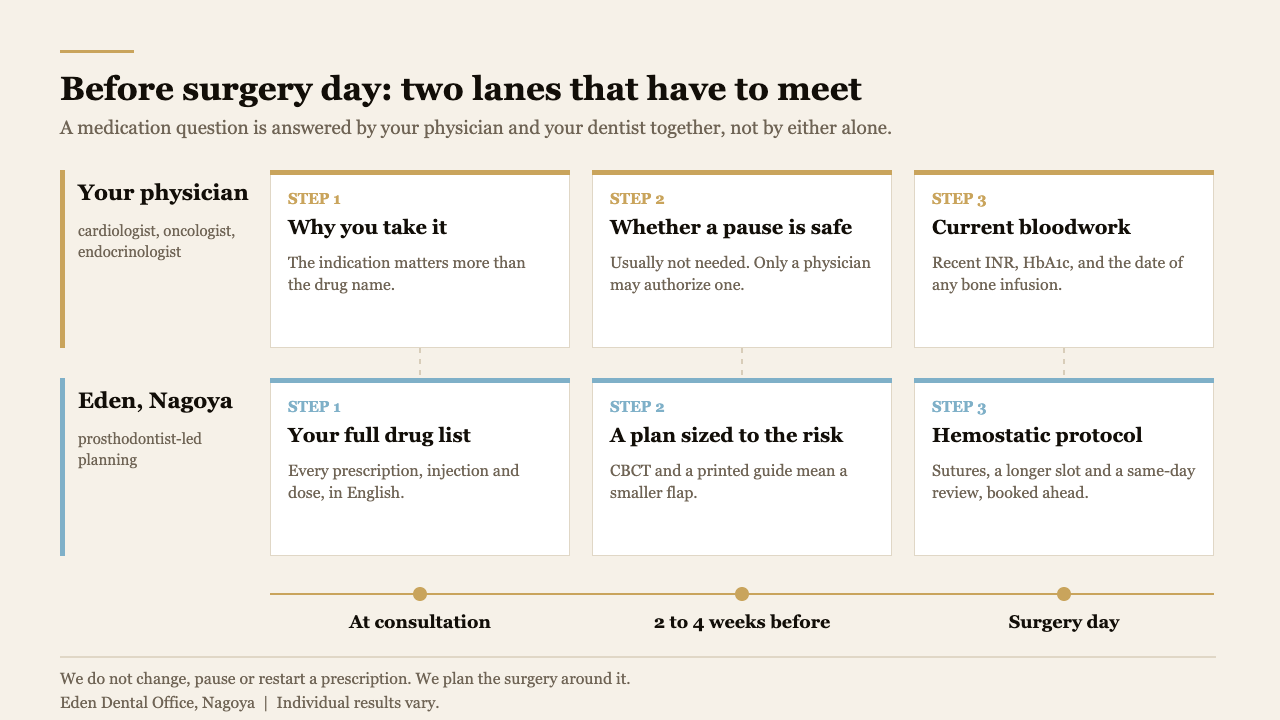
What we will not do is tell you to pause a prescription. Only the physician who started the drug can weigh a two-day gap against the reason you take it — a mechanical heart valve and atrial fibrillation are not the same problem wearing the same pill. If a pause is genuinely warranted, it comes in writing from that physician, and we plan around it. The wider sequence of appointments this sits inside is set out in our guide to the implant procedure, timeline and recovery in Japan.
Bone medications need a real conversation
Antiresorptive drugs — bisphosphonates such as alendronate or zoledronic acid, and denosumab — are the genuinely nuanced case, and the honest answer is less comfortable than the anticoagulant one. A 2023 systematic review and meta-analysis in the Journal of Oral Implantology screened fourteen non-randomized studies, then meta-analyzed eight with implant-level data (2,697 implants) and five with patient-level data (265 patients). At the patient level there was no statistically significant difference between groups. At the implant level there was. The authors’ reading is that antiresorptive medications, mainly bisphosphonates, may reduce implant survival and impair osseointegration — while also noting that implants which failed in these patients did not necessarily lead to osteonecrosis, and were often replaced successfully. The review is indexed here.
Two figures pointing in different directions is not a defect in the research; it is what a real risk signal looks like when the underlying studies are observational and the patients are heterogeneous. What it means for you is that the conversation has to be specific: which drug, at what dose, by mouth or by infusion, for osteoporosis or for a malignancy, and for how long. A low-dose oral bisphosphonate taken for three years for osteoporosis and intravenous zoledronic acid given for bone metastases sit at opposite ends of a spectrum, and they warrant different answers. Where the plan involves a full arch, the wider assessment is covered in our article on All-on-4 candidacy, bone loss and health factors.
Diabetes, smoking and the variables you can still move
Diabetes is rarely a bar to implant treatment. Poorly controlled diabetes is a different matter, because glucose control affects the same wound-healing and bone-remodeling biology that osseointegration depends on. We ask for a recent HbA1c rather than a yes-or-no answer to “are you diabetic”, because the number tells us something the label does not. Where control is unstable, the sensible move is usually to sequence the surgery later, not to abandon the plan.
Smoking is the variable most within your control and the one most patients would rather not discuss. It is associated with poorer implant outcomes and with the soft-tissue problems described in our article on gum tissue around dental implants. We do not moralize about it, and we do not make quitting a condition of treatment. We do tell you plainly that the healing window — the first two weeks covered in our implant aftercare guide — is when it matters most, and that reducing rather than continuing during that window is a genuine intervention rather than a gesture.
What usually happens, drug by drug
| Medication or condition | What usually happens | What we need from you |
|---|---|---|
| Low-dose aspirin, clopidogrel | Treatment proceeds, drug continued, local hemostatic measures planned | Drug name and dose |
| Warfarin (vitamin K antagonist) | Usually continued; wider bleeding tendency in the pooled data than with DOACs | Recent INR, taken close to the surgical date |
| Apixaban, rivaroxaban and other DOACs | Usually continued; no significant bleeding increase in the pooled data | Drug name, dose and timing of your daily dose |
| Oral bisphosphonate for osteoporosis | Case-by-case; often proceeds with informed consent about survival data | Drug, dose, start date, and your physician’s note |
| Intravenous antiresorptive, oncology setting | Frequently declined or deferred in favor of an alternative restoration | Oncologist’s assessment before we plan anything |
| Type 2 diabetes | Proceeds when control is stable; sequencing may shift | HbA1c from the last three months |
| Head and neck radiotherapy history | Requires assessment of field, dose and interval before any surgical plan | Radiotherapy records or a summary letter |
This table describes what usually happens, not what will happen in your case. Any row can be overturned by something else in your history.
How your list actually changes the plan here
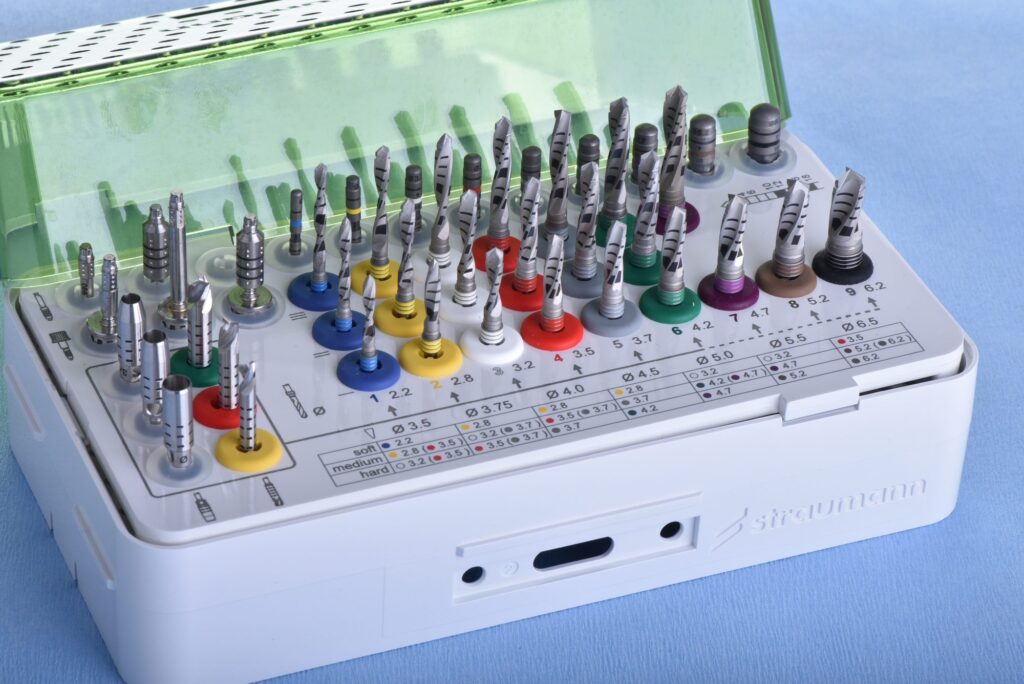
At Eden, the drug and condition list is taken before we discuss implants at all, and it is written in English so nothing is lost in a translation of a translation. Where a bleeding or healing risk is present, it changes three concrete things. First, the imaging is not optional: a CBCT scan lets us see the vessels and the bone volume before we decide on a flap, rather than during. Second, we plan through a 3D-printed surgical guide produced in our in-house laboratory, which lets a Straumann BLX or TLX fixture be placed through a smaller opening — the single most useful thing we control when tissue is going to bleed more readily. Third, the appointment itself is built differently: a longer slot, sutures as standard, and a same-day review before you leave the building.
Medical history also shapes the sedation conversation rather than being separate from it, since some of the same drugs and conditions affect what is appropriate; the options for sedation during implant surgery are set out separately. And where healing is expected to be slower, we lean harder on objective measurement before loading the implant — the ISQ stability reading is more useful in a patient with a healing risk than in a healthy one, because it replaces an assumption with a number.
Anticoagulant and antiplatelet therapy also shape how soon you can travel after an extraction or implant placement; we cover the timing in our guide to flying after dental surgery in Japan.
Frequently Asked Questions
Do I have to stop my blood thinner before implant surgery?
Usually not. Pooled data on continued anticoagulant therapy shows no significant increase in bleeding when local hemostatic measures are used. Any decision to pause belongs to the physician who prescribed it, in writing.
Can I have implants if I take bisphosphonates?
Often, but not automatically. Oral bisphosphonates for osteoporosis and intravenous antiresorptives in an oncology setting are different situations. We assess drug, route, dose and duration, and we say no when the balance does not justify surgery.
Does diabetes rule out dental implants?
No. Unstable glucose control is the issue, not the diagnosis. We ask for an HbA1c from the last three months and may sequence surgery around your physician’s work rather than cancel the plan.
What should I bring to a consultation about medications?
A current list of every prescription, injection, and supplement with doses; recent INR or HbA1c where relevant; and the date of any bone infusion. Photographs of packaging are fine.
Will you speak to my doctor at home?
We can correspond in English with your physician, and for international patients we prefer to have that exchange complete before you book flights rather than after you arrive.
What this costs
A medical review is part of the consultation rather than a separate charge. Our published anchors are a comprehensive check-up package at ¥40,000 and annual membership tiers from ¥88,000 to ¥288,000; implant and full-arch fees vary with the number of fixtures, the need for grafting, and the restoration, and are listed on our fee page. What we commit to is a written estimate in English before any treatment begins, with the surgical, laboratory and review components itemized. A medically complex case may require a longer surgical slot, and if that changes the figure, you will see it in the estimate rather than on the invoice. For patients coordinating this from abroad, our guide to planning a dental treatment trip to Japan covers how the visits sequence.
Risks, limitations and next steps
Implant surgery in a medically complex patient carries the ordinary risks — bleeding, swelling, infection, nerve disturbance, and failure of the implant to integrate — and in some cases a modestly higher chance of the last of these. Antiresorptive medication carries an additional, uncommon risk of osteonecrosis of the jaw, which is why the oncology cases are the ones we most often decline. No dentist can promise an outcome, and we do not. Individual results vary, and the evidence quoted here comes from pooled studies of other patients, not from you. If you take medication or live with a chronic condition and want an unhurried assessment of whether implant treatment is reasonable in your case, bring the list and we will go through it properly. English consultation, WhatsApp for questions, two minutes from Fushimi Station in Nagoya.
More on this topic: Implant Guides — every article we have published in this cluster, grouped by stage.