
Sedation for Dental Implant Surgery in Japan: Your Options
Reviewed by Dr. Ryosuke Murai, DDS, MSD — Prosthodontist, trained at Indiana University School of Dentistry (U.S.). Last updated August 2026.
Sedation for dental implant surgery is not general anesthesia, and it does not mean being unconscious. In Japan the realistic choices for an implant patient are local anesthesia alone, nitrous oxide, an oral sedative, or intravenous conscious sedation — a spectrum on which you remain responsive but calm, and often remember very little afterward. This guide explains what each level actually feels like, which patients benefit and which do not need it, how sedation is staffed and monitored in a Japanese clinic, and what it adds to your fee. It is written for self-pay patients — residents and those traveling in from Tokyo, Osaka or abroad — who have already decided they want implants and are now weighing anxiety against the appointment. For the surgery itself, start with our walk-through of the implant procedure, timeline and recovery in Japan, or see how we plan implant treatment in Nagoya.
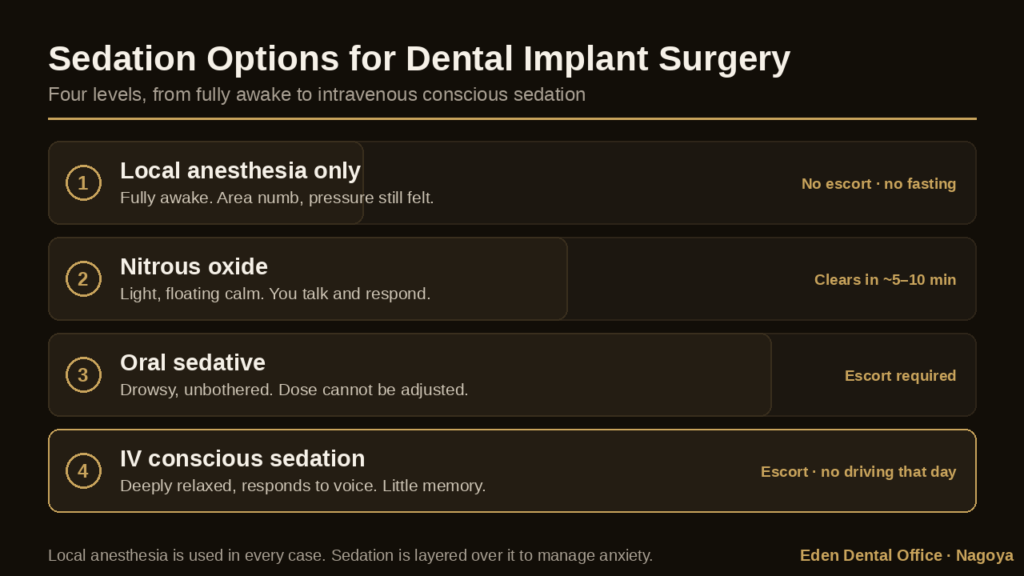
Four levels, and what each one is like
“Sedation” is a single word covering four quite different experiences. Nearly all implant surgery in Japan — sedated or not — is performed under local anesthesia; sedation is layered over it to manage anxiety, not to replace the numbing.
| Method | What you experience | Memory of the procedure | Recovery | Escort home |
|---|---|---|---|---|
| Local anesthesia only | Fully awake and aware; the surgical area is numb, pressure still felt | Complete | None; you leave as you arrived | Not required |
| Nitrous oxide (inhalation) | Light, floating detachment; you talk and respond normally | Usually complete | Clears within about 5–10 minutes of breathing oxygen | Usually not required |
| Oral sedative before the visit | Drowsy and unbothered, but the effect cannot be adjusted once taken | Often patchy | Several hours of grogginess | Required |
| IV conscious sedation | Deeply relaxed, responds to voice, protective reflexes intact | Little or none | Alert within an hour, dull for the rest of the day | Required; no driving that day |
The practical difference between the oral and intravenous routes is control. A tablet delivers whatever dose it delivers, and if it is not enough, nothing can be done mid-appointment. An intravenous line lets the clinician titrate — give a small amount, watch how you respond, and add more only if needed. That is why midazolam given intravenously is the workhorse of implant sedation worldwide, and why longer or more involved surgery tends toward the IV route rather than a pill.
Who benefits, and who genuinely does not
Anxiety before implant surgery is not unusual, and it is not trivial. A study of 180 patients receiving implants under intravenous conscious sedation, published in the International Journal of Oral & Maxillofacial Implants, found preoperative anxiety was moderate or high in roughly two-thirds of them, and that it measurably dragged down how satisfied those patients were with the experience afterward. Whether sedation fixes that has also been examined directly: a 2022 systematic review and meta-analysis in Dental and Medical Problems pooled the available trials and concluded that conscious sedation during implant surgery reduces patient anxiety and raises both patient and surgeon satisfaction, with midazolam the most frequently used agent across the included studies.
In clinical practice the candidates sort themselves fairly cleanly. Sedation earns its place when someone has avoided dentistry for years because of fear, when the appointment will run long — several implants in one session, a full-arch case, or surgery combined with grafting — when a strong gag reflex makes working in the back of the mouth difficult, when a medical condition or tremor makes lying still for ninety minutes hard, or when a patient simply does not want the afternoon stored as a memory.
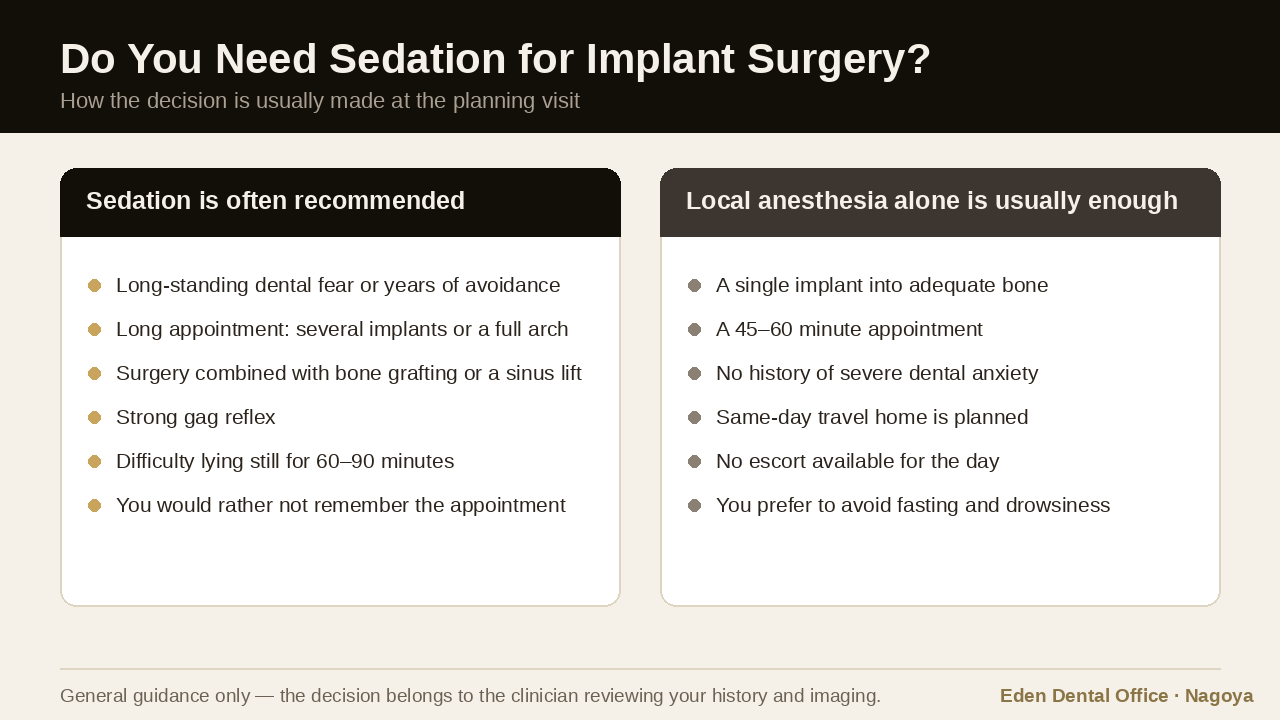
Equally, a great many patients do not need it. A single, straightforward implant into adequate bone is typically a 45- to 60-minute appointment under local anesthesia, and most adults find the reality far less dramatic than the anticipation. Sedation is a tool, not an upgrade: adding it to a short routine case introduces fasting rules, an escort requirement and a lost day for no clinical gain. What sedation reliably removes is the anxiety, not the physiology.
How sedation is handled at a Japanese clinic
Two things surprise patients arriving from abroad. The first is that inhalation sedation with nitrous oxide is widely available in Japanese dental practices and inexpensive, while deeper intravenous sedation is more selectively offered — it requires an anesthesia-trained clinician dedicated to your airway and vital signs rather than to the surgery, plus continuous pulse oximetry, blood pressure and ECG monitoring, and a recovery area. The second is procedural: fasting for a set number of hours beforehand, no driving afterward, and a responsible adult to take you home. These are not formalities to be negotiated on the day; if you arrive having eaten breakfast, the appointment is rescheduled.
Language matters more here than in almost any other part of implant treatment. Sedation consent covers drugs, monitoring and what to do if you feel unwell overnight, and it is not the moment to be nodding along to a Japanese form. Ask before booking whether consent, pre-operative instructions and the post-sedation discharge sheet are available in English, and whether someone will be speaking English to you while you are under.
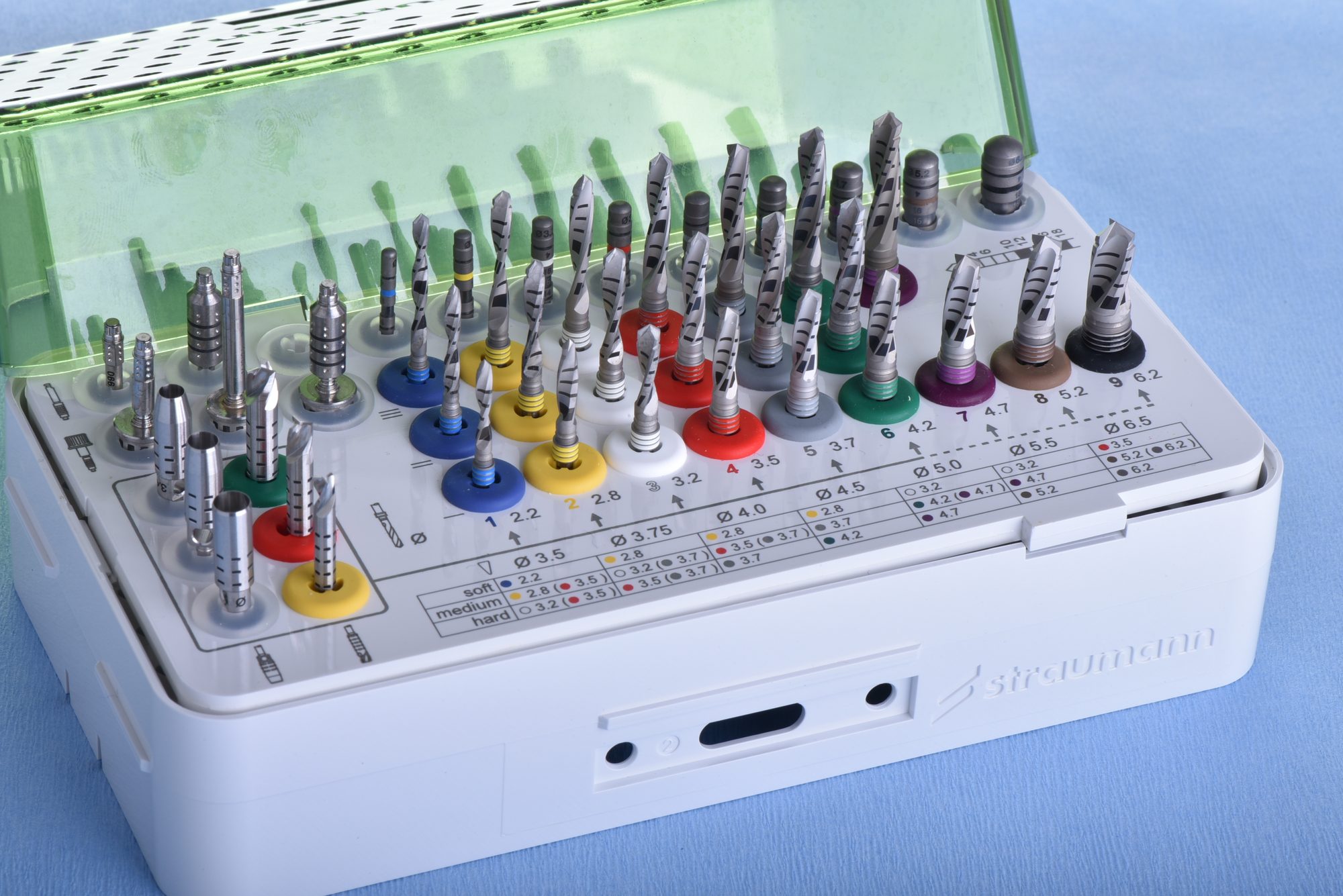
At Eden Dental Office we decide the sedation question at the planning visit rather than on the surgical day, because it changes the schedule for the whole appointment — and because the more effective anxiety measure for most people is shortening the surgery itself. Planning from a CBCT scan and placing Straumann BLX implants through a surgical guide printed in our own lab compresses the time spent in the chair and removes the improvisation that patients can sense. We then discuss whether nitrous oxide, which suits the majority of anxious patients well, is sufficient, or whether the case warrants arranging intravenous sedation with an anesthesia-trained colleague. Instructions and consent are issued in English, and patients keep a direct WhatsApp line to the clinic for the evening afterward.
For patients flying or taking the Shinkansen in, sedation reshapes the trip. You cannot travel home alone the same afternoon after IV sedation, so the visit needs an extra night and, strictly speaking, a companion. Nitrous oxide does not carry that constraint, which is one reason it is often the sensible compromise for a same-day return. If your plan already involves grafting — see our article on bone graft and sinus lift costs in Japan — or a full-arch session on the scale described in our All-on-4 treatment timeline, build the sedation decision into the travel plan from the start rather than adding it later.
What this costs
Sedation is billed separately from the surgical fee, and the gap between the levels is wide. Nitrous oxide is a modest addition, because it uses equipment already in the operatory and adds only minutes to the appointment. Intravenous sedation costs considerably more, and for a defensible reason: it buys a second clinician’s time for the length of the surgery, monitoring, drugs and recovery-room supervision. The variables that move the number are the level chosen, how long the surgery runs, and whether an external anesthesia-trained clinician attends.
We do not publish a sedation price list, because a figure quoted without knowing the duration and staffing would be meaningless. What we do commit to is that any sedation appears as its own line on the written, itemized estimate in English issued before treatment starts — the same principle set out in our article on what is actually included in a Japanese implant quote. Our published anchors remain the initial check-up package at ¥40,000 and annual membership plans from ¥88,000 to ¥288,000; current figures are on the fee page, and implant and sedation fees are quoted per case at planning.
The complexity visible on your scan is part of the sedation discussion; our guide to CBCT imaging before implant treatment explains what that scan measures.
Sedation changes how the appointment feels, not how long the bone needs. That interval is decided separately, by the torque and ISQ values recorded during and after surgery.
Your medication list shapes the sedation conversation as much as it shapes the surgery. We set out the wider picture in how medications and medical conditions affect implant planning.
Frequently Asked Questions
Will I be asleep during dental implant surgery?
Not with conscious sedation. You breathe on your own and respond to voice, but you are relaxed and typically remember little afterward. True general anesthesia is rarely used for routine implant placement.
Is IV sedation available at dental clinics in Japan?
Yes, though selectively. Nitrous oxide is widely offered; intravenous sedation requires an anesthesia-trained clinician, continuous monitoring and a recovery period, so it is arranged case by case in advance.
Do I need someone to take me home after sedation?
After oral or intravenous sedation, yes — a responsible adult must accompany you, and you cannot drive that day. Nitrous oxide usually clears within about ten minutes and does not require an escort.
Does sedation reduce pain during implant surgery?
Local anesthesia controls the pain; sedation controls the anxiety. The two are used together, and neither removes the pressure and vibration you may still notice during placement.
Can I fly home the same day after implant sedation?
Not after intravenous sedation — plan an extra night and a companion. After nitrous oxide, same-day travel is generally acceptable for an uncomplicated single implant if your surgeon agrees.
Risks, limitations and next steps
Sedation adds its own risks to the risks of surgery. Intravenous sedation can cause over-sedation with slowed breathing, a drop in blood pressure, nausea, prolonged drowsiness, or bruising at the injection site, and it interacts with alcohol, opioids and several common medications — which is why the medical history and drug list you provide must be complete and honest. Nitrous oxide is milder but unsuitable with certain respiratory conditions, in early pregnancy, or when the nose is blocked. Sleep apnea, obesity, significant cardiac or liver disease and some psychiatric medications all change the calculation, and in some cases the safer answer is a hospital setting rather than a dental office. Individual results vary. No sedation technique removes the surgical risks covered in our other implant guides. This article is general education, not a recommendation for your case; the decision belongs to a clinician who has reviewed your history and imaging. Once surgery is done, the instructions that matter are the ones in our guide to implant aftercare in the first two weeks and the recovery expectations set out in our implant procedure and recovery guide. To discuss sedation against your own medical history and travel schedule, see our approach to implant planning or contact the clinic in English via WhatsApp.
More on this topic: Implant Guides — every article we have published in this cluster, grouped by stage.