Veneers vs Crowns in Japan: Choosing the Right Restoration
Reviewed by Dr. Ryosuke Murai, DDS, MSD — Prosthodontist, trained at Indiana University School of Dentistry (U.S.). Last updated August 2026.
Patients who arrive asking about veneers have usually already decided on veneers. But the choice between veneers and crowns is not a cosmetic preference — it is a structural judgement about how much sound tooth is left and where the ceramic can be bonded. A veneer covers the front surface and, in most designs, the biting edge. A crown wraps the whole tooth. That difference determines how much enamel comes off, how the restoration is retained, and what happens in fifteen years. This article sets out where the line falls, what the published survival data supports, and how we work through the decision in our aesthetic treatment planning at Eden Dental Office in Nagoya.
Two restorations, two very different amounts of tooth
A porcelain veneer is a thin ceramic shell, roughly 0.3 to 0.7 mm thick in most anterior cases, bonded to the outer face of the tooth. Retention comes almost entirely from adhesion to enamel, so the preparation can stay shallow — and staying inside enamel is not a stylistic choice but what makes the bond durable. The deeper a preparation runs into dentin, the more the adhesive interface has to compensate for.
A crown is a full-coverage restoration. The tooth is reduced on every surface to create room for the material and a continuous margin, and retention comes from the shape of the remaining core as much as from cement. That is an advantage when a tooth has already lost structure to fracture, an old build-up or root canal treatment, and a real cost when the tooth is essentially intact, because reduction of that scale cannot be undone.
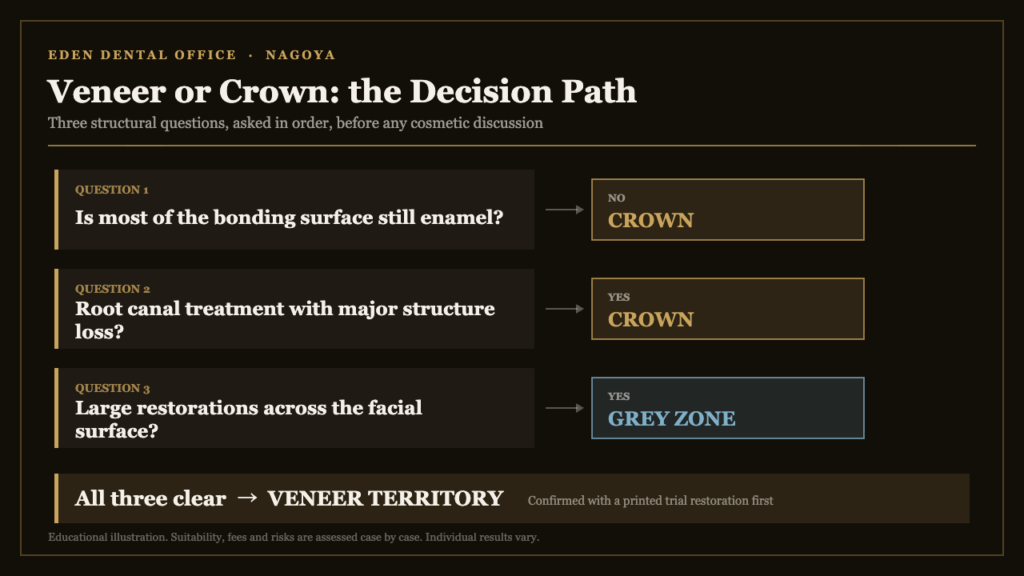
So the useful question is not which looks better — well-made ceramic in either form can look convincing. It is whether the tooth still has enough healthy enamel to justify the conservative option, and enough sound structure to survive without the reinforcement a crown provides.
What the survival numbers actually say
Two large evidence syntheses cover the options. They are worth reading side by side, but carefully, because they do not measure the same window.
For veneers, a systematic review and meta-analysis of 13 clinical studies (Morimoto and colleagues, International Journal of Prosthodontics, 2016) estimated cumulative survival of 89% (95% CI 84% to 94%) over a median follow-up of nine years — 94% for glass-ceramic, 87% for feldspathic porcelain. Complication rates were low: debonding 2%, fracture or chipping 4%, secondary caries 1%, severe marginal discoloration 2%, endodontic problems 2%.
For crowns, a 2026 systematic review and meta-analysis by Pjetursson, Sailer and colleagues in the same journal pooled 64 studies covering 3,509 metal-ceramic and 8,051 all-ceramic single crowns. Five-year survival was 98.5% for monolithic lithium-disilicate, 97.3% for veneered densely-sintered zirconia, 97.1% for metal-ceramic and 90.4% for feldspathic and silica-based ceramic. Monolithic designs showed significantly fewer ceramic fractures and chips than layered alternatives.
| Evidence | Veneers (Morimoto 2016) | Single crowns (Pjetursson 2026) |
|---|---|---|
| Studies pooled | 13 | 64 |
| Follow-up reported | Median 9 years | 5 years |
| Survival | 89% overall (94% glass-ceramic) | 98.5% monolithic lithium-disilicate; 90.4% feldspathic |
| Most common technical issue | Fracture or chipping, 4% | Chipping, higher in layered designs |
| Endodontic problems reported | 2% | Reported separately by study; a known crown complication |
The temptation is to read those numbers as “crowns last longer.” They do not support that. The crown figure is a five-year estimate and the veneer figure spans nine years, which makes them different measurements rather than a ranking. What the reviews do support is narrower and more useful: both restorations are reliable when the indication is right, and material choice moves the result more than category does. Feldspathic ceramic sits at the bottom of both lists.
One further finding from the veneer review deserves a mention, because it settles an argument patients often bring with them. Whether the ceramic should wrap over the biting edge produced an odds ratio of 1.25 with a 95% confidence interval of 0.33 to 4.73 — an interval that comfortably includes 1.0, meaning incisal coverage neither clearly protects a veneer nor clearly endangers it. Preparation design should follow the individual tooth, not a rule.
Where the line falls
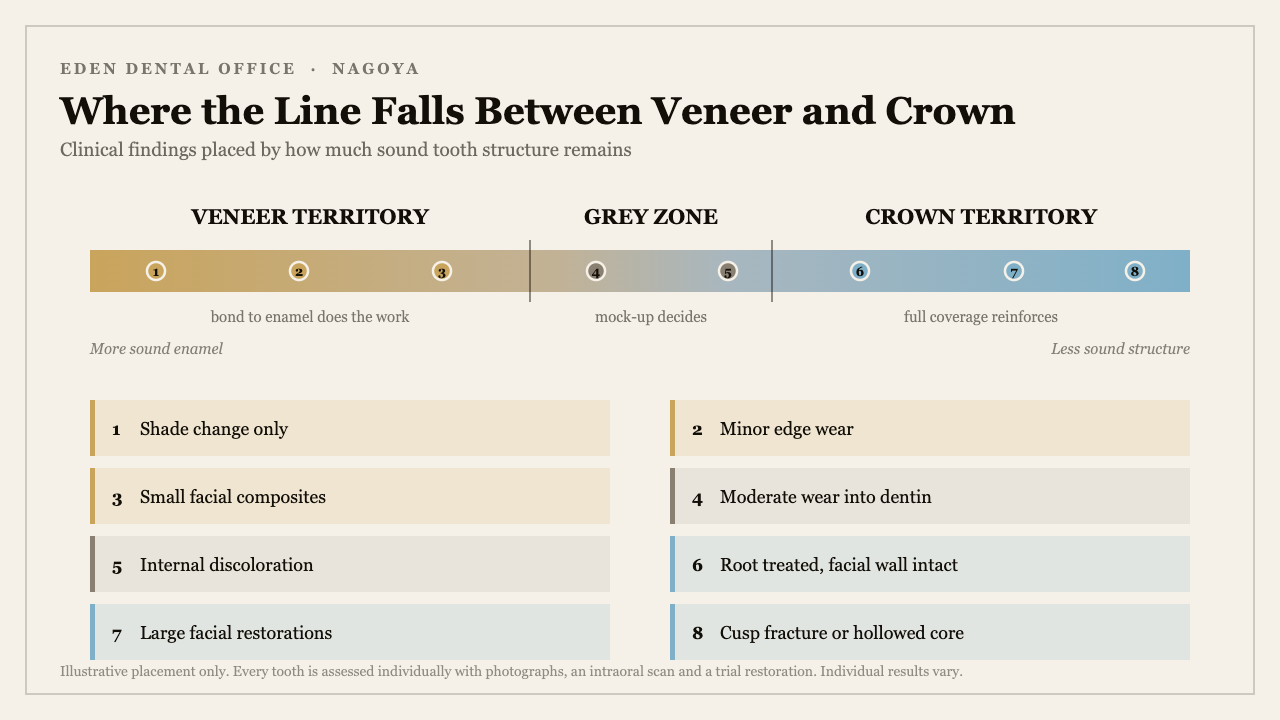
Most anterior cases sort themselves into three zones once you look at the tooth rather than the photograph.
Veneer territory. The tooth is largely intact, discoloration is the main complaint, the shape or width needs modest correction, or there is minor edge wear. Enamel is available on most of the bonding surface. This is where the conservative option earns its reputation, and where minimal and no-prep designs occasionally apply.
The grey zone. Large old composite restorations on the facial surface, moderate wear into dentin, or a tooth darkened by internal staining rather than surface pickup. The decision can genuinely go either way, and it turns on how much enamel survives around the perimeter of the preparation.
Crown territory. The tooth has been root treated, carries a substantial core or post, has fractured, or has lost a cusp. Reinforcement matters more than conservation, and a bonded shell is being asked to do a job it was not designed for.
Four findings that push a case toward a crown
Little remaining enamel. If the preparation would sit mostly on dentin, the adhesive foundation of a veneer is compromised. This is the most common reason we advise against a veneer on a tooth the patient assumed was a veneer case.
Root canal treatment with significant structure loss. A root-treated incisor with an intact facial wall can sometimes take a veneer. One that has been hollowed out cannot.
Heavy functional loading. Deep bites, edge-to-edge contact and grinding concentrate force exactly where a veneer margin sits. That does not rule out veneers, but it changes the design and makes protective appliances non-negotiable — covered in our guide to veneer care and night guards.
Large existing restorations. When two-thirds of the visible surface is already filling material, you are no longer bonding to tooth, and full coverage becomes the more predictable engineering answer.
A fifth situation sits outside both options: a tooth that will not support any restoration. There the conversation moves to extraction and replacement, and the relevant comparison becomes implant treatment and its costs.
| Porcelain veneer | Full-coverage crown | |
|---|---|---|
| Coverage | Facial surface, often the incisal edge | All surfaces |
| Typical thickness | About 0.3–0.7 mm anteriorly | Roughly 1.0–2.0 mm depending on material |
| Retention | Adhesive bond, ideally to enamel | Preparation geometry plus cement |
| Indicated for | Largely intact teeth, shade and shape change | Structurally compromised or root-treated teeth |
| Reversibility | Limited, but far less tooth removed | None — reduction is definitive |
| Repair if it chips | Composite repair or replacement of the shell | Usually replacement of the crown |
How we plan the decision at Eden
Planning starts with photographs, an intraoral scan and, where the history warrants it, radiographs to see what previous treatment left behind. The scan is overlaid on a Digital Smile Design proposal so the target shape exists as a file before any tooth is touched. From that file our in-house digital lab prints or mills a trial restoration the patient wears — and only then do we know how much reduction the target shape actually requires. Often it is less than expected, which moves a case from crown territory back toward a veneer. Sometimes it is more, and the mock-up is what makes that conversation concrete rather than hypothetical.
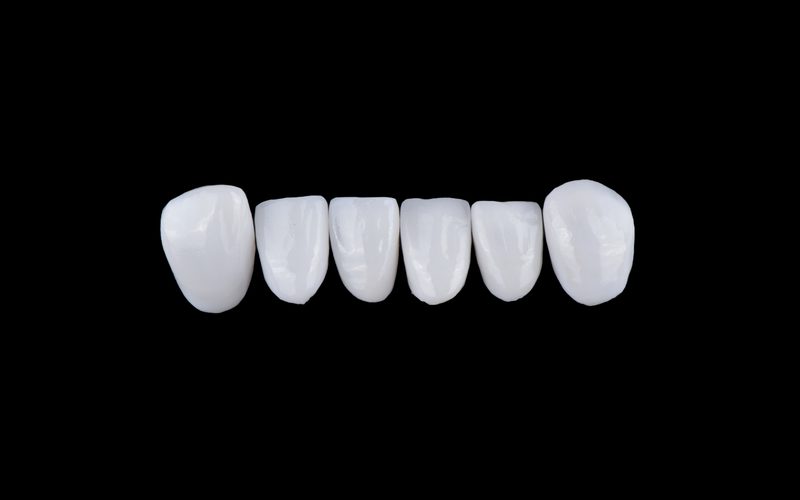
Working in-house also matters for mixed cases, where one tooth needs a crown and its neighbours need veneers. Matching a single crown to adjacent veneers across two different ceramic thicknesses is far easier when the technician can see the patient. For those travelling in from Tokyo, Osaka or overseas, that is what allows several appointments to be compressed into a single treatment trip.
A third possibility sits behind both options: neither restoration is the answer if the tooth is buried rather than short, which is the subject of gum contouring and crown lengthening before veneers.
Remaining tooth structure decides between a shell and full coverage, but where a tooth sits in the arch changes that calculation. See the discussion of braces or veneers for misaligned front teeth for how alignment alters what the preparation has to remove.
If the unit in question sits next to an untouched natural incisor, read this alongside our account of how shade is recorded and why the stump dominates the outcome.
Frequently Asked Questions
Can I have a veneer on a root canal treated tooth?
Sometimes. If the facial wall is intact and the access cavity was small, a veneer can work. If the tooth has been hollowed out, a crown is more predictable.
Do crowns look less natural than veneers?
Not inherently. Appearance depends on material selection, ceramic layering and the technician’s work, not on whether the restoration wraps the tooth.
Should I whiten before choosing?
Yes, if shade is part of the complaint. Ceramic does not respond to bleaching, so natural teeth should be stabilised at their target shade first — our whitening guide explains the sequencing.
What if another dentist has already recommended crowns?
That may well be correct, but having the remaining tooth structure assessed independently is reasonable before committing. We hold second opinion consultations in English regularly for this question.
Is composite bonding an alternative to both?
For small corrections, yes. The trade-offs in longevity and staining are set out in our comparison of veneers and composite bonding.
What this costs
Fees for ceramic work depend on the number of teeth, the material, whether a build-up or root treatment is needed first, and how much laboratory time the case requires, so a single published figure would be misleading. Our published anchors are a comprehensive examination package at ¥40,000 and a whitening package at ¥75,000; membership plans run from ¥88,000 to ¥288,000 per year. Current treatment fees are on our fees page, and every patient receives a written estimate in English, itemised by tooth and by stage, before treatment begins. If you are comparing quotes internationally, our analysis of how Japanese dental costs compare with other countries explains which line items actually move the total.
Risks and limitations
Both options involve irreversible removal of tooth structure, a crown considerably more than a veneer. Ceramic can chip or fracture, particularly under grinding or edge-to-edge contact, and bonded restorations can debond. Preparation can cause post-operative sensitivity, and in a small proportion of cases a tooth may later need root canal treatment. Gum margins can recede and expose a margin line. Ceramic does not respond to whitening, so later shade changes in the natural teeth can create a mismatch. No restoration lasts indefinitely, and the survival figures quoted here are group averages from published research, not predictions for an individual tooth. Individual results vary.
If you want the structural question answered before the cosmetic one, an unhurried consultation is the place to start. The full background is in our guide to porcelain veneers in Japan; you can also review the aesthetic treatment page or message the clinic in English on WhatsApp about your own case.