
Gum Contouring Before Veneers in Japan: Crown Lengthening
Reviewed by Dr. Ryosuke Murai, DDS, MSD — Prosthodontist, trained at Indiana University School of Dentistry (U.S.). Last updated August 2026.
Two millimetres of gum can decide whether a smile reads as balanced, and no amount of ceramic will correct it. Gum contouring — and its more substantial relative, surgical crown lengthening — reshapes the soft tissue and, where the case requires it, the bone underneath, so that the visible tooth is the right length before a single veneer is designed. This is written for self-pay patients who have been quoted for veneers, or who have looked at their own photographs and concluded their teeth look short. It covers why a gum line sits low, what each version of the surgery removes, how long the result takes to settle, and where the step belongs in aesthetic treatment planning at Eden Dental Office in Nagoya.
When the tooth is not the problem
A tooth that looks short is not necessarily short. In a large proportion of the cases we assess the enamel is a normal length and the gum is simply sitting further down it than it should be: the clinical crown, the part you can see, is shorter than the anatomical crown underneath.
That distinction decides the plan. If the tooth is genuinely worn, ceramic adds length back and the gum is left alone. If the tooth is buried, ceramic layered over an already-low gum line produces the wrong proportions — too wide for its height, with a margin where it is hard to clean and hard to hide. Patients call that result bulky or square; they are describing a planning error rather than a laboratory one.
Telling the two apart takes minutes. Adult central incisors typically run 10 to 11 mm of clinical crown height at a width-to-length ratio near 75 to 85 percent, so a tooth measuring 7.5 mm at normal width has already answered the question.
Three reasons a gum line sits low
Altered passive eruption. During development the gum should migrate up the tooth as it erupts and come to rest near the enamel margin. In some people it stops early. The teeth are full-sized and healthy; they are simply covered. This is the classic finding behind a young patient with a gummy smile and no dental history to speak of.
Wear with compensatory eruption. Grinding shortens the biting edge over years and the tooth slowly erupts to keep contact, bringing gum and bone with it. Ceramic alone restores length at the edge but leaves the gum line where the wear put it.
Asymmetry from previous treatment or trauma. One tooth whose gum sits a millimetre lower than its twin after an old restoration, an injury or orthodontic movement. Nothing is wrong except that one contour, which is exactly what the eye finds.
A fourth presentation should be ruled out first, because surgery does not fix it: excessive gingival display caused by a short or highly mobile upper lip, or by the vertical position of the upper jaw. Assessing that — lip at rest, lip in full smile, tooth position, bone level — is why this consultation takes longer than a cosmetic quote does.
| Finding | What is actually low | What it usually needs |
|---|---|---|
| Altered passive eruption | Gum, sometimes bone, over a full-length tooth | Gum contouring, with bone reduction if the crest is high |
| Wear with compensatory eruption | Both the edge and the gum | Crown lengthening plus restoration of the edge |
| Single-tooth asymmetry | One gum margin | Localised contouring, often under 1 mm |
| Short or mobile upper lip | Nothing dental | Not a surgical gum case; managed differently |
| Vertical excess of the upper jaw | Skeletal position | Orthodontic or surgical referral, not contouring |
Gum contouring or crown lengthening: what each removes
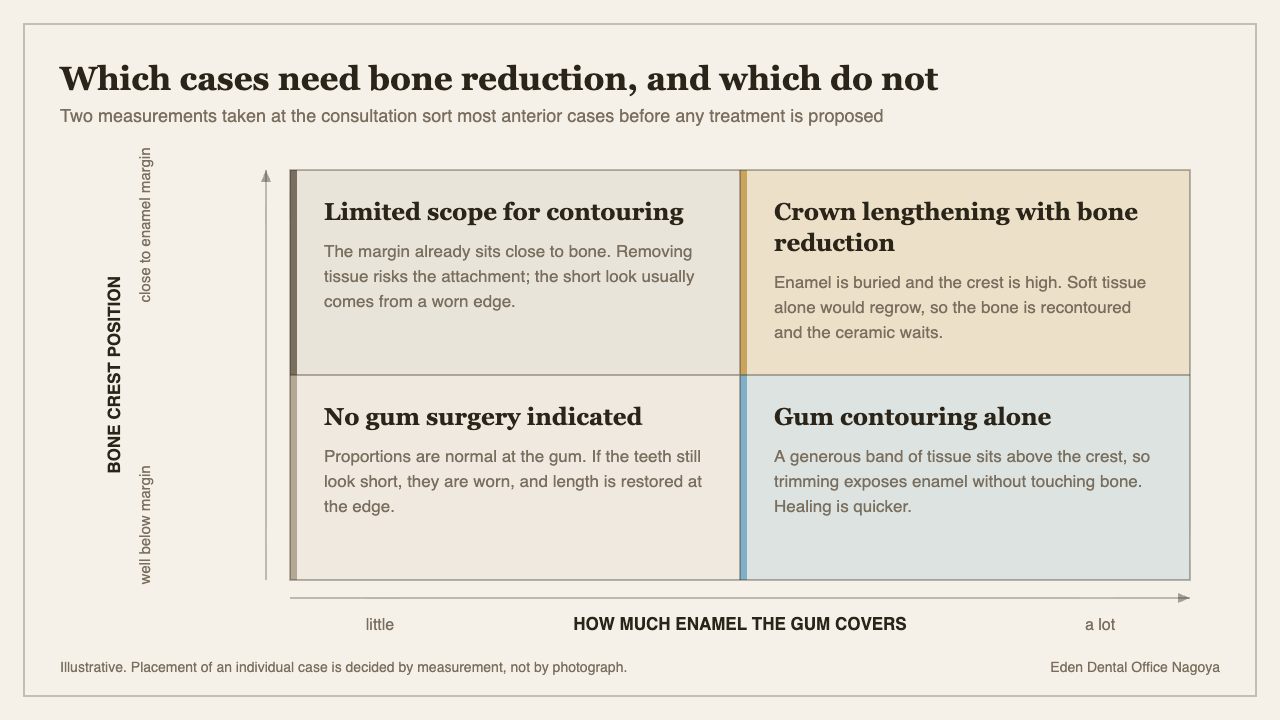
The two procedures are often discussed as one, and they are not. Gingival contouring, or gingivectomy, removes soft tissue only. It suits cases with a generous band of gum between margin and bone crest, so trimming exposes more enamel without disturbing anything else. The limitation is strict: if bone sits close to the enamel margin, soft tissue removed on its own grows back.
Surgical crown lengthening reduces the bone crest as well, re-establishing the space the attachment apparatus occupies between bone and gum margin. That biological dimension is why the surgery exists, and a gum line placed without respecting it migrates back down until the dimension is restored.
| Gum contouring (gingivectomy) | Surgical crown lengthening | |
|---|---|---|
| Tissue removed | Soft tissue only | Soft tissue plus bone crest reduction |
| Indicated when | Bone crest sits well below the enamel margin | Bone crest sits close to the enamel margin |
| Typical chair time | Short, often a single visit per sextant | Longer; a flap is usually raised |
| Healing before ceramics | Weeks in limited cases | Several months — see the stability data below |
| Main failure mode | Tissue regrowth if bone was the real constraint | Margin rebound during healing |
| Reversibility | Tissue may partially return | Bone removal is definitive |
What the twelve-month data says about waiting
The most useful evidence for a patient planning veneers is not about the surgery. It is about what happens afterwards.
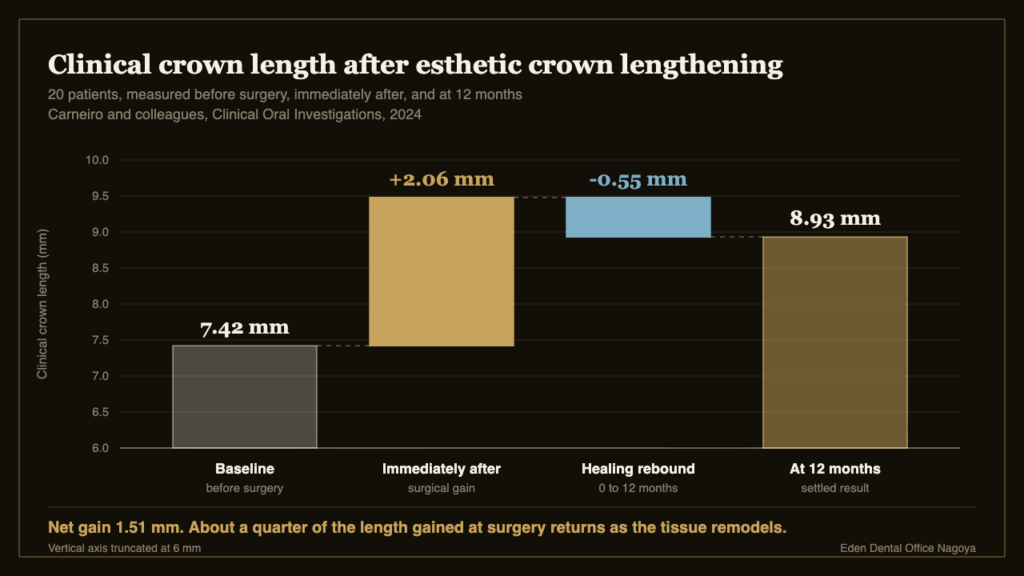
A twelve-month clinical study of twenty patients (Carneiro and colleagues, Clinical Oral Investigations, 2024) measured periodontal dimensions before esthetic crown lengthening, immediately afterwards, and at three, six and twelve months. Clinical crown length averaged 7.42 mm at baseline and 9.48 mm immediately after surgery, then settled at 8.93 mm by twelve months. Roughly a quarter of the length gained on the day was given back during healing.
The rest of the picture is equally practical. Probing depth fell by 0.60 mm in the first six months and rose again by 0.39 mm between six and twelve. Bone thickness decreased by 0.20 mm while gum thickness increased by 0.29 mm — the tissue did not simply return, it remodelled, ending thicker than it started. The authors concluded the procedure was effective and that although some rebound occurred, it was not clinically important.
Read that as a planning instruction rather than a warning. The tissue moves, it moves predictably, and it is still moving at six months — so designing definitive ceramic margins against a gum line recorded two weeks after surgery is designing against a moving target.
Does a digital guide make it more predictable?
Digital planning is heavily marketed here, so it is worth being precise. A randomised controlled trial of twenty-four patients with altered passive eruption (Carrera and colleagues, Clinical Oral Investigations, 2023) compared a guided dual technique, planned digitally with a double surgical guide, against conventional planning by examination and transgingival probing. Crown length in the guided group ran 8.04 to 9.94 to 9.35 mm across baseline, surgery and twelve months; the conventional group ran 8.09 to 9.92 to 9.47 mm. Both were stable at twelve months with high esthetic satisfaction, and the guided technique was reported as being as effective as the conventional one.
The guide did not beat careful conventional work; what it does is transfer a pre-made plan onto the patient reliably, which matters most when several teeth are reshaped together and the surgery has to agree with the ceramic design that follows. The trial also found no correlation between gum thickness and margin stability, so thin tissue is not by itself a reason to expect relapse.
How the sequence runs at Eden
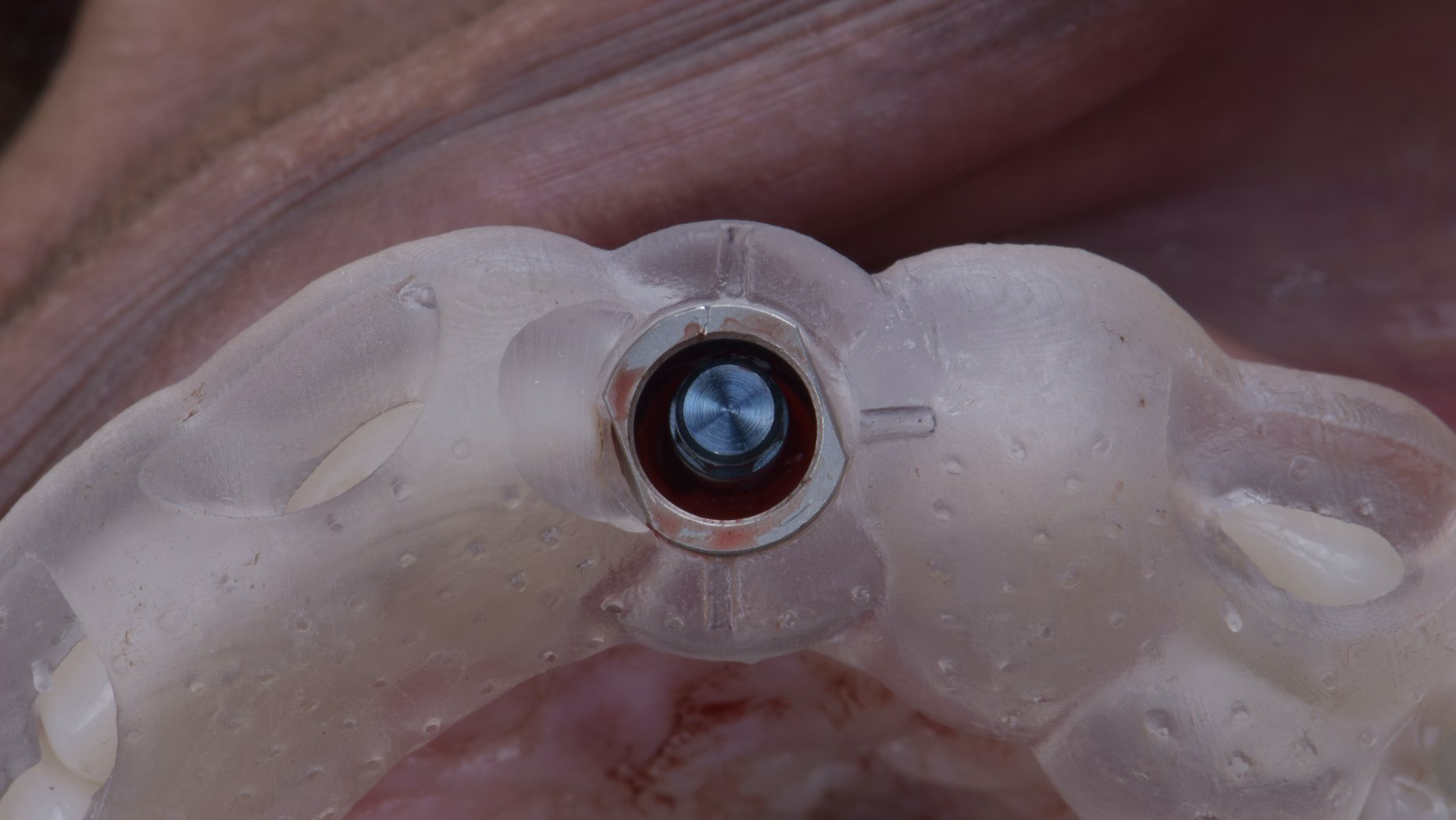
We start with photographs at rest and in full smile, an intraoral scan, periodontal measurements around each tooth in the display zone and radiographs to locate the bone crest. The scan is overlaid on a Digital Smile Design proposal so the intended proportions exist as a file before anything is removed, and our in-house laboratory prints a trial restoration from it. The patient wears that. Only then is it clear whether the target shape needs gum moved, ceramic added, or both — and if surgery is indicated, the printed guide comes from the same file rather than a separate judgement on the day.
After surgery we review at three and six months and re-scan before the ceramic is prescribed. For patients travelling from Tokyo, Osaka or overseas this is the part that needs honest scheduling: a case involving contouring is not a single-trip case, and we say so at the consultation rather than at the second visit. How visits can be grouped is set out in our guide to planning a dental treatment trip.
What this costs
Fees depend on how many teeth sit in the display zone, whether bone reduction is required, and whether the case continues into ceramic work, so a single published figure would be misleading. Our published anchors are a comprehensive examination package at ¥40,000 and a whitening package at ¥75,000; membership plans run from ¥88,000 to ¥288,000 per year. Current treatment fees are on our fees page, and every patient receives a written estimate in English, itemised by tooth and by stage, before treatment begins. If shade is also part of the complaint, bleaching is normally stabilised before ceramic shades are chosen — see our whitening guide.
Gum position is one prerequisite to cosmetic ceramics; tooth position is the other. The comparison of short orthodontic alignment against ceramics alone sets out when moving a tooth first makes the eventual veneer thinner.
Frequently Asked Questions
How long after gum surgery can veneers be made?
Commonly three to six months where bone was reduced, because the margin is still remodelling. Soft-tissue-only contouring can proceed sooner.
Will the gum grow back over the tooth?
Partially. Twelve-month data shows about a quarter of the length gained is lost during healing, which is planned for rather than treated as failure.
Do I need surgery, or would veneers alone be enough?
It depends on whether the tooth is buried or worn. A trial restoration answers that before anything is removed.
Is gum contouring done with a laser?
Instrumentation matters less than diagnosis. Published comparisons show technique has little effect at twelve months when bone position is respected.
I have already been quoted for veneers. Should I ask about this?
Yes, if your teeth look short rather than worn. We hold second opinion consultations in English for this question.
Risks and limitations
Crown lengthening removes bone, and that removal is definitive. Sensitivity at the exposed root surface is common and usually settles, though occasionally it persists. Gum margins can recede further than planned, papillae may not fill completely, and a poor outcome in the display zone is visible in a way a posterior complication is not. Removing too much bone can compromise the support of a tooth. Where the real cause is lip or jaw position rather than gum level, surgery will not solve the complaint. The figures quoted here are group averages from small clinical studies, not predictions for an individual patient. Individual results vary.
If your teeth look short and you are unsure whether the answer is ceramic, surgery or neither, a consultation should settle that before any quote is issued. The background is in our guide to porcelain veneers in Japan, with related reading on choosing between veneers and crowns, minimal and no-prep designs, composite bonding and protecting finished ceramics. You can also review the aesthetic treatment page or message the clinic in English on WhatsApp about your own case.