
Video Dental Consultation in Japan: Before You Book a Flight
Reviewed by Dr. Ryosuke Murai, DDS, MSD — Prosthodontist, trained at Indiana University School of Dentistry (U.S.). Last updated August 2026.
A video dental consultation before you fly to Japan is not a diagnosis, and any clinic that treats it as one is selling you something. What the call decides is narrower and more useful: whether the trip is worth making, roughly how many days in the chair it will take, and what the work is likely to cost. Those three answers are what a flight and a hotel booking actually depend on. The clinical plan itself is written after an examination, not before it. This is what a pre-travel video consultation with our Nagoya clinic can settle honestly, what it cannot, and what we are willing to put in writing before you spend money on a ticket.
The call answers travel questions, not clinical ones
A patient in Singapore with a failing upper bridge does not need us to name the final restoration on a video call. She needs to know whether this is a five-day case or a two-trip case, whether the first surgery can happen on the first visit, and whether the figure is closer to one number or three times that number. Those are logistics questions wearing clinical clothing, and they are answerable at a distance.
They are answerable because most of the work happens before the call, not during it. We ask for your imaging and history first — which records travel usefully and which do not is a separate subject, and worth reading before you send anything. Dr. Murai reviews what arrives, and the call is spent on the reasoning: what the images suggest, which of two or three routes the case is likely to take, and what would have to be true for the cheaper route to work. How those days are then grouped into visits is set out in our guide to planning a dental treatment trip to Japan.
What the evidence says a screen can do
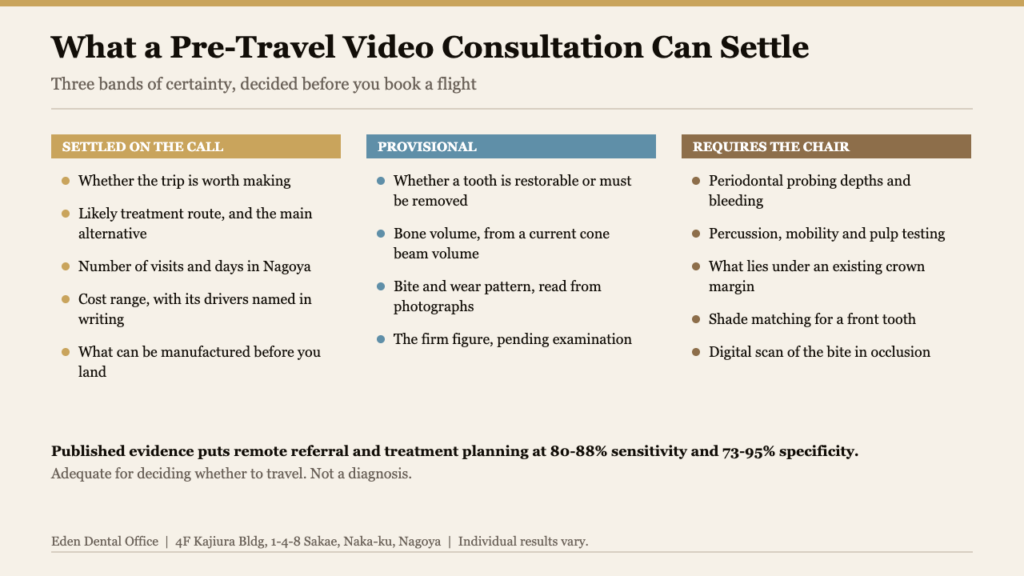
Remote dental assessment is better studied than most patients expect, and the findings are neither dismissive nor flattering. A 2022 umbrella review in Evidence-Based Dentistry synthesised six systematic reviews covering more than seven thousand participants and found that, for dental referrals and diagnostic treatment planning, sensitivity ranged from 80 to 88 per cent and specificity from 73 to 95 per cent — while noting that the underlying reviews were themselves of low methodological quality.
Two things follow. Remote assessment is good enough to decide who should be seen and what the likely route is, which is exactly the referral-and-planning task a pre-travel call performs. It is not good enough to be the last word: at 80 per cent sensitivity, roughly one finding in five is missed, and the misses are not randomly distributed. They cluster in the things a camera cannot reach.
The pattern holds for soft tissue. A systematic review in the Journal of the American Medical Informatics Association examined eleven studies of teledentistry for oral lesions and reported that most found a high level of agreement between remote and in-person consultation, with nine of the eleven judged good quality. Agreement on what a visible lesion is, in other words, is generally strong. Agreement on what is happening under a crown margin was never the claim.
Where the line falls
Here is the division we work to, stated plainly.
| What you want to know | Settled on the call | Needs the chair |
|---|---|---|
| Is this trip worth making at all | Yes — with your imaging in front of us | — |
| How many visits and how many days here | A structure and a realistic range | Confirmed at the first appointment |
| What it will cost | A written range with the drivers named | Firm figure after examination |
| Whether a tooth is restorable or must go | Only when the radiograph is unambiguous | Usually — probing, percussion, removing the old restoration |
| Periodontal condition | No | Six-point probing depths, bleeding, mobility |
| Bone volume for an implant | From a cone beam volume, yes | A current scan, not a photographed panoramic |
| Bite, wear pattern, joint function | Partially — and unreliably | Yes, with a digital scan and articulated records |
| Shade for a front-tooth restoration | No — screens and phone cameras both lie about colour | Yes, in daylight, in person |
Two rows deserve comment. Gum disease is measured in millimetres with a probe; no camera angle substitutes for that, and it is the commonest reason a plan drawn from images changes after the first appointment. Shade fails for a duller reason: every phone camera and every monitor makes its own decision about white balance, and two of them in series make it twice.
How we run the consultation
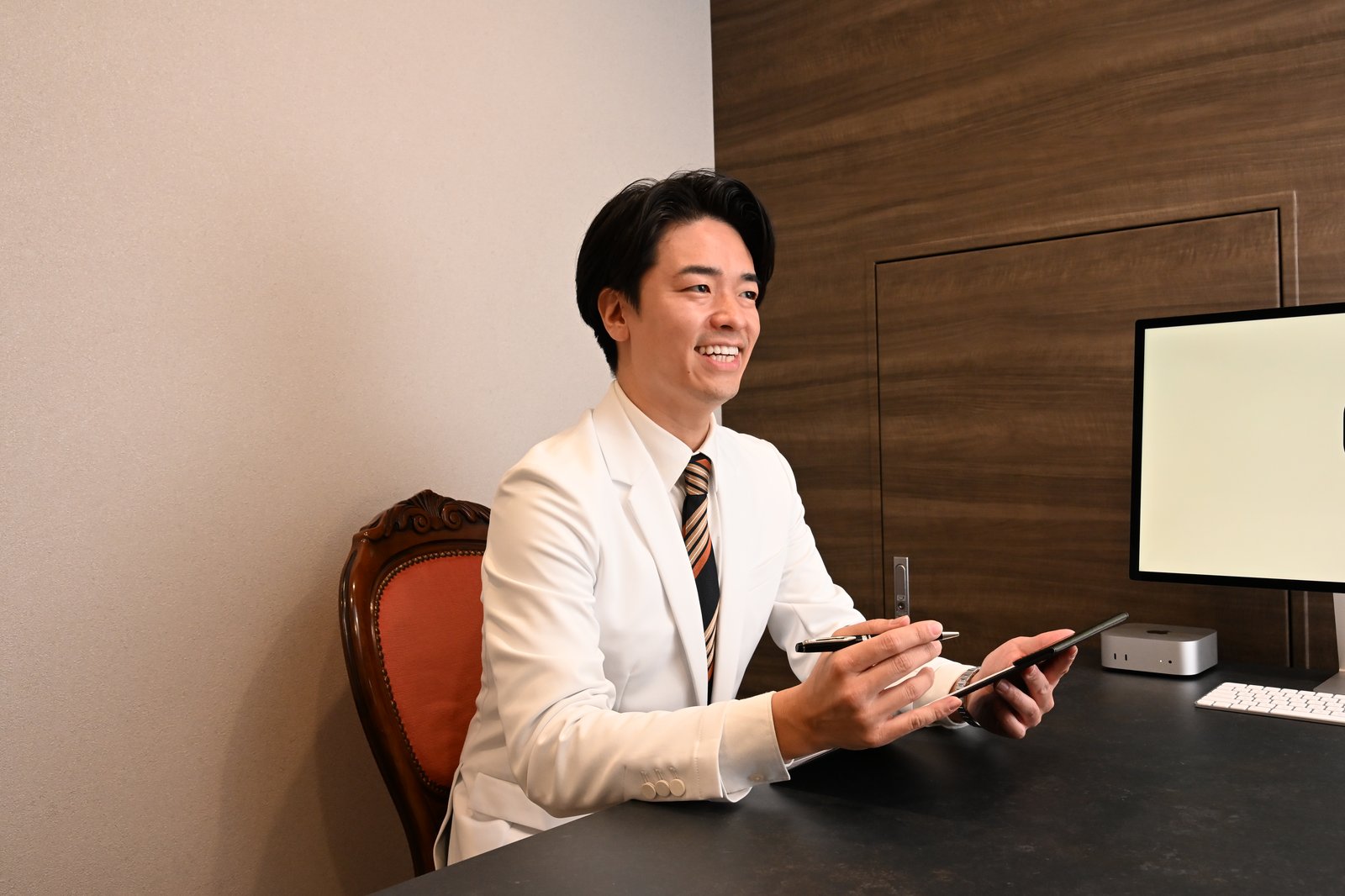
The call is scheduled in your time zone, runs thirty to forty minutes, and is conducted by Dr. Murai in English rather than through an interpreter. Your records are opened on screen alongside you. Where implants are being discussed, we place provisional Straumann BLX or TLX positions in our planning software during the call so you can see why a site does or does not work, and where the case is aesthetic we will often show a Digital Smile Design mock-up of the arrangement being proposed. Because the laboratory is inside the clinic, we can also tell you honestly which components can be made before you land and which cannot.
What we will not do on that call is give you a fixed price and a finished plan. If you are travelling because two clinicians have already told you different things, the call is where we say which parts of the disagreement are genuinely open — our article on how a second opinion works here covers what happens next. And this is a first assessment, not remote supervision of treatment in progress; ongoing review during aligner therapy is a different arrangement, described under Invisalign for English-speaking patients in Japan.
What we commit to in writing before you buy a ticket
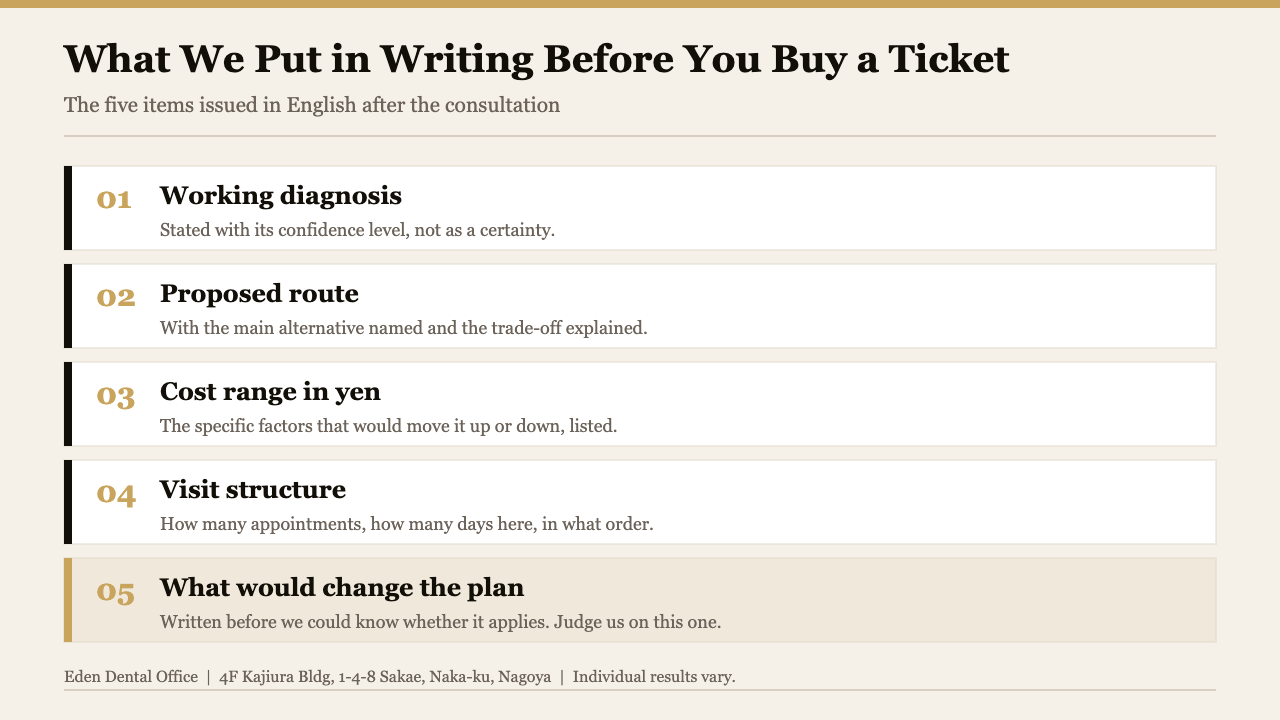
After the call you receive an English document containing five things: the working diagnosis and its confidence level; the proposed route with the main alternative named; a cost range in yen with the specific factors that would move it up or down; a visit structure with the number of days required; and an explicit list of the findings that would change the plan, written before we could know whether they apply.
That last item is the one to judge us on. A plan that cannot say in advance what would falsify it is not a plan. Ours names them: probing depths beyond what the radiograph suggested, a root fracture found on removing an existing crown, insufficient bone width once the volume is measured, or a medical history detail that changes surgical sequencing. If one of those appears, we tell you before treatment starts, not in an invoice afterwards — and the same principle governs the return flight, since when it is safe to fly after oral surgery depends on what was actually done.
What this costs
The pre-travel video consultation and the record review that precedes it are not billed. We would rather lose an hour than have someone fly for a case we could have told them not to travel for. The published anchors on our fee page are where costed treatment begins: the examination and check-up package is ¥40,000, the whitening package ¥75,000, and annual membership runs from ¥88,000 to ¥288,000 depending on tier. Everything else is quoted as a written English estimate, issued before treatment and itemised. How Japanese self-pay fees sit against other countries is covered in our comparison of dental costs internationally.
Frequently Asked Questions
Can you diagnose me over video?
No. We can form a working diagnosis from your records and reasoning, and tell you how confident it is. The definitive diagnosis follows examination.
Will the price change after I arrive?
The range should hold. It moves when examination finds something the images could not show, and we tell you before treatment begins.
What should I have ready for the call?
Your imaging and medication list sent in advance, and the two or three questions that actually decide whether you travel.
Is the consultation with the dentist or a coordinator?
With Dr. Murai, in English. A coordinator handles scheduling and logistics separately.
Can we do it on WhatsApp?
Yes. WhatsApp video is our default because it works reliably across time zones. Records are sent by secure link, not through the chat.
A remote consultation reduces uncertainty; it does not remove it, and the published accuracy figures above are the reason we describe it as a screening and planning tool rather than a diagnosis. Some cases turn out to need more visits than the images suggested, and occasionally examination reveals that the proposed treatment is not the right one. Dental and surgical treatment carries risk in any setting — bleeding, infection, swelling, temporary numbness, sinus involvement where the sinus is close, and the possibility that a restoration or implant fails over time. Costs and timelines given here are typical and shift with the individual case. Individual results vary.
If Japan is on your shortlist, have the conversation before you book anything — see how we work with patients travelling in for treatment, or message the clinic on WhatsApp in English to arrange a time.