
Worn or Short Front Teeth in Japan: Rebuilding Options
Reviewed by Dr. Ryosuke Murai, DDS, MSD — Prosthodontist, trained at Indiana University School of Dentistry (U.S.). Last updated October 2026.
Worn or short front teeth in Japan can be rebuilt in several ways, from bonded composite to porcelain veneers or crowns, but the right choice depends on why the teeth have shortened. Grinding, acid, an old bite pattern and gum tissue that sits low on the tooth can all produce the same look in a mirror, and each calls for a different plan. This guide sets out how we tell the causes apart, what each rebuilding option removes and risks, what the published evidence says about durability, and how the bite is handled first. It is written for self-pay patients who have noticed their front teeth getting shorter and want to understand the options before committing to ceramic.
Why front teeth look short
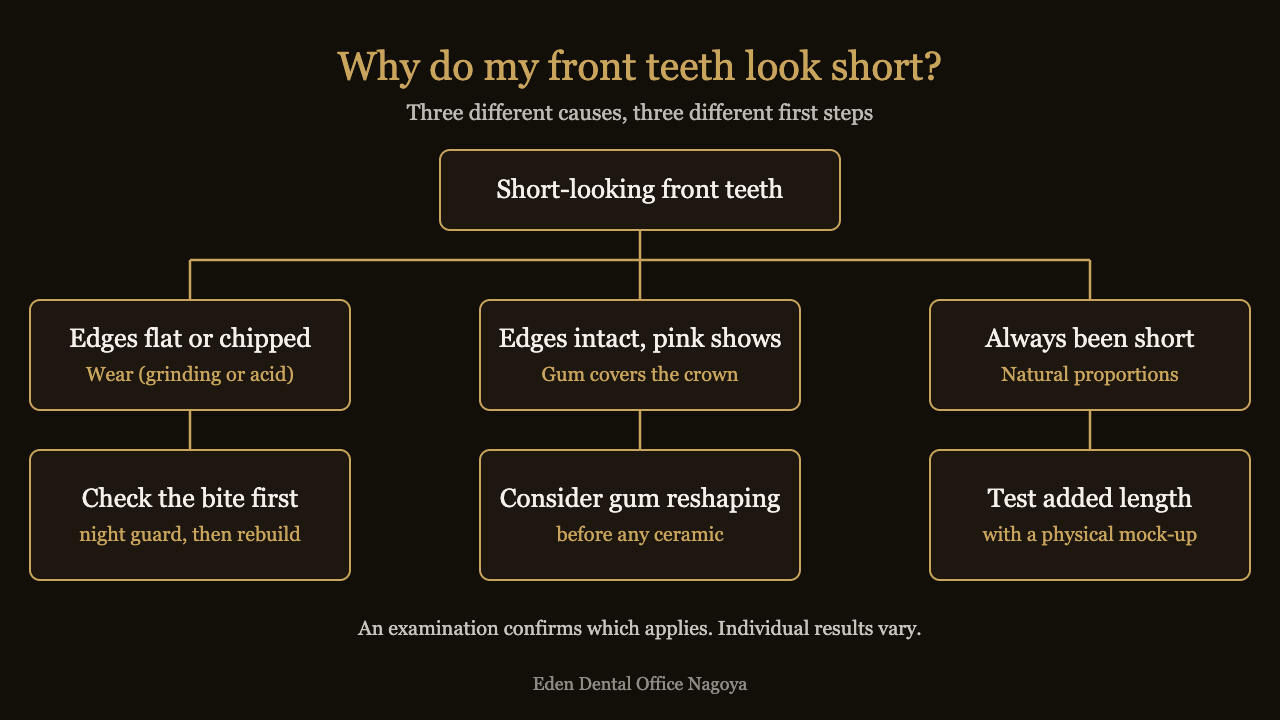
Short teeth are not always worn teeth. Three different situations produce a similar smile, and mistaking one for another is the most common planning error we see in second opinions.
The first is true wear. Edges flatten and shorten through grinding or clenching, or through repeated acid exposure that softens enamel, from reflux, frequent sparkling drinks or citrus. A systematic review of adult tooth wear found that the share of adults with severe wear rises from about 3% at age 20 to about 17% at age 70, so this is a gradual, age-related process rather than a sudden event (Van’t Spijker et al., Int J Prosthodont 2009). The second is gum tissue that sits low over the crown, so the teeth are the normal length but a portion is hidden. The third is simply short teeth that were never long, sometimes after earlier orthodontic treatment or a previous restoration.
| What you notice | Likely cause | What it points to |
|---|---|---|
| Flat, translucent or chipped edges; teeth shorter than they were in old photos | Wear from grinding or acid | Find and control the cause first; then rebuild length with bonding or ceramic |
| Teeth look square and small, with a lot of pink showing | Gum tissue covering part of the crown | Gum reshaping may do more than any restoration; see our guide to gum contouring and veneers |
| Teeth were always short, edges intact | Natural proportions | A design question; a trial shape shows what added length would look like |
Why the bite is checked before any ceramic is planned
If wear is the cause, the cause is still active. Rebuilding worn edges without addressing it simply gives the grinding something new to chip. For that reason the first appointment is as much about the bite as the smile: how the teeth meet, which ones guide the jaw when it slides sideways, and whether there are wear facets that match the opposing teeth. In many cases a night guard comes first, and sometimes aligner treatment to move the teeth into a position where they can be restored with less removal. Our article on veneer care and night guards explains why ceramic and grinding make a poor pairing.
At our clinic, the front-tooth length we propose is tested before it is made. We scan the teeth with our intraoral scanner, design the new proportions on screen as part of our Digital Smile Design planning, and print a physical mock-up with our in-house 3D printers. You wear it, speak in it and look at it in ordinary light. Speech is a useful test: the edges of the upper front teeth are judged largely while you talk, and a length that looks right in a still photograph can feel wrong when you say certain sounds.
Four ways to rebuild length, and what each removes
Once the cause is understood, the options differ mainly in how much healthy tooth they take and how long they are expected to last. A 2025 systematic review of 14 studies on restoring the worn dentition found no significant difference in survival between direct composite and indirect composite restorations. It also found that indirect restorations, especially lithium disilicate ceramic, showed the lowest failure rate, at 1.8%. The authors describe direct composite as better suited to a medium-term solution, and note that the evidence is limited and of varying quality (Chantler et al., J Esthet Restor Dent 2025).
| Option | Tooth removed | Where it fits | Main trade-off |
|---|---|---|---|
| Direct composite added to the edge | Little or none | Mild wear, or a trial of added length | Can chip or stain; usually refreshed over time |
| Indirect composite or ceramic overlay | Little to moderate | Moderate wear with enough enamel left to bond to | Needs laboratory work; margins must be planned |
| Porcelain veneers (lithium disilicate) | Moderate, often within enamel | Several worn or short front teeth, shape and color change wanted | Enamel removed does not regrow; see no-prep veneers for the least-removal approach |
| Full crowns | Most | Heavily broken down or cracked teeth | Greatest removal; weighed in our veneers versus crowns comparison |
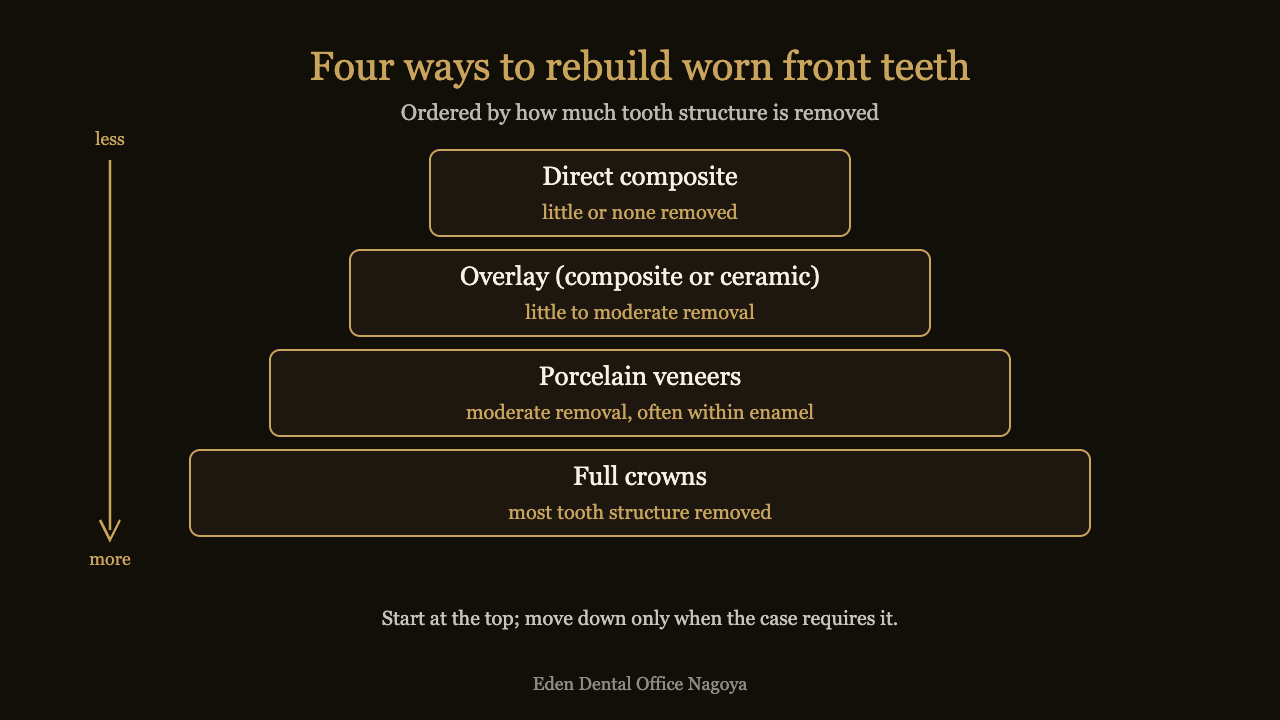
Our general approach is to start at the top of that ladder and move down only when the case requires it. Because we are a prosthodontic practice with an in-house laboratory, indirect work can be made, adjusted and remade without sending a case away, which matters when the margin between a natural look and an over-long one is a fraction of a millimeter. The porcelain veneer guide covers the ceramic route in more depth.
What this costs and how long it takes
Fees depend on how many teeth are involved, the material, and whether gum reshaping, a night guard or aligner treatment is part of the plan, so we do not quote a single figure here. Published fees are on our fees page, and any treatment-specific price is given in a written estimate in English before work begins. The number of visits depends on whether the bite needs stabilizing first. Patients traveling from abroad can read how we compress visits in our guide to a dental treatment trip to Nagoya, and early records can be reviewed remotely, as described in the article on video dental consultations.
Frequently Asked Questions
Are my front teeth worn, or is it my gums?
Look for flat or translucent edges and compare old photographs. If the edges are intact but a lot of pink shows, gum position is more likely. An examination and measurements confirm which applies.
Can worn teeth be fixed without removing any tooth?
Sometimes. Added composite or a thin bonded overlay can restore length with little or no removal when enough enamel remains, though these repairs are usually refreshed over time.
Will wear keep progressing after treatment?
If the cause remains, it can. That is why the bite is assessed first and a night guard is often part of the plan. Restorations do not stop grinding.
How long do rebuilt front teeth last?
It varies with material, bite and care. Reviews suggest ceramic tends to outlast direct composite, but the evidence is limited and no restoration is expected to last indefinitely.
Can I preview the new length before committing?
Yes. A physical mock-up, made from a digital design, lets you wear the proposed length, speak and judge it in ordinary light before any tooth is prepared.
Risks, limits and what to expect
Rebuilding worn teeth is not a one-time fix. Bonded composite can chip, stain or need refreshing; ceramic can fracture or debond, particularly if grinding continues; and any preparation removes enamel that does not regrow, after which the tooth will always need some form of restoration. Teeth may be sensitive to temperature for a few weeks, and a change in tooth length can alter speech or bite feel until you adapt. Gum reshaping, where needed, carries its own healing period. The evidence on durability comes from a small number of studies of varying quality, so any figure should be read as an estimate rather than a promise. Individual results vary.
If you would like the cause of your short front teeth assessed before deciding anything, a consultation is the right first step. We review the bite, measure the teeth and gums, and give a written estimate in English before any treatment, and you can reach the clinic on WhatsApp. Our aesthetic and cosmetic dentistry page explains how consultation, design and laboratory work fit together, and the guide to replacing old veneers helps if earlier work is part of the picture.
More on this topic: Veneer and Cosmetic Guides — every article we have published in this cluster, grouped by stage.