
Dental Implant Stability in Japan: ISQ, Torque & Timing
Reviewed by Dr. Ryosuke Murai, DDS, MSD — Prosthodontist, trained at Indiana University School of Dentistry (U.S.). Last updated August 2026.
Two patients have an implant placed on the same morning. One is told the crown can be fitted in six weeks; the other is asked to wait four months. Implant stability explains the gap. Stability is not a judgment formed by feel — it is measured at surgery, recorded as a number, and measured again during healing. This guide explains how dental implant stability is assessed in Japan, what insertion torque and the implant stability quotient (ISQ) each tell us, and why the interval before your crown is a clinical finding rather than a scheduling preference. It is written for self-pay patients who would rather understand a timeline than simply be handed one.
Primary and secondary stability are not the same thing
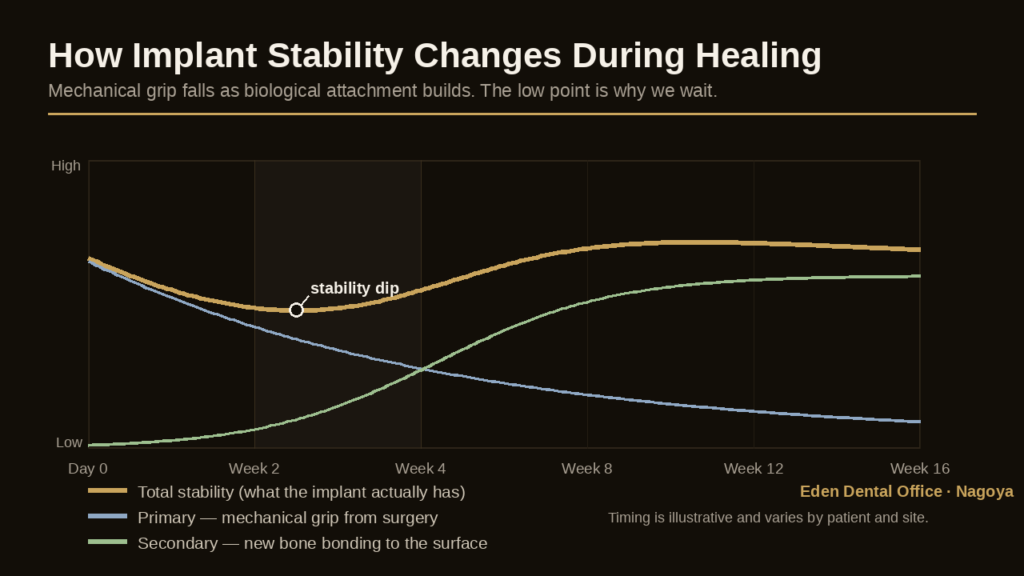
On the day of surgery an implant is held by friction. The fixture is threaded into a site prepared slightly narrower than itself, so the grip between titanium and bone is purely mechanical. This is primary stability, and it exists from the moment the last thread engages.
Over the following weeks that grip weakens, because the compressed bone at the interface is resorbed and remodeled. At the same time new bone begins forming directly onto the implant surface. That biological attachment is secondary stability, and it is what carries a restoration for years. The two curves cross, and where mechanical grip has fallen while biological attachment has not yet risen to meet it, total stability passes through its lowest point — usually within the first month. Heavy loading during that window is what a healing period is designed to avoid, and modern implant surfaces exist largely to shorten it.
The two numbers we record
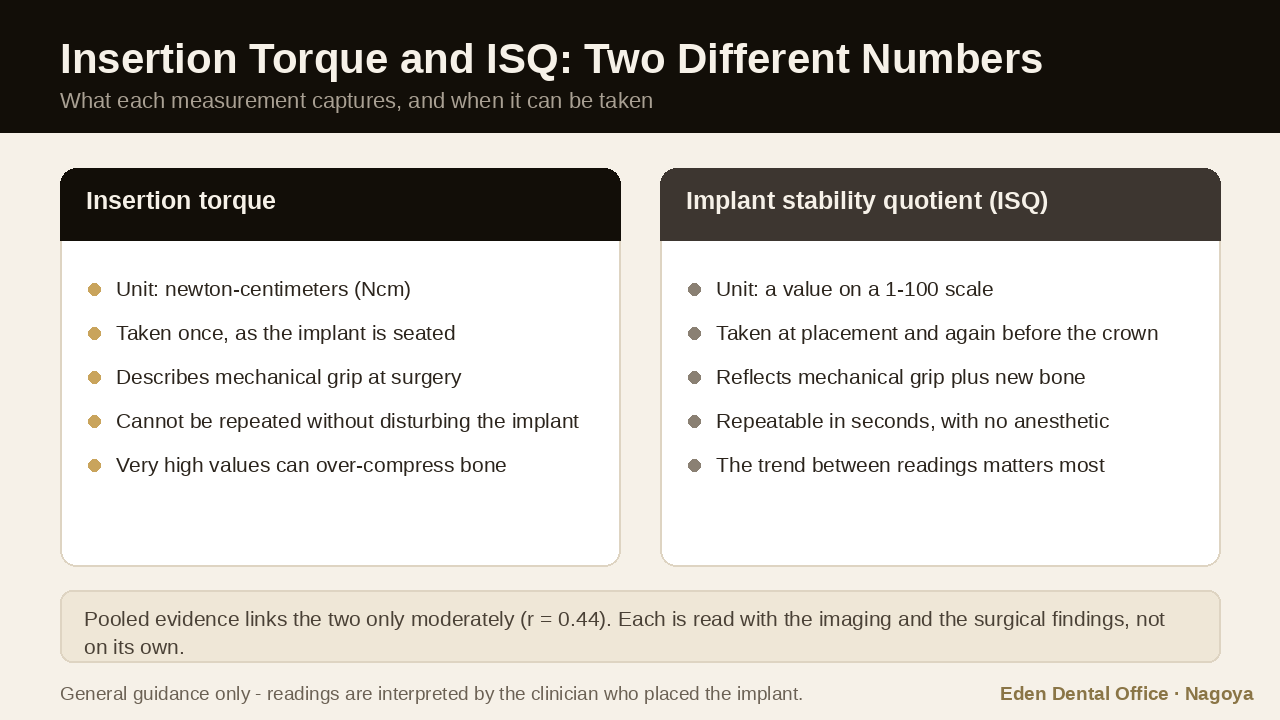
The first is insertion torque, read from the surgical motor as the implant is seated and expressed in newton-centimeters (Ncm). It describes how hard the fixture had to be turned to reach its planned position — a snapshot of mechanical grip at a single moment, and one that cannot be taken again without disturbing the implant.
The second is the implant stability quotient (ISQ), obtained by resonance frequency analysis. A small transducer is screwed onto the implant, made to vibrate, and its resonant frequency converted to a value on a 1–100 scale. The measurement takes seconds and — critically — can be repeated. Recording ISQ at placement and again before restoration shows a direction of travel: a rising value indicates integration is proceeding, while a static or falling one is a reason to wait and investigate.
It is worth being precise about what these numbers are not. A 2026 systematic review and meta-analysis in Clinical Implant Dentistry and Related Research pooled forty-eight studies and found that ISQ correlates only moderately with insertion torque (r = 0.44); surviving implants did show higher baseline ISQ values, but the pooled difference was not statistically significant. The authors’ conclusion is the one we give patients: ISQ is a complementary indicator of stability, not a verdict on an implant’s future, and it is read alongside the surgical findings and the imaging rather than instead of them.
Why your healing interval is not a fixed number
Most of what moves the interval is visible before surgery rather than discovered during it. Bone density is the largest factor: dense cortical bone at the front of the lower jaw commonly gives high initial values, the softer trabecular bone at the back of the upper jaw gives lower ones, and the same implant in the same patient can behave differently at two sites four centimeters apart. This is where a CBCT scan changes the plan most often, since density and ridge width are read from it before any instrument is chosen.
Fixture length and diameter matter, as does whether the site was grafted — regenerated bone is asked to do the same work as native bone but reaches that ability later, so an implant placed alongside a sinus lift or a graft runs on the graft’s schedule. Poorly controlled diabetes and smoking both slow the biology, which is part of why the instructions for your first two weeks seem disproportionate to a small surgical site.
Immediate, early or conventional loading
Loading means putting a tooth on the implant and letting it take chewing force. Stability measurement is how a case is assigned to one of three recognized protocols.
| Protocol | When the tooth goes on | What has to be true first |
|---|---|---|
| Immediate | Same day to about one week | High insertion torque at placement and a plan that keeps the provisional out of heavy function |
| Early | Roughly one week to two months | Sound initial stability plus a repeat ISQ confirming values have held or risen |
| Conventional | About three to six months | Chosen where initial stability was modest, bone is soft, or the site was grafted |
The published evidence supports care in choosing. A systematic review and meta-analysis of randomized controlled trials in the Journal of Prosthetic Dentistry, drawing on thirty-nine trials, found a significantly lower implant survival rate with immediate loading than with conventional loading, while immediate and early loading were comparable to each other. That is not an argument against same-day teeth; it is an argument against them in a case that does not meet the criteria. The provisional bridge fitted on the day of full-arch surgery is justified only because several fixtures share the load and each reached the torque the plan required.
How these numbers are used at Eden
Every implant we place has its insertion torque written into the surgical record, and ISQ measured at placement and again before restoration. Both figures are shown to the patient in English, because a healing interval is easier to accept when it is attached to evidence rather than to clinic policy. Where a value comes in lower than planned we say so on the day and move the schedule.
This matters most for patients traveling in. Someone flying from Singapore or taking the Shinkansen from Tokyo needs to know how many visits are genuinely required, and a stability reading is the only honest basis for that answer. Because our digital laboratory is in the building, restorative appointments that follow a favorable measurement can often be compressed into a shorter stay; where it is not favorable, we would rather say so before you book a flight. The wider sequence is set out in our guide to the implant procedure, timeline and recovery, and the surgery itself can be managed with sedation without changing any of it.
Once the fixture is stable enough to load, the next question is how the crown joins it — see the difference between screw-retained and cemented implant crowns.
A stability reading is the gate to the next phase; what happens after it is covered in our guide to recording the implant and shaping the gum for the crown.
Frequently Asked Questions
What is a good ISQ value for a dental implant?
Many clinicians treat values in the seventies as comfortable and values below the mid-fifties as a reason to wait. No single threshold fits every site or implant system, so the trend between two readings matters more than one number.
Does measuring implant stability hurt?
No. A small transducer is screwed onto the implant and removed within seconds, and no anesthetic is needed for the measurement itself.
Would a higher torque number mean a stronger implant?
Not on its own. Very high insertion torque can over-compress bone, and the pooled evidence links torque and ISQ only moderately. The aim is adequate stability, not maximum force.
Can an implant with low stability still succeed?
Often, with a longer undisturbed healing period. A modest reading calls for patience rather than removal, provided the implant is not mobile and the site is free of infection.
Do all clinics in Japan measure ISQ?
No. Resonance frequency analysis is optional equipment, and many clinics judge readiness from elapsed time alone. It is a reasonable question to ask before agreeing to a plan.
What this costs
Stability measurement is rarely a separate line on a Japanese implant quote. It sits inside the surgical and planning fee, along with the surgical guide and the review appointments at which the second reading is taken — worth knowing when comparing estimates, because a lower headline figure sometimes reflects fewer review visits rather than a cheaper implant. Our published fees, including the check-up package at ¥40,000, are on the fee page; figures for surgical treatment depend on the findings and are confirmed in a written estimate in English before anything is scheduled. What is included at each stage is described on our dental implant page.
Risks, limits and what to expect
No measurement removes risk. An implant with strong numbers can still be lost — to infection, an undiagnosed systemic problem, heavy grinding, or smoking resumed during healing — and one with modest numbers frequently integrates given time. Resonance frequency analysis has limits: readings shift with the transducer, the direction of measurement and the operator, and the published evidence ties them only moderately to long-term outcome. These numbers guide a decision; they do not predict one. Healing intervals, comfort and the final result differ from person to person. Individual results vary.
If a clinic has quoted you a healing time without explaining what it rests on, that is a fair question to put to them — or to us. A planning consultation in English, including a review of imaging you already hold, is the usual starting point, and you can reach the practice on WhatsApp. Our implant treatment page sets out how consultation, surgery and restoration fit together, and our procedure and recovery guide covers the stages in between.
More on this topic: Implant Guides — every article we have published in this cluster, grouped by stage.